
— Samyukta Mahesh
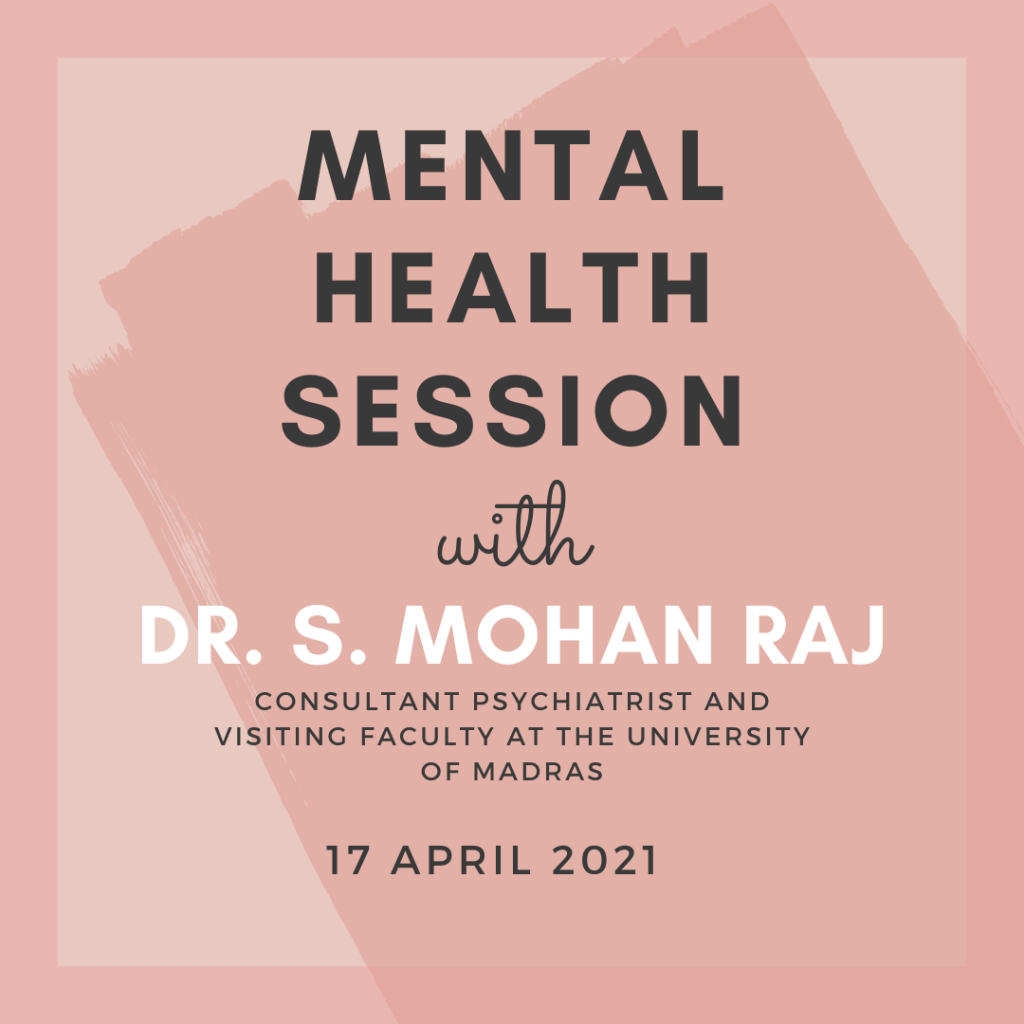
At a time when online education has become the common practice, students have begun to experience burnout, emotional fatigue and helplessness with regard to the ongoing pandemic. The mental health session was conducted to address the general and specific concerns in this regard. A survey was sent out in the morning of this conference to evaluate the general morale of the attendees and to identify potential problems that needed to be addressed.
The speaker began by addressing how human beings have been accustomed to the idea of certainty or predictability. Throughout ancient history, the number of predictable entities remained very low. No one could comment on how the politics, lifestyle or even the weather will be tomorrow. However, this continuing need for predictability led to most of the systems and inventions that we see today. The discipline of astrology made strides in convincing people that everything was pre-planned or pre-destined. Predictability, thus became a key factor of the rationalized world order. The speaker thus alluded to how unpredictability has always been the norm and any form of predictability is man-made or forced. He encourages us to embrace the unpredictability rather than trying to accurately know or actualize the future. This is especially relevant at a time when the end of the pandemic or our return to campus remain uncertain.
He then proceeded to address specific uncertainties starting with anxiety over a thesis or academics. He points out that most of our project anxiety comes from the pressure we put on ourselves to make a ground-breaking discovery. It is better to come to terms with the fact that our discovery may not actually change the world or make much of a difference in the larger picture. By eliminating this layer of pressure, one is able to work more diligently. While meeting difficult deadlines, he suggests that we practice self-care. He proceeds to define self-care as taking care of oneself the way we would take care of others. An example is given about how we would console a friend who is experiencing a minor academic setback. While we would reassure them that things will eventually be okay, we go extremely hard on ourselves under the same circumstances.
While countering general anxiety that we may experience in these times, he asks us to be self aware about the situation we are in. Once again, he asks us to ease the pressure that we impose on ourselves to be perfect. We need to understand that we are in one of the most difficult times in history and that we are bound to be anxious due to the gravity of the situation. He terms it ‘a normal reaction to an abnormal situation’. Once we accept this and become self- aware, we no longer feel that we are the only ones experiencing these negative emotions. At this point, a question is raised by an audience member. She asks, “If uncertainty is the norm, how do I set goals for myself? How to set these goals knowing that I may not be able to achieve them? How to motivate myself in such a scenario?”. To this he responded that the goal should not be a tangible final result. The goal should be the process itself. Any individual needs to commit themselves to the process and trust its progress rather than attempting to achieve a certain target. An example thus given is about how the goal to personal fitness should be exercising for half an hour a day instead of reducing five kilos by the end of the month. In the former, the effort taken on one particular day becomes a short-term achievable goal that can act as positive reinforcement. In case of the latter, there is a pressure to achieve when in reality, most of the factors required to achieve that goal aren’t actually in our control.
Finally, he talks about the stress caused by family disputes or incompatibility. He points out how the lack of communication within families in the developing years can be a cause of the same. He further emphasizes that it is never too late to build open and respectful communication. He suggests approaching a family member and asking if they have anything to tell us. By opening up the conversation, he encourages us to fully confide and share our apprehensions with them. He also compares two approaches to parenting: carpentry and gardening. While the carpentry approach is focused on the ends, the gardening approach focuses on the means to reach the end. At this point, another member of the audience raises a question about the peer-pressure that conditions us to be goal-oriented. In response, he asks us to go through life goal-by-goal. Peer pressure can actually be healthy in setting these short doable goals that focus on the process. However, such pressure may be detrimental if it is conditioning you to set ultimate and final goals. He says that the goal should never be set in stone, nor should we make the consequences of failure so dire and unthinkable. In case of academics, we are encouraged to develop a better understanding of why the subjects we study are included as a part of the course in the first place. If we find a particular subject daunting and another subject interesting, we should try to find common ground between the two and look at the former through the lens of the latter.
In essence, this session provided us with a fresh perspective to goal-setting and uncertainty. There was also a great degree of comfort in the fact that a professional was guiding us through our issues. In a world of Instagram posts or well-meaning but unprofessional friends who would jump at any opportunity to advice, this session helped us gain the correct analysis. It also taught us self-care practices and affirmations that can help us guide through this grim period of history. The attendees felt heard, understood and comforted knowing that no one is truly alone in these uncertain times. It also replenished our hope that maybe uncertainty or unpredictability wasn’t the worst thing after all.
Edited by Samaja Penumaka
Design by Shatabdi Deori
 Article 19