
–Gowri Raj Varma

I didn’t know what to call this mood board, so I came up with the most pretentious title I could think of. The best way to describe it would be to call it a ~vibe~ of sorts because there’s no assertion that one can make claiming they know what it means to be human since the experience is different across space, time, and societies. However, there are a few elements intrinsic to the human experience. Ranging from artificial friends and machines dealing with love to grappling with loss and trying to outlive regrets and “what ifs,” this mood board, starting from birth and ending with death, explores unconventional facets of humanity that are surprisingly familiar.
Book – Klara and the Sun by Kazuo Ishiguro
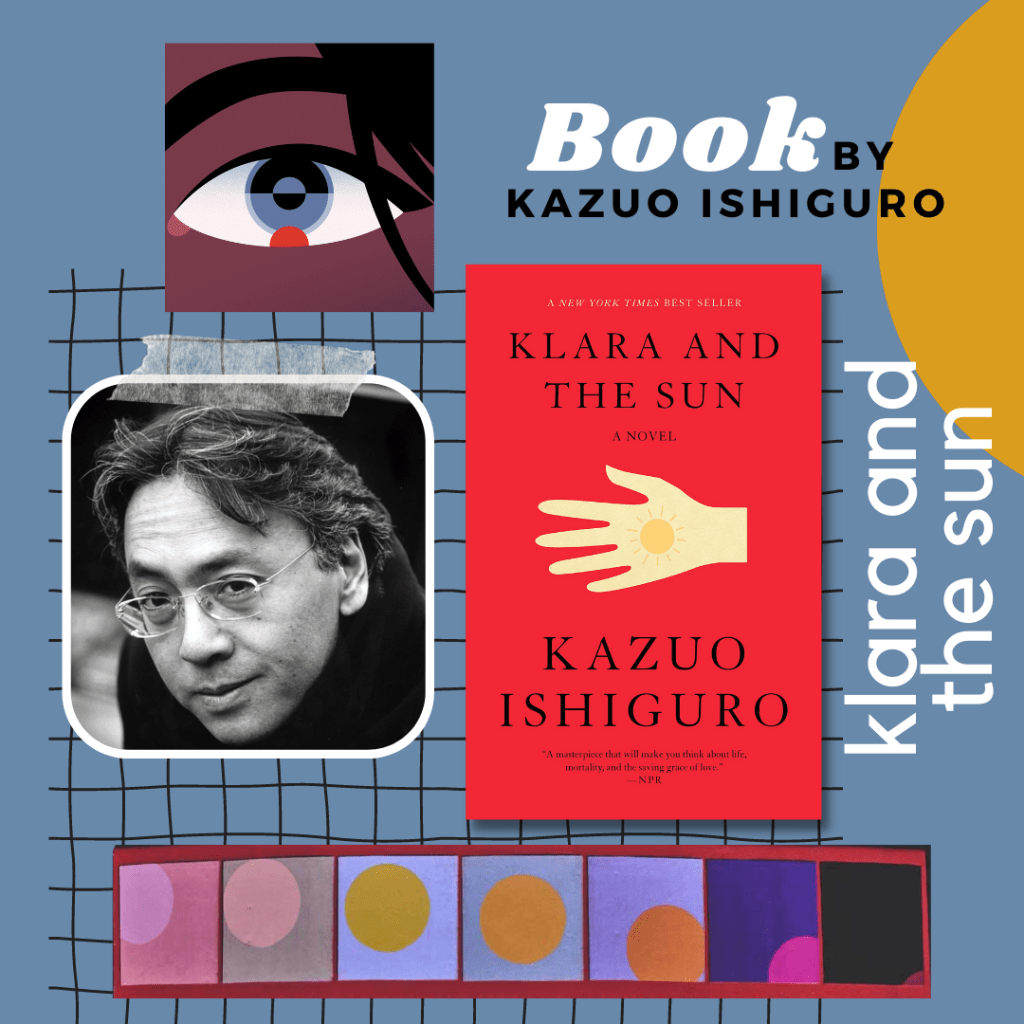
“Until recently, I didn’t think that humans could choose loneliness. That there were sometimes forces more powerful than the wish to avoid loneliness.”
To explore humanity through a robot seems counterintuitive, doesn’t it? That was my first thought after I saw a few reviews of Ishiguro’s latest book. But being a fan of some of his earlier works, I knew that his writing had the uncanny ability to stay long after closing a book of his. And as expected, Klara and the Sun did not disappoint.
The novel follows Klara, an Artificial Friend or ‘AF’ in a dystopian world where families can just walk into a store and buy artificial companions for their children. Klara is a highly intelligent being who is curious about the world outside her store, especially the elusive ‘Sun’ that graciously shines His light upon all people without discrimination. The book is divided into about four to six parts; The first details her early days in the store with other AFs (different, more upgraded models as well), while the rest observe her journey with Josie, a fourteen-year-old who is suffering from an unmentioned illness.
What is so special about Klara and the Sun is that Ishiguro tries to provide an outsider’s perspective on the human race. Klara’s commentary subtly points to the fickle nature of human emotions, and how frail we really are. Ishiguro also hints at a mildly disturbing future where some children are “lifted” and provided the best of education, but for a heavy price, highlighting the tradeoff between perceived success and health at such a young age. Even more scary is the idea of an AF replacing the human themselves. Strangely (or maybe it isn’t that strange), it is during the story’s darkest themes that we are made starkly aware of our own humanity. In the end, you are left with a single question: what does it mean to be a human?
Movie – Her

“We’re only here briefly, and in this moment. I want to allow myself joy.”
Over the years, I had seen many “aesthetic” Instagram posts with quotes from this movie, but it never piqued my interest until I watched Joaquin Phoenix in Joker. I found myself wondering how a man who delivered a terrifyingly sincere performance of the evolution of a psychopath could ever play a role that seemed so mild in contrast. But he did.
Theodore Twombly is a gentle and sweet greeting card writer who spends his life dealing with and translating other people’s emotions into words, while his own personal life is a mess. Enter, Samantha. She is young, she is smart, she is curious, and they both form an immediate and deep bond. The only problem? She’s a virtual assistant with artificial intelligence within the OS upgrade he recently purchased.
Watching Theodore and Samantha fall in love brings with it a lot of scepticism. Is it possible for Samantha to feel things, considering she isn’t “living” in the biological world? What is intimacy between a living creature and a non-living being? Can you love if you don’t have a heart?
As Theodore grows more attached, and as Samantha’s intelligence evolves, we are presented with a love story that is replete with joy and melancholy but rooted in simplicity. Her stayed in my mind long after I watched it. Barring the aesthetics, writing, and Scarlett Johannson’s voice as Samantha, the film left me deeply satisfied, for it while it was ephemeral, it was real, and it was beautiful.
English Show – This is Us

“We go through this life slowly but surely, just collecting these little pieces of ourselves that we can’t really live without until, eventually, we have enough of them to where we feel whole.”
For those of you who have talked to me about pop culture, this definitely comes as no surprise. To (attempt to) model your personality based on a show is something I never thought I would do, but then came This Is Us, and since then, nothing has remained the same.
From a simplistic point of view, This Is Us is a family saga spanning across multiple generations and following the Pearsons as they stumble through life. But that’s not all it is; in my opinion, no show comes close to capturing the human experience as this one does. Good old family wholesomeness? Check. Coping with loss? Check. Some of the most beautiful romances? Check. Witty humour? Check. Exploring important issues like race, sexuality, war, addiction, adoption, and the foster care system in the US with sensitivity and nuance? Check.
No character in this show is perfect (no, not even Jack Pearson, the father everyone fell in love with); every person is haunted by their own ghosts (even if they have a seemingly perfect life), but happiness and growth are not irredeemable. The character arcs and the brilliant performances, coupled with an amazing plot filled with memorable dialogues, will stay with you long after you finish each episode, and will compel you to keep returning to this show from time to time, seeking its wisdom and relating deeply to some of its parts. A multiple-times Emmy winner, This Is Us will give you a story that you will keep with you forever, and from it, learn how to love, to grow, and to forgive.
Korean Drama – Move to Heaven
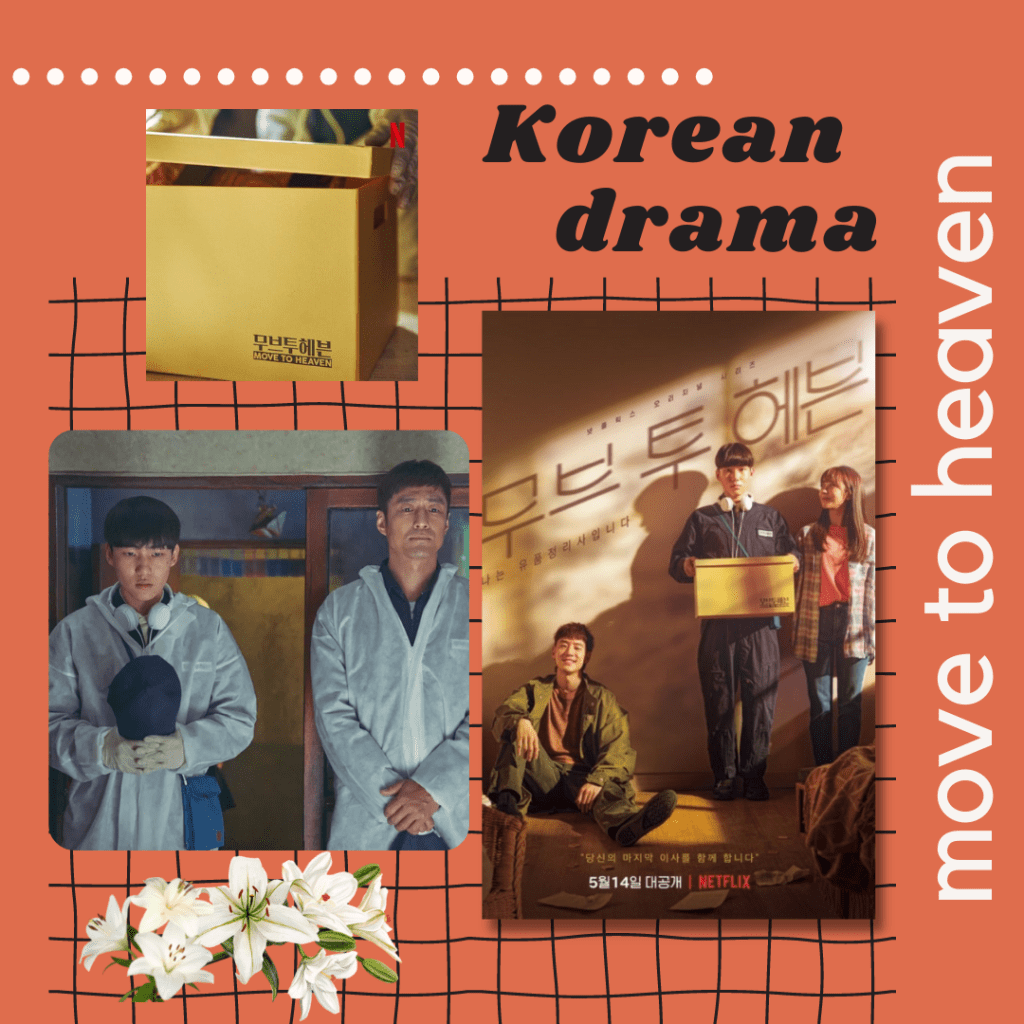
“Although you can’t see someone, it doesn’t mean they’re not with you. As long as you remember, they’re not gone.”
I started watching Korean dramas around mid-September, 2020. One may have chanced upon several articles on the article heralding the “second Hallyu Wave”; the pandemic had generated profound loneliness, and several people in India and around the globe were turning to Korean dramas because they were warm, happy, and feel-good. When I first watched Move To Heaven’s trailer this April, I was surprised. For one, it seemed considerably deeper than most of the fluffy shows I’d watched so far. Second, it seemed to miss the one crucial element that transforms most k-dramas into comfort shows- the guarantee of a happy ending. I wondered if it would end up being what we Malayalis call an “Award cinema”- type show- long and boring but filled with great acting and aesthetics.
Move To Heaven exceeded all expectations. Inspired by an essay titled “Things Left Behind” by Kim Sae-byul, an ex “trauma-cleaner,” it follows the story of young Geu-ru and his uncle, Sang-gu, who are left to manage a trauma-cleaning business after the former’s father suddenly passes away. Geu-ru’s struggle as a boy with Asperger’s Syndrome coping with the unexpected and overwhelming changes in his life, and Sang-gu’s gradual journey from being a grumpy ex-convict and illegal boxer to the caretaker of his differently-abled nephew is heartwarming and poignant.
And underlying all the character development is the concept of being a trauma-cleaner. A rather common practice in South Korea, these are the people who tend to the material possessions left behind by the dead. Each episode explores the story of a dead person- their messy dorm rooms, empty wallets, half-eaten ramyeon cups, splattered blood on the wall (the aftermath of a murder), or a secret garden. To come face to face with the remains of the dead, and to fit all of their important belongings into one single box, is a task weighed by emotional burdens. But in this show, we laugh and we cry with Geu-ru, Sang-gu, and their friends, and come to a realisation that while our time on earth is ephemeral at best, there are always people who will carry your memory for generations to come.
Music – The Ballad of Cleopatra by the Lumineers

“I was Cleopatra, I was taller than the rafters
But that’s all in the past love, gone with the wind
Now a nurse in white shoes leads me back to my guestroom
It’s a bed and a bathroom
And a place for the end”
Melancholy, yearning, joy, and regret- the Ballad of Cleopatra is a bittersweet cocktail that is marvellous both in terms of the music and the 20-minute music video composing of five songs from the album, “Ophelia,” “Sleep on the Floor,” Angela,” “My Eyes,” and the titular track. The video is a movie in itself; it follows the story of a woman from her young days to her old. The storyline is nonlinear, and we don’t know if all the songs are talking about the same people. The Ballad explores the question of “what if.” What if she had run away with the man she loved instead of staying behind? What if her circumstances were different? What if she wasn’t “late for, late for that”? Would she really die alone, embittered by regret, or was she at peace with how her life had turned out? This line of questioning is universal to humankind, and The Ballad of Cleopatra shows us that dreams and reality can be starkly different things, but that’s okay because it doesn’t imply that the latter was bad- it was just different. So roll down the windows of your car, feel the breeze ruffling your hair, and smile. You and Cleopatra are evergreen.
Play – Happy Days by Samuel Beckett
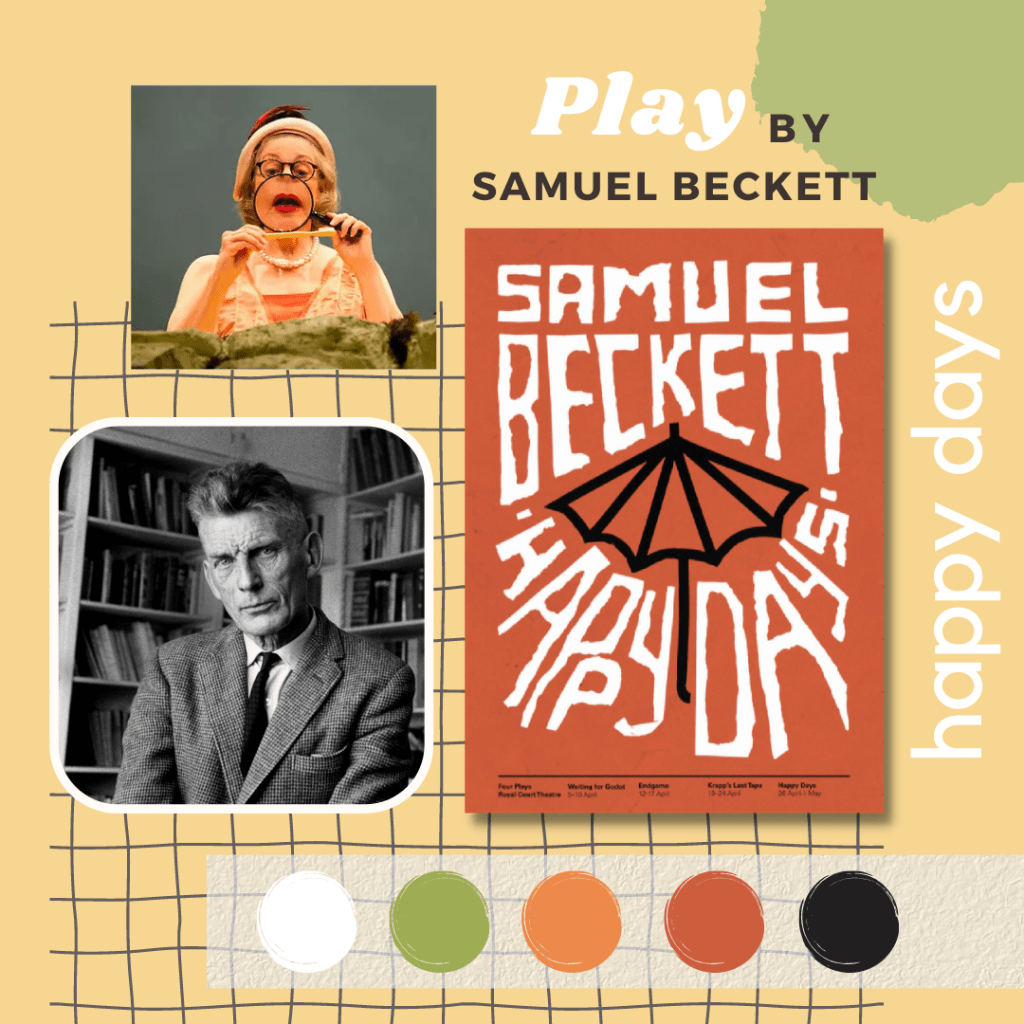
Those of us that encountered Waiting For Godot in our courses are familiar with Beckett, and the Theatre of the Absurd. His penchant to write plays that highlight the cyclical nature of daily life is apparent in Happy Days, widely considered to be one of the greatest plays ever written. The script follows Winnie, who, throughout the play, is buried waist-deep in a large mound of mud under broad daylight. Within the mound, she wakes up and follows her everyday routines, struggling here and there due to the restrictions imposed by her being stuck. Her husband, Willie, is a laconic man who, for the most part, remains hidden by the mound. The tale, often punctuated by Winnie’s refrain of “Oh this is a happy day,” represents a protagonist who is slowly sinking and becoming consumed by the sands of time (of which the mound is a physical manifestation). This play, through its strange setting, innuendos, and wry humour, presents us with an image of humanity that we would much rather ignore: that sometimes, it is possible to remain so trapped in the mundane-ness of reality that we unintentionally sink into languor and disappointment. And as you sink further into this abyss, all you have as company are wistful recollections of happy memories from bygone times.
Poem – Finale by Pablo Neruda
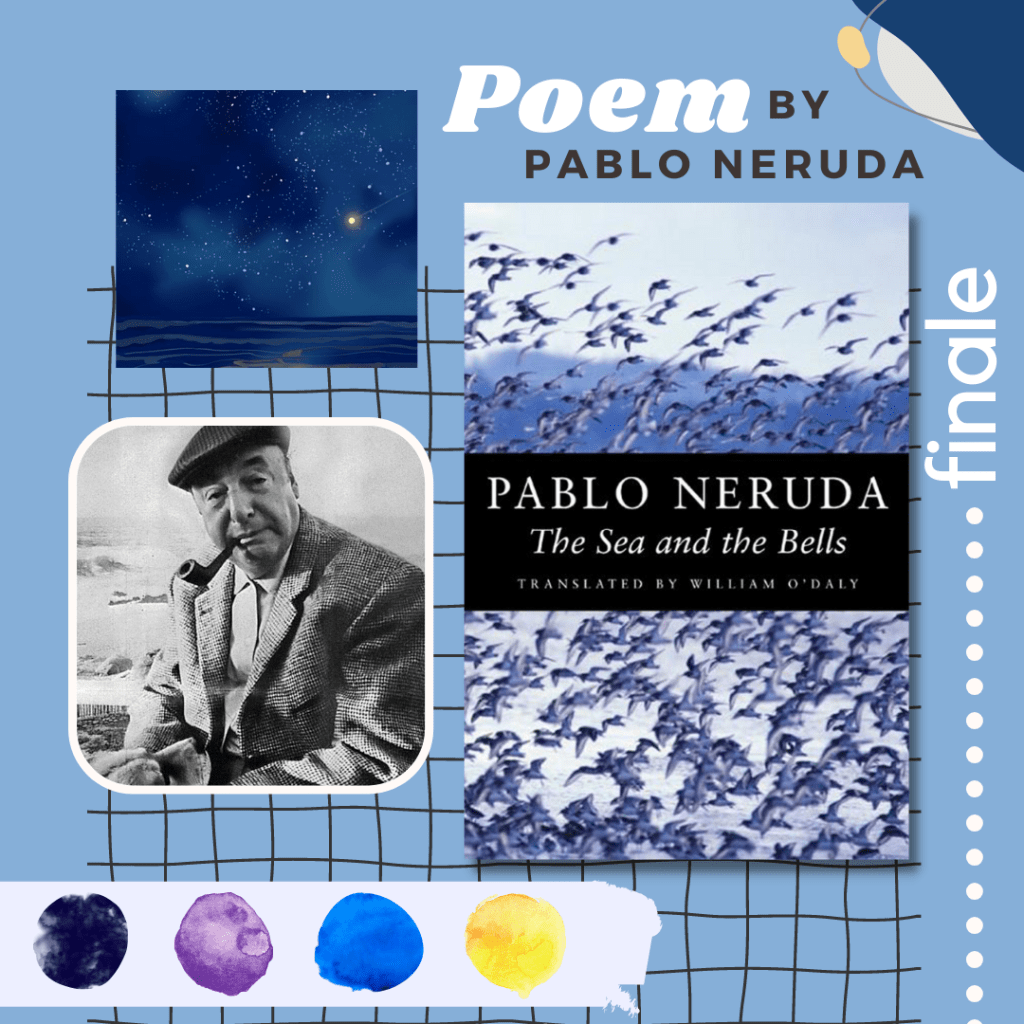
Matilde, years or days
sleeping, feverish,
here or there,
gazing off,
twisting my spine,
bleeding true blood,
perhaps I awaken
or am lost, sleeping:
hospital beds, foreign windows,
white uniforms of the silent walkers,
the clumsiness of feet.
And then, these journeys
and my sea of renewal:
your head on the pillow,
your hands floating
in the light, in my light,
over my earth.
It was beautiful to live
when you lived!
The world is bluer and of the earth
at night, when I sleep
enormous, within your small hands.
I have always enjoyed whatever I have encountered of Neruda’s poetry, even though my friend tells me that the Chilean patriot had a tumultuous personal life that reflects rather poorly on him (maybe I’ve struggled with the question of whether to separate the art from the artist in his case). His poems are usually passionate and despondent, evoking the fears and the urgency attached to falling in love. Neruda’s other works are simple, describing human life as he saw it. I chose Finale as the last element of this mood board (the emblematic nature of the title is fully coincidental) because its vivid descriptions are gentle and sweet, almost as if he was writing this by his wife’s hospital bed as she fell asleep. It is simple, and reflects a maturity in his writing- instead of lamenting her loss through powerfully sad lines (as he is prone to usually do), he seems to be rejoicing in gratitude for being able to spend his days with her. Incidentally, this poem was found on Neruda’s desk after his death. Finale is the closing chapter of a book, a happy ending, where two people in love grow old together and depart quietly, with grace, leaving behind only fond memories.
Design by Shatabdi Deori

