
– Navaneeth MS

Arnyakam is a Malayalam movie from the late 80s, that is sure to leave a deep mark on any cinema lover. The script is powered by the famed author M T Vasudevan Nair and supplemented by the directorial brilliance of Hariharan. It’s a movie of startling contradictions – on one side it’s the story of a 16-year-old free-spirited girl Ammini (Saleema), who likes to spend time with nature and is carefree. While on the other side, the film handles deep political issues of exploitation of Adivasi communities by the estate owners who had arranged themselves to neo-feudal lords, and that of Naxalism which attempts to resist and counter this – a grim picture of the realities of the Naxal movement in Pre-Emergency Kerala.
Ammini returns to stay with her uncle, post her schooling at “St Joesph’s girls prison”. With her mother died long ago, and her father away as a busy bureaucrat in Delhi, her relatives consider the quirky Ammini a bit of an embarrassment. It’s clear she had a neglected childhood for she avoids most of the family gatherings, likes to venture into nature, sings along with birds and her favourite pastime is to write letters to famed personalities which she never posts.

Her cousins fondly refer to her as “Kirukku,” which means “crazy,” and refer to her diary as Kirukku Posthakam (Book of the crazy). She, too, reaffirms the belief that she is abnormal and socially awkward. She spends much of her time alone, reading and writing or making goofy faces in the mirror. Ammini’s uncle Madhavan Nair, the owner of the large estate is what you could call an erstwhile feudal lord – a ‘Thampuran’ who exploits the nearby Adivasis who work as indentured labors making sure to use his connections to crackdown any deviants. He has no remorse to mercilessly beat the old and sickle workers using his friends in the police when they ask for a pay rise or try to organize strikes. In a sense, the movie shows whatever was wrong with India in the 70s – and oppressive regime with the spectral threat of a police state. Ammini fundamentally disapproves of this – one reason why she is happy to leave the house as early as possible to wander into the deep wilderness, observing birds with her binoculars around the hills, streams, and never-ending treeline.
She had chosen a breathtakingly beautiful and serene corner in the wild, scattered by remains of an old stone structure, and claims it as “Private Property. Trespassers will be prosecuted.” She rearranges a small part of it and made it her corner of the world where she writes all that comes to her mind – from Basheer to Indira Gandhi.
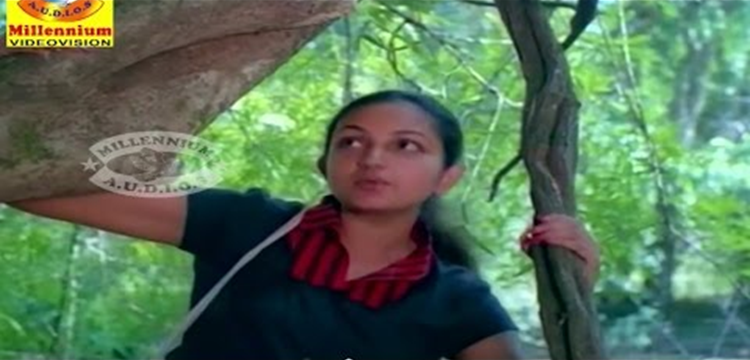
Soon she meets Mohan (Vineeth), a family friend and a Sociology Graduate who is supposed to be married to her cousin (Parvathy). Her eccentric nature and quirky jokes only make her cousin berate her more leading to her further withdrawing into the woods. Mohan is attracted to Ammini’s amusing character but she continues to find him as a bit of an annoyance although she’s confused about the feelings she has towards Mohan.
But the most interesting character that arrives is the stranger (Devan) who trespasses her private corner in the forest. Ammini deduces him to be a forest surveyor and beekeeper hobbyist. “I can assume just by looking at you. Haven’t you seen the photograph of a man in the newspaper who grows bees in his beard?” – Ammini inquires. She finds the stranger who soon parts away and promises to not disturb her private habitat to be an idiosyncratic soul. She writes in her diary the stranger to be one of three – a prince in disguise or a dacoit pretending to be a beekeeper or someone like her who likes solitude. It’s the last possibility that draws her more to the stranger.

She meets the stranger many other times but the stranger keeps his identity hidden, but he expresses acceptance and respects her individuality, which people normally dismiss as weird and outspoken. He ignores her eccentricities and describes her as fascinating and brilliant. Ammini encounters someone who finds something significant in her for the first time in her life – the duo forms a strange companionship and agrees to share the space without disturbing one another. But this soon takes a turn when she learns about the real mission of the stranger which comes into conflict with her own life and understanding of the world.
The movie can be interpreted in many ways. It can be seen as a character study – of Ammini which portrays the confusion of an adolescent girl or a person’s retreat into nature. It’s very hard to describe what her real personality is – she can be introverted due to her constant flight to the wilderness but her quirkiness and outspoken nature pushes her into the other side of the spectrum. The fact that she found the stranger to be her ally in solitude itself offers a very interesting perspective of the person – one of loneliness and detachment but at the same time showing an enriched personality that is reflected in the serene nature she chose to be with.
On the other side, it takes a deep political undertone by portraying the plight of the Adivasis. Her uncle, the patriarch is the core opposite of whatever Ammini represents. Her so-called love interest – Mohan, the Sociology guy is an ironic character, not too different from the youth of today. He’s blind to the deep oppression happening around him by his own family but is happy to stay aloof and take a passive approach. Mohan’s ambition to do a Sociology Ph.D. on tribals shows the amusement of scriptwriter MT, like in many other works, at the establishment’s hand-tied approach in solving social realties.
It’s a deeply nostalgic movie for any movie lover. It’s not easy for one to forgo the impact of Ammini as a character: just like how she retreats to nature, this movie is one of those serene classics that will not get old despite multiple viewings.
Design by Rohit
Edited by Samaja Penumaka

