
— Neeraj BR
Rahul Nath is an alumnus of HS13. After his graduation, he worked with Little Black Books in Goa before joining Condé Nast in Mumbai as a Junior Photography Editor. Currently, he’s part of the Global Photo Team of Condé Nast Travel Magazine. His work has also been featured in National Geographic.

How did the journey as a photographer begin for you?
Photography is something I picked up in insti during my first year. Before joining insti, I didn’t have any hobbies to mention, though I did write a bit and read a lot. So when I came to campus, I looked around to see the opportunities insti had to offer. My friends dragged me to the Media Club’s fundae session, where it all started. I didn’t go there expecting to pick up photography. But, I met one of my first inspirations for photography there – a third-year Mech student named Roshan Santhosh, who was heading the session. The idea of photography as a hobby never crossed me, but after seeing his work, I thought, why not give it a try. That was my first exposure to DSLR photography.
So the campus is where it all started?
Yeah. You can say that. That’s the truth, actually. In insti, there is space to explore everything, which allowed me to see what type of photography I was good at. I had the space and time to learn photography from scratch. Insti also had great places and provided privacy for everyone to start doing something they like. There were also numerous subjects- people, deer, fawns and monkeys to try photography on. Moreover, I had five long years before me, so I had an unrushed introduction to photography. The only regret I had at the time was that I wasn’t able to shoot Chennai as a city like I wanted to. But that was because of my personal inhibitions, asking people their permission before shooting- the beginner’s inhibitions. But you can say that my pursuit for photography started in insti.
As a photographer, how do you know when is the right time to click a particular
picture?
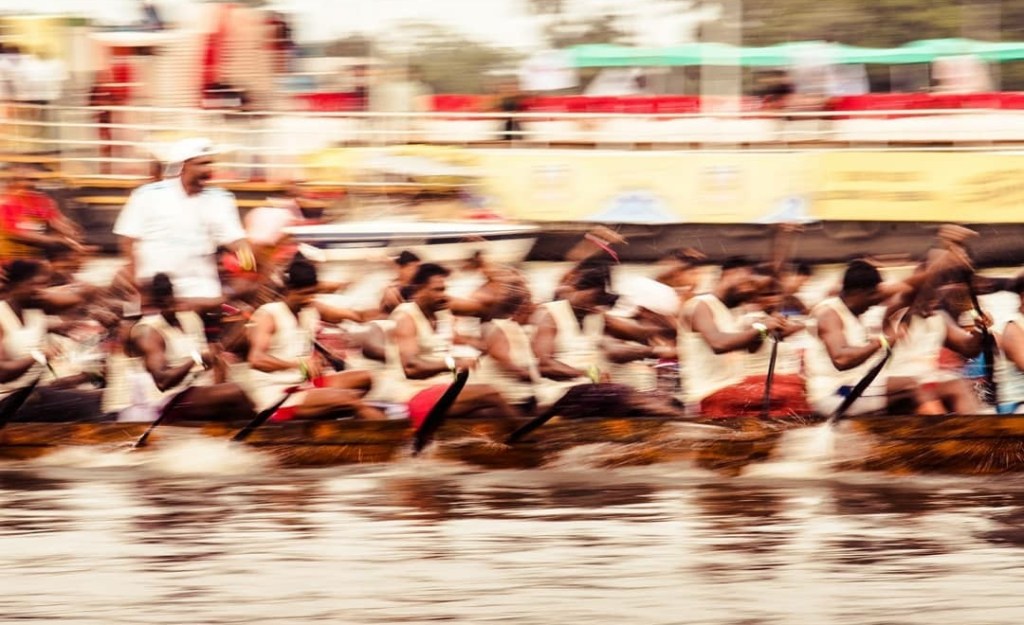
It’s great that you asked that question. As a travelling photographer, you encounter numerous objects and elements that you can’t control when you are shooting on subjects of travel. You can’t control the weather, the people’s behaviour, and you don’t know what will pop in front of your lens next. There is a lot of thinking on your feet involved when you are on the field clicking the pictures or processing them on the editing table. Both these processes have their own distinct methodology attached to them. When I click a picture, my inherent style and vision kick in, and I shoot it in a flow without thinking much about it. But for, photos like the Nehru Trophy Boat Race and the Kathakali dancer, they were entirely beyond my control. It was a large event with bad weather, and I had 2-5 seconds to get the shot.

At that time, your impulse kicks in. When looking at the photos from the comfort of your home or workspace, you get a free thinking space to decide how you want the picture to come out- what elements do I like, whether it accentuates the mood it conveys. There are two different workflows, and we always have to be on our feet in travel photography. It is the most challenging yet the most rewarding part of travel photography.
How do you decide which photograph goes for publication and what goes into your personal collection?
My job designation is a Visuals Editor at Conté Nash. That empowers me to look at photographs from various photographers worldwide and see which picture fits a feature. Given the nature of my job, I have trained myself to be as objective as possible so that I am not biased while choosing a picture for a feature. The requirements of the feature or assignment matter, not my personal preferences.
So when I get an assignment, I try to stick to what the brief wants me to do because they trust a part of their work with you. So we have to follow the guidelines and adhere to the brief’s requirements. But the standalone pictures come out when we try to bring out the best within the guidelines provided. When on an assignment, there are constraints like time, equipment, and subjects, but I am not bound by these constraints when I am doing photography freely. That provides me with the space to experiment and shoot things the way I want. It gives me a personal connection with whatever I am shooting at the time. All the pictures I have put on my social media accounts are from my personal collection. They might have an element I like or reminds me of something. It helps me express my thoughts better than through words. These images are close to my heart because they were shot freely.
Do you have any favorite locations to shoot pictures?
Being a travel photographer makes you enthusiastic about travelling and open minded about it. I have gone to obscure locations that I wouldn’t have otherwise had I not known how to shoot pictures. This helps me be optimistic that something of interest will come my way, whether the location is damp or dry. That really helps me as a photographer. One of my favourite locations to shoot is Kerala. However, I haven’t been able to shoot Kerala as extensively as I wanted to, because I picked up photography in Chennai, then I went to Goa and then Mumbai. It is only very recently that I am back in Kerala. Shooting Kerala is a work in progress. It becomes a personal piece as it will give me the satisfaction of having worked on my home state when I look at it years down the line. Odisha is another location and so is Rajasthan, especially Ranthambore. Two years back, I had the opportunity to shoot a huge commercial project for a client, for which I had to go to Balugaon in Odisha. When I was told about it, I didn’t know the place and had to google it. It was a very interior village in Odisha. At first glance, there wasn’t much to be excited about, but when I went there, there were little exciting elements, which made the entire experience rewarding. Abroad, Nepal was a great yet challenging place to shoot. The weather kept changing frequently, and the shoot was physically demanding as I was carrying the gear. Another interesting place was Barcelona when I went there for my semex. I found the city had a rich blend of textures, colours and vibrance.
Did you get to shoot the football culture in Barcelona?
Yes, I did, but as tourists and not in an official capacity. I got decent seats towards the higher ends of the pavilion and took the photographs. Though I could see the players, I could not zoom enough due to the limits of the lens. Nevertheless, I did get some good pictures, and it was a lot of fun.
How did the opportunity to work for NatGeo come by?
I have worked with NatGeo only as a freelance photographer. They used to do short photo essays on their website and asked me if I could do a photoshoot for them since I was in Pondicherry at the time. I shot two stories for NatGeo- one on Pondicherry and the other on Chennai. I attempted to shoot Pondicherry unconventionally, pitched it to them, and they liked it.
How did the opportunity to work with Rana Daggubati come by, and how was your experience?
Shooting Rana was very quick. We were doing a feature with Condé Nast Travel Magazine, where I was a junior photo editor at the time. Rana was promoting his film Haathi Mere Saathi in Mumbai, and we got a chance to interview him. I had a lightning photoshoot session with Rana, lasting just 10-15 minutes. We were shooting indoors inside the Eros office, and I had like five minutes to check out places where I thought I could shoot a good photo with decent lighting. When Rana came for his photoshoot, I had to be quick because he was busy with the promotions of his film. So I got him to do some quick poses, and I took him to another location inside the Eros building to do some outdoor shots. I was very tense
because I had to get the picture within a minimum number of shots and not make the subject- which is Rana- uncomfortable. The thing is, he wasn’t exactly dressed for a photoshoot. So I had to play with colours, especially black and white, to conceal the colour of his clothes. Nevertheless, I was pleased with the images despite the constraints. It was one of the quickest portraits I have ever taken.

How would you describe your time as a student in the HS department?
As a student in the department, I was constantly trying to find my way. You get insulated from many things in the first year, and the pressure to maintain the good grades for the stream allocation gets to you in the third semester. So I had to keep my grades up when I just discovered photography. I wasn’t a bad student or a great student. However, a few elements of the course really helped me with my photography. I became well-read and well- informed at the end of five years. I think that impacted my photography too because I was aware of less-important but critical topics like ‘Othering’. Certain courses from the department have made me mindful of my photography, especially when shooting people and cultures that I don’t know about.
I did have a struggling phase in the second and third semester. I struggled with Economics courses during my department days, and I couldn’t see their relevance in my career path. Not that they are irrelevant. The real struggle started when the quant courses like statistics and econometrics jumped in. But being in DS helped me to go on a semex for one semester, which was a really wholesome and rich experience.
At the time, I was probably the only person from my batch who took up a job in visuals and creatives, but now things have changed. Many of my classmates are currently working in various creative fields. My career choice meant that I had to constantly find outlets for my benefit. I had to find internships in photography, publishing, and editorial because they didn’t come through the Department Placement Cell. It was a steep learning curve, it wasn’t easy, but I don’t regret it.
Any courses that you really liked?
One of the courses that really left an impact in me was International Relations by Prof Sonika. I wouldn’t have thought of things beyond a certain point if it wasn’t for the IR course. That course definitely made a mark on me, and I still remember concepts that she taught us in our second year. I found myself going back to the notes when something of international relevance happens, like the recent Ukraine Russia conflict, just to jog my memory.
Cultural Studies by Prof Kaamya Sharma (who is also an alumnus of our department) was another really insightful course. I picked up concepts that learned from the course to compare and contrast with the images I shoot and the approaches that I use, to make my approach better. Another course was West Asia, because my history wasn’t great when I came to insti- I had an idea of where what took place, but no clue about the nuances of the events, especially in the case of West Asia. So, the course helped me get things straight.
Word of advice for juniors?
Always keep an open mind going forward in the department. Never think that there are set number of ways your future can proceed. Always explore other outlets to see the opportunities they have to offer. Because if you are stuck in a single line of interest or work, you might get bored easily. If I was just a freelance photographer till now, I would have got bored of a lot of elements I encountered. I would have had to take up assignments just to pay the bills and not for its excitement. So always keep an open mind and see what else interests you so that you can keep it at the back of your head if you feel that you will be able to handle two things at the same time sometime in the future. Keep yourselves updated with things happening around you.
One can find Rahul Nath’s extensive photo collection on his personal website and instagram page
Design by Rohit G
 Article 19