— Khushi M P
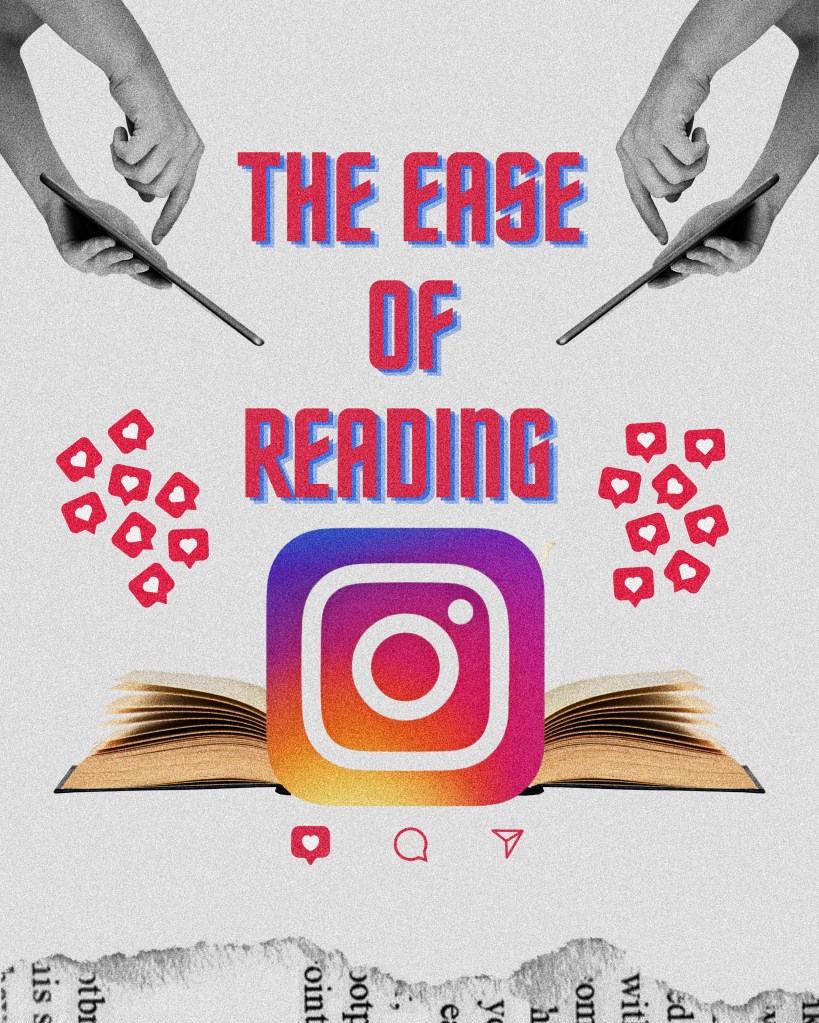
Bookstagram. Booktok. Booktube. These words have been created by blending the word ‘book’ with different social media platforms. They refer to a significantly large online community that deals with books. Bookstagram is probably the most popular and influential community, so we will be examining it in this article. This community is made of creators, consumers, reviewers, authors, commentators, passive scrollers and more. But what exactly is this community and what does it do?
Bookstagram is a community on Instagram where people get to talk about their favourite books, genres, characters, movie adaptations, aesthetics and themes. The concept works mainly with genres, and each genre has its own niche – its own rabbit hole. Genres range from sci-fi and mystery to rom-coms and biographies. Instagram has different book communities that cater to different types of readers. There are some influencers who promote reading as a form of self care. They post about books that fit their aesthetic, regardless of whether they really read them, regardless of whether they really like books. Their audience does not follow them for the books they read, but for their other content, and books become mere props in their reels and posts.
Getting the lifestyle influencers out of the way, now we come to actual bookstagrammers (unfortunately, there’s a word for everything). The average bookstagram page with a decent following looks like this: scores of aesthetic posts that make books look visually attractive, annotations and highlights to make a few lines stand out and represent the whole book, long captions that expound upon what the person thought about the book. Some pages have detailed reviews and plot summary, some have just annotations and the review in stars. This is a general framework, and it differs from person to person. Each influencer has their own touch to the concept, and this is what makes each page beautifully stand out and find their audiences.
Bookstagram is not necessarily a strict niche; a lot of pages have mixed genres with other interests the influencer might have. For example, fashion, music, movies. It is almost impossible to talk about this topic without bringing in aesthetics. Instagram is a visual media platform, currently most famous for its artistic pictures and videos. Dark academia, light academia, romantic academia, which combines features of both. Chaotic academia, soft academia, the list goes on and on. They all do one thing: make academia look cool, make reading look desirable.
For a person who has been a reader most of her life, something that was not ‘cool’ as such, Bookstagram was a breath of fresh air. Books and their worlds are taken and morphed into the most beautiful swipeable posts. Characters are taken and given life, worlds come alive and invite more people into them, all through less-than-a-minute videos. Bookstagram converted a lot of non-readers to people who now buy books, read them, and want to discuss them. The books that go viral are easier to understand and relate to, written in simple language that does not intimidate people. So the world does get a bit better, with bookstores and libraries having a larger consumer base. But there is a catch, like there always is in these cases. It popularised a certain type of book – catering to the female audience, centering around the most attractive, dreamy men and relatable but resourceful women, and the plot usually deals with their romance. These books are most popular on Bookstagram, and recently in bookstores as well. Bookstores are slowly catching up with the trend, with some stores having a section titled ‘Trending’ that cater specifically to the Bookstagram audience. Some examples of these trending books are ‘The Love Hypothesis’, ‘The Spanish Love Deception’, ‘It Ends With Us’, ‘We Hunt The Flame’ and more. Another very interesting thing about these books in particular is that their authors are basically influencers, catering to the Bookstagram audience. This is bittersweet, because it hints that unless an author can put themselves out there and build a social media following, their books will not sell. It also puts not-so-popular (or dead) authors who don’t (or cannot) publicise much on social media, out of business because people will prefer buying books they have heard about.
Yes, this is the ‘digital age’ and everything is online, but I, a reader who started reading books offline, not even knowing the faces of the authors whose books I was reading, cannot be fully satisfied with the new trend of the author-influencer. Bookstagram books make for fun reads, but they tend to be boring once you go through a few of them. Their plots get repetitive after a point, the characters start getting a little too familiar, and the book itself reads like a cliché movie. Easy to read, easy to understand, with little emotional and mental engagement with the brain. However, these are the kinds of books that are most popular on Bookstagram pages because they can resonate with many and easily convert non-readers to readers.
Having said that, social media is a great way to encourage more people to read, to build up an audience you can take feedback from as an author, and knowing that if a person follows you and likes your page enough, there is a bigger probability of them buying your book. Good reviews online get people to buy books, book recommendations get people to read books. My dissatisfaction with this format stems from the fact that book reading used to be a difficult thing for me. I would blindly wander into a store, spending hours looking at the reviews at the back, the picture on the front, the name of the author, the thickness of the book, and then deciding whether to buy it or not. My reading habits have definitely changed since then. Now I tend to gravitate towards the most familiar covers when I visit a bookstore. I probably already know a bunch of spoilers and character names, or at least the trope used in the book. The nostalgia of not having everything a click away hits me everytime I open my favourite aesthetic dark academia Bookstagram page, and I take this easy access to information with a pinch of salt.
Edited by Devika Dinesh
Design by Abhiram V M
 Article 19