
— Neha Cherian
I have always taken unembarrassed delight in the sounds of the French language- its softness and slight musicality, the abundance of “z” sounds, the elusive “r” and the maddeningly unreasonable rules of pronunciation. So it made perfect sense that when I stumbled upon the word that would have described an ideal semester exchange sojourn in European capitals, it was French- flânerie. I say ideal, because the tyranny of itineraries and Google maps is difficult to escape.
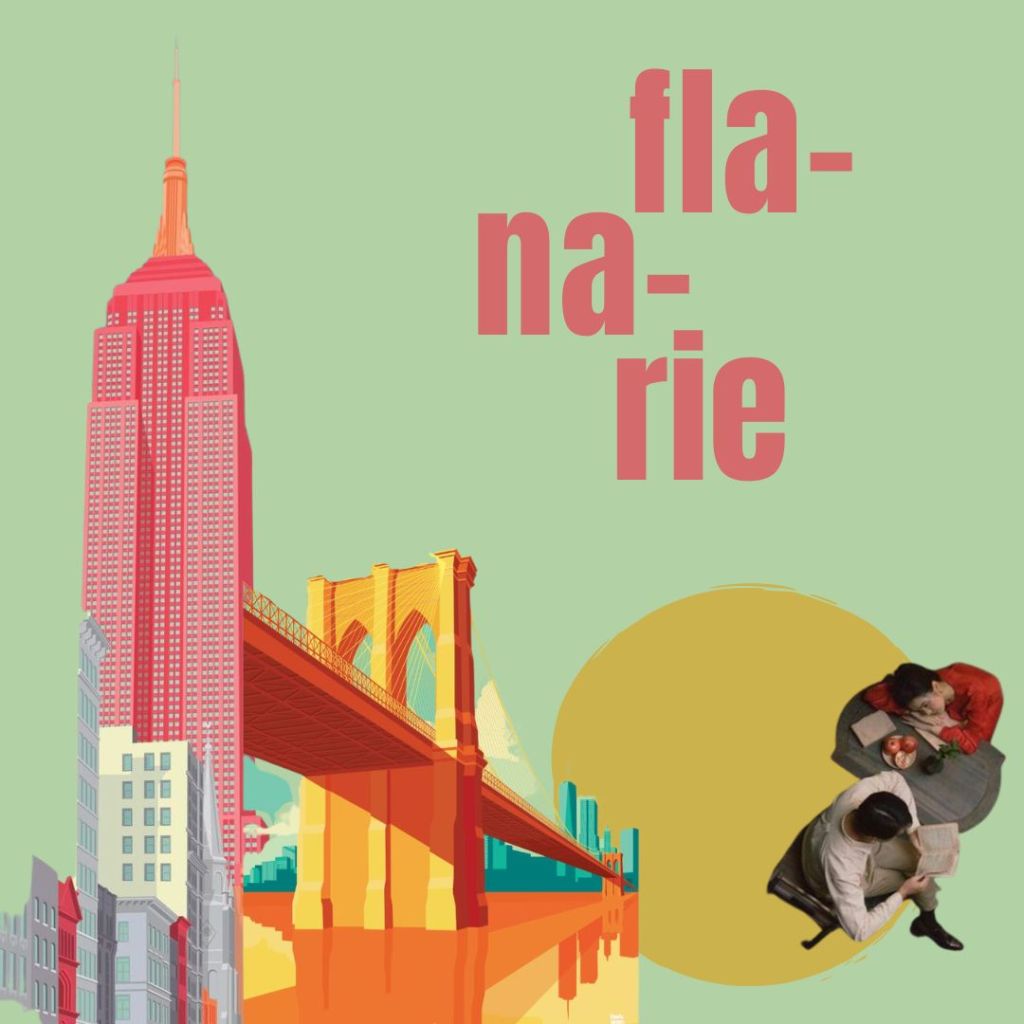
Fla-ne-rie : aimless wandering of the urban variety.
The figure of the flâneur captured a certain European sensibility in the 19th century. The original flâneurs were idle gentlemen- men of leisure, veterans of the streets who strolled around the city (usually Paris) observing life. The female equivalent is called a passante, or less frequently, flâneuse. The city being less a safe space for women, examples of famous passantes are rather fewer. This changed in the 20th century, when women began claiming their right to public spaces.
The 20th century and the rise of movies was a fertile ground for a kind of double flânerie- observational wandering through the lens of the camera and the flaneurs themselves. Agnès Varda plays the cinematic, directorial flâneuse to perfection in her 1962 film Cleo de 5 à 7. Cleo, a singer, wanders through the streets of Paris, awaiting a biopsy report. Preoccupied and detached herself, we come to realise that she is not the real flâneuse – Varda is. Through her camera, we see Parisians in the business of daily life. We enter the sleeping subconscious of a booming metropolis engaged in a faraway war that surfaces occasionally through the mundane prosperity.
A film that is particularly dear to my heart, which has always made me think of flânerie, while not being precisely about flânerie, is Richard Linklater’s Before Sunrise. Celine (Julie Delpy) meets Jesse (Ethan Hawke) on a train and on a whim, spends all night walking around with him in Vienna. The real focus of the film is on their conversational back-and-forth. But it is impossible not to romanticise the unintentional encounters with Vienna, the city. A few weeks ago, my friends and I attempted to recreate the Before Sunrise night in Vienna- but it turns out that flânerie is rather more difficult than it seems. It sounds lazy and mindless. Certainly, it is a function of having nothing to do and having to do nothing. But whatever it is about urban rambling that captured the interest of the literary establishment, it is not easy to replicate. There is an art to flânerie- it is about hovering at the edges of the urban reality and observing life, curious but disengaged. A deliberate aimlessness if you will. Walter Benjamin identified in the French writer Charles Baudelaire the ideal modern flâneur in the ultimate modern setting- the metropolis:
“The flâneur is still on the threshold, of the city as of the bourgeois class. Neither has yet engulfed him; in neither is he at home. He seeks refuge in the crowd. … The crowd is the veil through which the familiar city lives the flâneur like a phantasmagoria.”
The idea of being alone in a crowd isn’t new- it’s how contemporary life with social media is often described. But in flânerie, there is a joy in this loneliness. It provides an essential stimulation for creative minds. Indeed, to be a flâneur may not even be particularly lonely. In Virginia Woolf’s essay Street Haunting, the narrator tries to imagine the lives of people that she is walking past- a harmless exercise to while away the long winter hours and “become part of that vast republican army of anonymous trampers, whose society is so agreeable after the solitude of one’s own room.”
To be a flâneur is to engage constantly with the city- that is why the idea of urban rambling is so fashionable in architectural circles. The term psychogeography denotes the psychological effect of a space on a person. When Baron Haussmann undertook his famous renovation of Paris under Napoleon III, he favoured wide streets and boulevards and arcades, straight lines, homogenous architectural complexes. The French philosopher Guy Debord identified a new kind of movement associated with this new psychogeography of Paris- one that involved “drifting” while observing. The word flânerie is French- and so is the sensibility. Only a people who treat their 90 minute lunch break as a sacred ritual could possibly elevate aimless wandering to an art form. Or perhaps it is to the detriment of the rest of us, that we do not see poetry in our daily lives. If this essay proved a bit of a ramble, chalk it up to a bit of literary flanerie 🙂
Design by Shatabdi Deori
Edited by Devika Dinesh
 Article 19