
I must begin this article, as Barry Goldwater wrote in his book “The Conscience of a Conservative”, by stating that it “is not written with the idea of adding to or improving the Conservative philosophy.” This article neither offers a defence of conservative ideals nor does it provide a caricature of it, but rather furnishes the readers with an elucidation of the history of modern conservative philosophy and statement regarding its relevance in contemporary era. I believe that throughout history, conservatism has often found itself sensationalised by both sides of the political spectrum – while leftists argue conservatism to be an outdated fool’s regressive ideology, rightists claim it to be the protector of culture and dignity against modernisation. I claim it is neither, and I explore the last few decades of this terminology in this article.
William F. Buckley Jr. defined a conservative as “a fellow who is standing athwart history yelling stop.’’ In this article, I comprehensively explore the history of conservatism in the last century and its success as a political movement in preventing humanity from falling off the precipice into the ocean of modernisation.
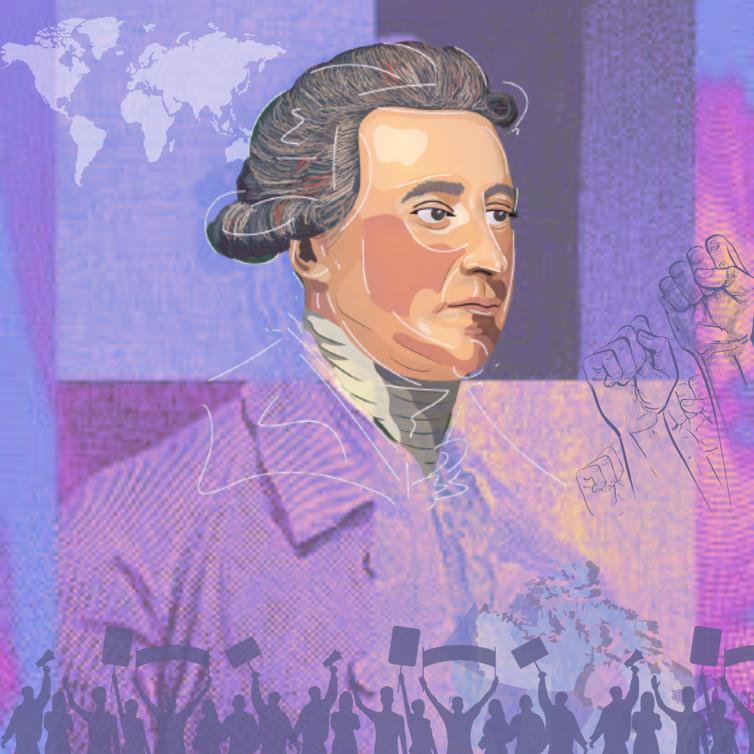
While it may be argued that conservative philosophies have existed in human civilisation since its very inception, an organised embodiment of conservative political philosophy originated from the economist and philosopher Edmund Burke, a Rockingham Whig and a believer in the gradualist emancipation of slaves. Burke’s philosophy, since then, has been interpreted, embellished, as well as disfigured by political scientists and philosophers for generations in order to appropriate its ideas for their own ends. Conservatism as a philosophy, since then, has also transformed and reincarnated into several images to keep itself pertinent through the ages.
In the United States, the issue of conservative political philosophy is generally centred around the adaptation of the two political parties with regards to specific political issues. Until the presidencies of Roosevelt and Kennedy, the Democratic Party was considered as the conservative political party, due to its adherence to the conservative white population of the states of the Deep South. Franklin Delano Roosevelt’s election as president in 1932 marked a change in the political atmosphere of the United States. With him came the emergence of big-state, collectivist and protectionist welfare-centred economic policies. He served as an alternative to the mismanagement of free market economics by Republican administrations, which had pushed millions of individuals into poverty during the Great Depression. This established the Democratic Party as the party of big government and fiscal liberalism. In the 1960 Presidential election, John F. Kennedy, the Democratic nominee, openly accepted desegregation as a policy preference of the Democratic Party in open contrast to the desires of generational Southern Democratic conservative voters, establishing the Democratic Party as the party of both social and fiscal liberalism. The implementation of the Equal Pay Act of 1963 by John F. Kennedy further confirmed the liberal stance of the Democratic Party.
The Republican Party, once founded upon the principles of classical liberalism and emancipation of black people, restructured itself to the whims and wishes of southern conservative voters, despite its libertarian foundations and established itself as the conservative party of the United States. The nomination of Barry Goldwater, a prominent constitutionalist who stood against the decision of desegregation, instead of Nelson Rockefeller – the liberal governor of New York State – in the 1964 Presidential Election primaries was a testament to its evolution. The endorsement of the Republican Party by the anti-feminist paleo-conservative movement led by Phyllis Schlafly – a movement which stood against the Equal Pay Act as well as the Equal Rights Amendment and the enlistment of political figures such as Storm Thurmond to the GOP, completely transformed it to a conservative political party.
This realignment of Republican politics was brought forth by William F. Buckley, a charming and charismatic writer and intellectual who single-handedly popularised this fusion of cultural conservatism with economic liberalism in the pages of his National Review magazine. The justification of this coalition was to be united against the menace of the Soviet Union. Libertarians, nationalists, religious leaders, constitutionalists, and conservatives, despite their difference of viewpoints and policy approaches, acted against the threat of communism to U.S interests and decided to stand in unison. Buckley conservatism, while initially affecting Republican politics in a trivial manner, would find its electoral vindication through the administration of Ronald Reagan.
In the United Kingdom, the political atmosphere had been divided in a two-party system for centuries – the Tories and Whigs, who later rebranded themselves as Conservatives and Liberals. In the early 20th century, the emergence of the new political ideology of Socialism, changed the political atmosphere dramatically. The election of Clement Attlee, the popularisation of socialist and interventionist policies such as universal healthcare, welfare, and economic intervention changed British politics and led to the acceptance of such policies by the Tories during the administrations of Harold McMillan and Edward Heath, who championed One-Nation Toryism in the tradition of Benjamin Disraeli and supported the post-war economic consensus of focusing on a mixed economy based on the establishment of a welfare state through Keynesian policies.
But this consensus would not last long, for increasing inflation, slow rate of economic growth and wealth creation would soon allow market oriented conservatives to garner strength in the 1970s, leading to the triumph of one of the most consequential and controversial political figures of the last century – Margaret Thatcher.
In 1979, Margaret Thatcher was elected the Prime Minister of the United Kingdom. Despite the association of Thatcherism with social conservatism, Margaret Thatcher’s voting record at the time demonstrated differently. In the year 1966, Thatcher voted to legalise homosexuality, standing up against the tide of traditionalist figures in her party, and had also voted in support of legalising abortion. But Thatcher was no “nineteenth century liberal”.
Margaret Thatcher enacted the poisonous policy of Section 28 which forbade the “intentional promotion” of homosexuality by authorities and forbade the teaching of homosexual relationships as an alternate and viable form of lifestyle. Thatcher was also quoted saying, “For I hate feminism.” and “I owe nothing to Women’s (liberation movement)”. Thatcher’s economic policies were generally based on supply side economics centered around tax cuts, deregulation, privatisation of nationalised industries, maintaining a flexible labour market, reducing government spending and public expenditure.
The reign of Thatcher in the Conservative Party and the Reagan presidency are generally considered to be eras of commendable electoral and political successes by historians. The historical rankings of these two political figures as the leaders of their country are also flattering, which justifies the extensive shift in the Overton window of the politics of these countries after their tenures. Following Thatcher and Reagan, came two political figures with equally consequential reigns – Tony Blair and Bill Clinton, who shifted their traditionally left wing political parties – Labour and Democratic respectively – towards the centred, endorsed third way politics, and gave up on long held beliefs of nationalisation, welfare economics, and Keynesian methods of economic problem solving, and endorsed market economics. Their emergence was a testament to the success of Thatcher and Reagan in having a significant rightward shift in the politics of two major nations of the world.
After Reagan, conservatism changed extensively in the United States, at the helm and the bottom of the Republican Party. In 1988, George H.W. Bush was elected president. His administration was recognized for the presence of neoliberal economists and neoconservative foreign policy strategists and the successes of the Gulf War. American foreign policy would be shaped by what was declared as the doctrine of proportionality for the next decade, including actions committed by the US Government which would be designated as “illegal but legitimate” by the United Nations. This era of foreign policy would find its conclusion during the Bush Jr. administration, which was infested with warmongering neoconservatives, who pushed the US Government into the Afghanistan and Iraq War. The 2003 invasion of Iraq by US forces vying to destroy non-existent Iraqi weapons of mass destruction would lead to an increasing suspicion towards the authority of the United States across the world, and the undermining of conservative ideology and the Republican Party in the States itself for almost a decade. While the top of the Republican Party was delegitimizing itself, the bottom of the Party was changing too. Beginning with Pat Buchanan and the revival of the paleo-conservative movement which promoted socially regressive policies, and then the 1994 Gingrich Revolution which gave rise an era of aggressive partisanship, the populist centred Tea Party Movement, and finally the election of Donald Trump has cordially shifted conservatism into an unserious, facetious and frivolous movement and a rest-space to the likes of white supremacists, neo fascists and antifeminists.
Conservatism in the United Kingdom has not fared well either. While the heart of the Conservative Party remains sane, its body does not. Eurosceptic and racist voters of the Tories became a plague to the philosophy of conservatism. Continuous political pressures from unintellectual mountebank politicians such as Nigel Farage led to David Cameron’s acceptance of a Brexit referendum, a decision whose consequences are still being faced by the British population who voted nonsensically despite being warned about fact-checked and expert-analysed economic repercussions. The Conservative Party, at its height of power during Margaret Thatcher’s reign has become a shell of itself – without a cause to fight for other than anger over immigrants and the existence of transgender people.
Writing this as a student of the social sciences, I must convince myself and the readers as well to question the meaning and relevance of conservatism in the contemporary period. Human society, like many times before, stands at a crossroads of economic and socio-political decision making . The ideologies of liberalism, capitalism, freedom and justice still needs its soldiers, but Buckley and the cult he created is not “standing athwart history” as they had promised, but rather hiding behind the legacy of electoral success they had once created. Fusionism, as we knew it had failed, its heritage in shambles, its purpose dissolved, and its popularity declining.
And as we stand in this Dark Age of political history, we must ask who to fight for. Conservatism has promoted tradition, honour and culture in our society for generations, upholding institutions and practices while applying “the wisdom and experience and the revealed truths of the past to the problems of today.”
But one cannot disassociate conservatism with its failures regarding upholding the rights of citizens, and escalating intolerant and authoritarian viewpoints in the general population. The history of conservatism has acted, till date, as the reason for liberals and free-marketeers to not alienate it despite its ambiguity towards natural laws, but has time finally run-out? To quote Cato, “The hero saves us. Praise the hero! Now, who will save us from the hero?” Conservatism claims to have saved society from communism. But now, the Mephistophelian figure of conservatism, having betrayed its own ideals which once granted it the trust it desires, arrives on the doorstep of humanity, asking for the souls of everyone and everything we hold dear.
Who will save us now?
Edited by Amirtha Varshini V C

