
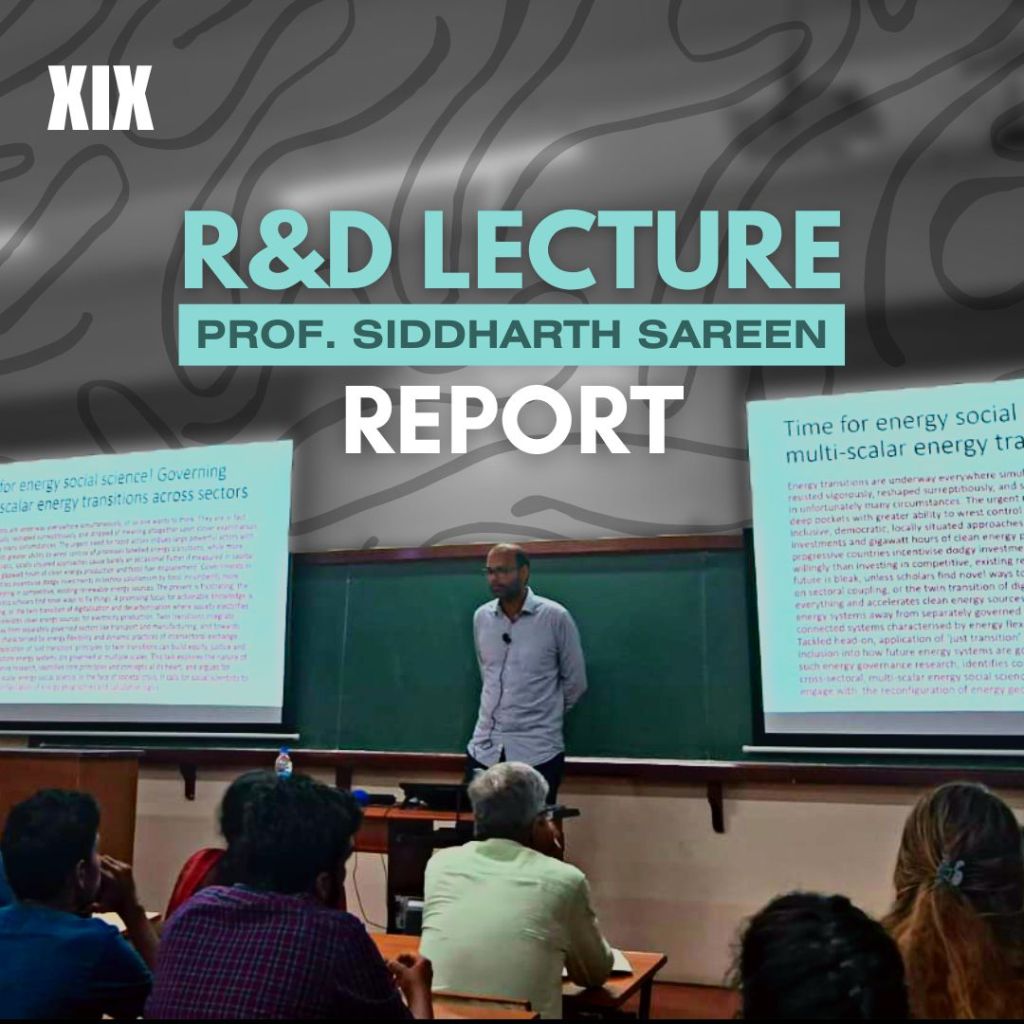
On the 11th of August 2023, the HSS Department was fortunate to be able to conduct a lecture by Professor Siddharth Sareen, a student of the first Integrated MA batch (2006-11). Sareen, who serves as a Professor in Energy and Environment at the University of Stavanger, and a Professor II at the Centre for Climate and Energy Transformation at the University of Bergen, furnished the students who attended the lecture with a detailed and well-researched analysis regarding the governance of “multi-scalar low carbon transitions across sectors.” The lecture included a presentation by Sareen, followed by a Q&A section between Sareen and the attendees.
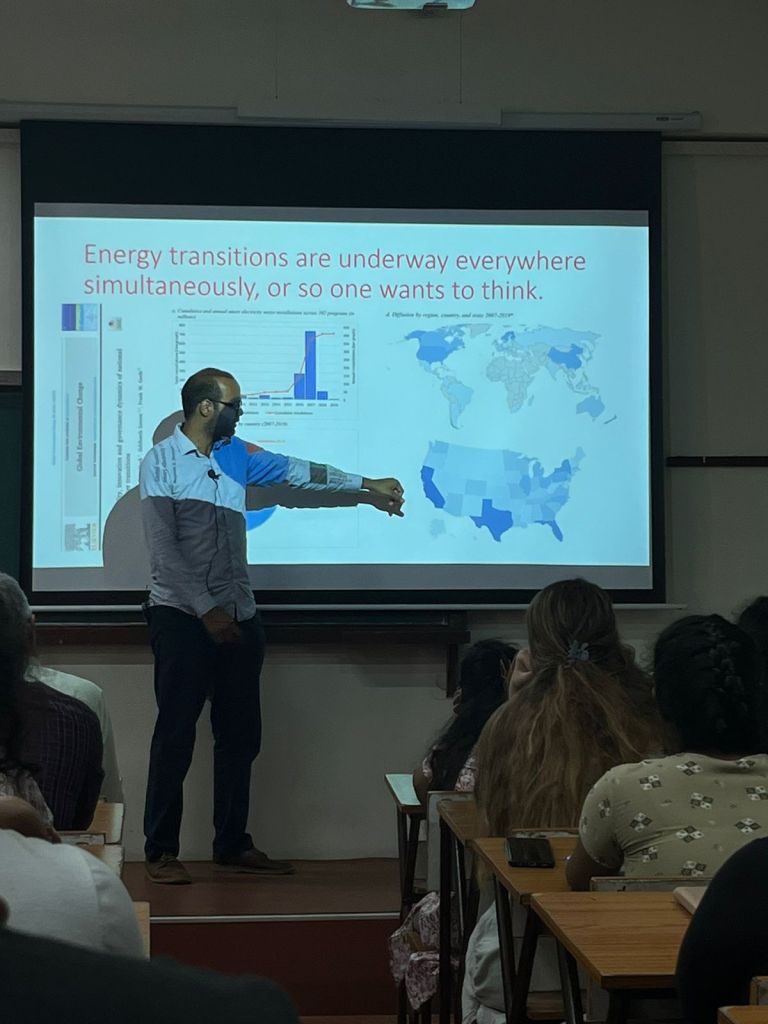
In the session, Sareen began by addressing the common misinformation that the transition to low-carbon emissions is “underway everywhere simultaneously”. He demonstrated how even in developed western countries, such as the United States, the transition has been successful, albeit limited, in only a few states such as California. He further elucidated the resistance which such transitions face, and how they are often diluted down to meaninglessness. He elaborated on how they are trying to illuminate how obfuscation is happening as an essentiality in ethics of quantification.
Sareen then talked about Smart Grids – which mark a new development on the path towards greater consumer empowerment – and the Multiscalar Practices of Fossil Fuel Displacements of Portugal (2017-20) and such practices, which have endured mixed results. He rather advances the concept of dispensing solar power to the people as a democratic, locally situated approach towards fair energy transition in Europe. He talks about the application of such an approach through legislative fronts in rural France, Spain and Portugal in accounts to the creation, growing and management of energy communities. He talks about the hundreds of houses which have been established as clean energy communities through the help of companies in Portugal who profit by being the middleman due to the absence of bureaucratic red-tape.
According to him, techno-solutionism in this field, despite the presence of numerous innovations, have reproduced a key failure of the past – monoculturing. He says emergent low-carbon experiments are unlikely to break with the auto-mobility regime and thus policies must enact scalable, integrated solutions with shared mobility services. Sareen further elucidates that the method of avoiding monoculturing is through institutional, accountability, socio-material change.
Sareen says that the “present is frustrating, the future is bleak, unless scholars find novel ways to fix things”. Some of the novel ways imparted by him during the presentation were producing and situating actionable knowledge , critically reframing discourses, and connecting actors and processes. He provides the example about how increasing metro lines should go hand in hand with sensitisation regarding choices, such as not buying a car, and using the metro service (public service) and question regarding the temporality of energy transitions and subjects such as ephemerality, permanence, and local transition pathways must be laid out as well.
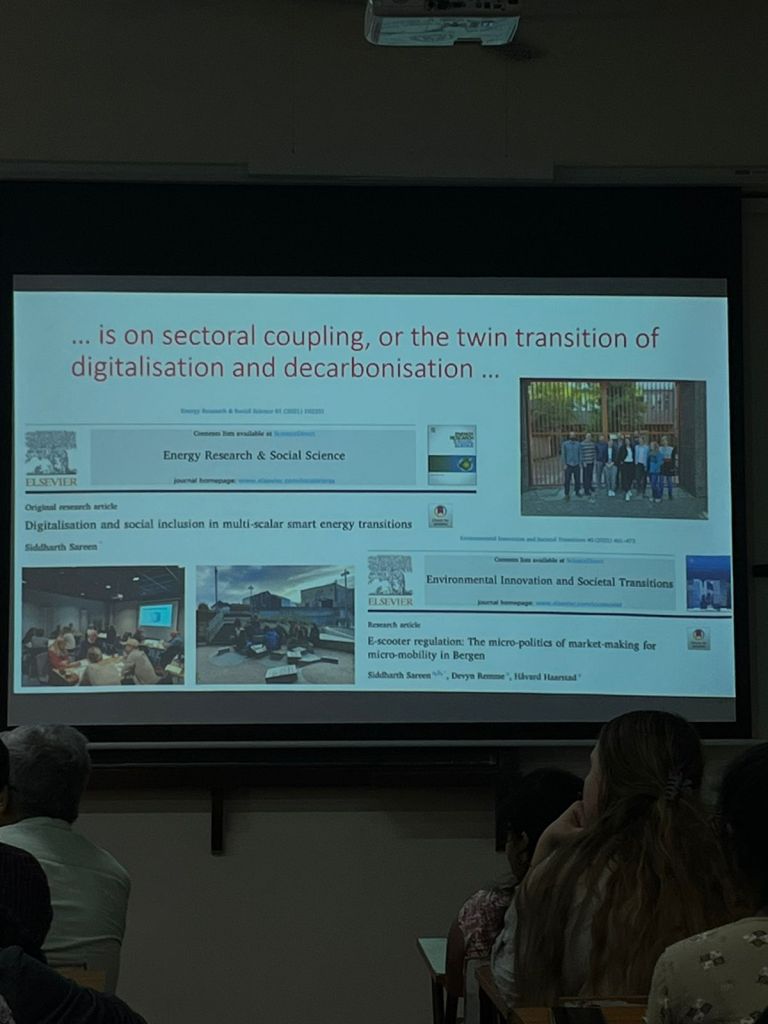
According to Sareen, the easiest way to move on from carbon is to move to electricity – such as smart devices and that digitalisation and decarbonisation are twin reforms. He says that “the twin transition of digitalisation and decarbonisation where society electrifies everything and accelerates low-carbon energy sources for electricity production.” He demonstrates how such a transition makes financial sense, and that any decision making and policy implementation on this subject must be inclusive, aligned, and shall necessarily come along with a shift in underlying processes and mechanisms away from incumbency and infrastructural legacies. He further elucidates the essential steps of shaping energy, enacting metrology, and reconfiguring metrics.
After the conclusion of his presentation, Sareen took a few questions from the attendees to address significant queries. As the answer to one such question, Sareen addressed the “car-centric-ness” of public transport and urban planning in modern cities including Chennai. He talks about how incentives must be implemented against the usage of cars, and gives examples of cities such as Paris, with its increasing bicycling lanes, and Barcelona.
Sareen also answers another question regarding the balance of “smart and privacy” and the increasing worry of surveillance capitalism. He says that while surveillance capitalism needs proper regulation, banning it is not a viable option. He says that the presence of severe sophistication from Silicon Valley and their technocrats deems the requirement of proper complicated regulation compulsory. He also says that subsidization through tax money of gas is not, in the long term, feasible and this field needs long term solutions to make electrical bills affordable for the general populace. Throughout the presentation and after, Sareen referenced and cited his own research and provided several sources to the attendees to learn more regarding the relevance of social science in the field of energy transition and the intersectionality of digitalisation and decarbonisation.
Report by Swapnaneel Dan
Photographs by Yatin Satish and Swapnaneel Dan

