
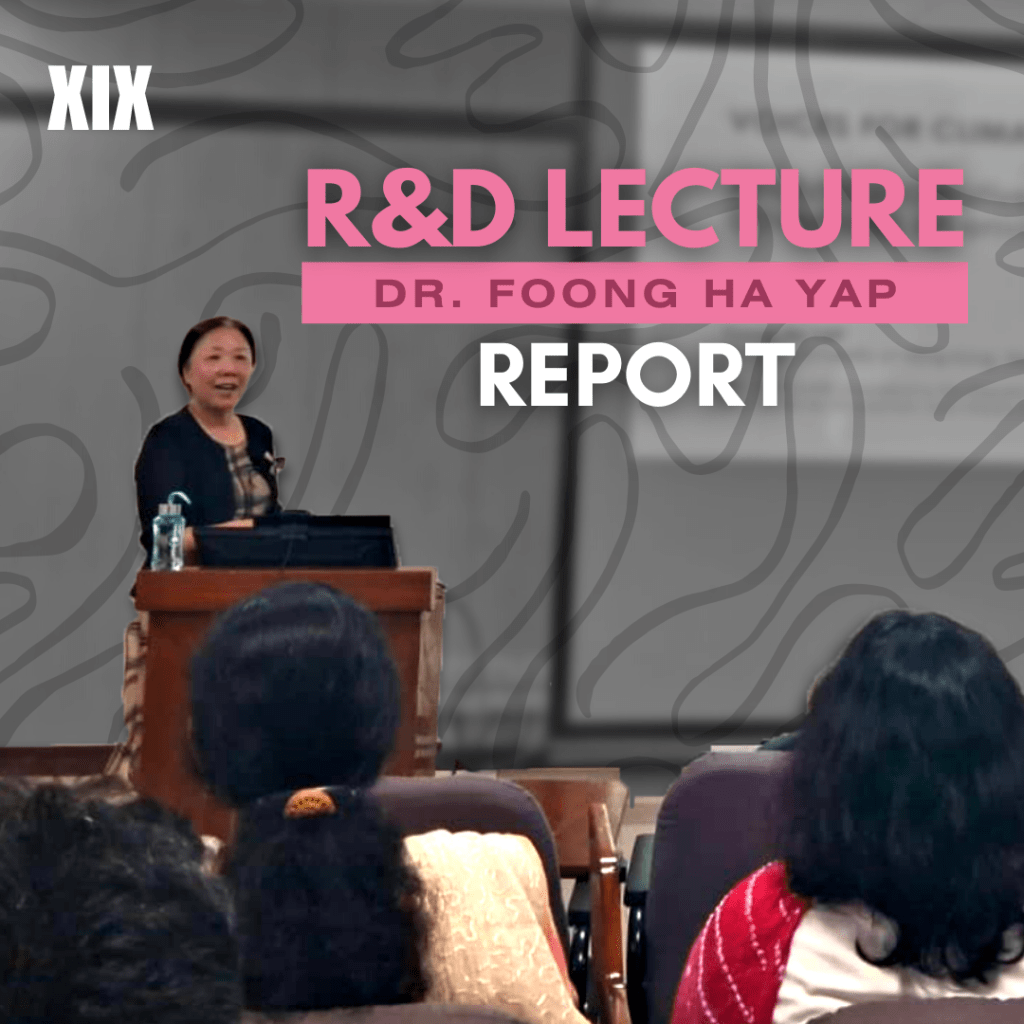
On the 23rd of August 2023, The Department of Humanities and Social Sciences, in collaboration with the Centre for Atmospheric and Climate Sciences, IIT Madras, organised an R&D Lecture titled “Voices for Climate Change: Analysis of Creative Public Service Advertising on Environmental Issues.” Foong Ha Yap, Associate Professor at the Chinese University of Hong Kong, Shenzhen delivered the talk, drawing from her expertise in the fields of Applied Linguistics and Discourse Analysis.
She was introduced to the audience by Avishek Parui, Associate Professor from the Department of Humanities and Social Sciences, IIT Madras.
Foong Ha Yap’s talk sought to look at public service announcements (PSAs) addressing climate change using the lens of discourse analysis. She began the talk by underscoring the pressing need to care about climate change, stressing on its human-initiated nature, and how it is our collective responsibility to take action. Discussing briefly pieces discussing “How to Grieve a Glacier” by Marybeth Holleman and Lacy M. Johnson, she looked at expressions of ecological grief which looked at glaciers as living entities, which “crawl” and are even “calved”, simultaneously emphasising the role that these marvels of nature play as memory banks and time capsules of the past.
Fear and hope were two diverging tactics which are usually used a strategy to spread awareness in PSAs and other varied media which seek to send out an environmental message.
Foong Ha Yap chose to look at the most viewed environmental protection video series of all time – the “Nature Is Speaking” series of videos – starring celebrities who “voice” different aspects of nature. For example, Penelope Cruz is Water, Harrison Ford is the Ocean, Liam Neeson is Ice, and Julia Roberts voices Mother Nature herself. What themes and strategies are deployed in these ‘blockbuster’ PSA videos. This is what the talk strove to examine.
Fear appeal is certainly an aspect – using multiple voices to send across one single coherent theme: “Nature doesn’t need humans; humans need nature.”
Through the talk, Foong Ha Yap used research by her students to demonstrate her points.
Using the framework of move structures, which involve a series of rhetorical “moves” or “steps” which contribute to the coherence of a communication act, Foong Ha Yap sought to deconstruct the rhetoric of these videos. She noted the remarkable similarity that the videos display in their similarity to the “Letter of Appeals” genre by measuring similarity in terms of five aspects which contribute to the genre- the lead-in, the request, the justification, the solicitation, and the “ending with pleasantries”. In “Nature is Speaking”, as in line with its emphasis on fear appeal, we see no initial offer of respect in the lead-in, and neither do we see the “offer of pleasantries” towards the end. Nature seems to speak authoritatively, with finality.
Looking at the spectrum of the entire series of videos, Foong Ha Yap identified obligatory “moves” across the videos which necessitated an introduction, a justification and a request; and optional “moves” which included backgrounds and suggestions. She went into further detail, analysing these categories with some very interesting insights.
She pointed out that the “request” in these videos is in the form of text at the end of the video, and is not “spoken” by nature. It is an appeal from fellow humans, rather any continuation of a warning from nature.
Summarising the findings of the move structure analysis, Foong Ha Yap concluded that the appeal videos are designed to arouse public awareness primarily from the perspective of respecting nature as a formidable force. The category of Introduction is used to establish Nature as a powerful life-giving force, while Requests are used to appeal to humans to stop harming the ecosystems supported by Nature. She also outlined a discernible move structure to the “Nature Is Speaking” series, which contributed to a general coherence through all of them, producing a cohesive, effective appeal message to the public.
Foong Ha Yap then went on to use another approach, which analysed the use of Metaphors in PSAs, once more utilising the research of her students to demonstrate her points. The example of a “Nature Is Speaking” video with Robert Redford and his daughter Lena Redford, playing a redwood tree and its sapling, was used to demonstrate the interplay of metaphor in the videos. The video, as Foong Ha Yap demonstrated, thus begins to employ dialogically constructed, multi-layererd conceptual mappings through the conversation that the parent and child have about the world.
Two important theories centring around metaphors were applied in relation to this conceptual mapping – Lakoff and Johnson’s Conceptual Mapping Theory, and Faconnier and Turner’s Conceptual Blending Theory. The use of the latter framework deconstructs the original metaphor’s role, as the parent-child metaphor with the redwood and the sampling is superimposed onto the nature-human relationship, as the metaphors in question blend. Conversational analysis reveals the elder redwood providing long, authoritative answers which evoke higher status, and credentials of an ancient wisdom, as opposed to the precocious, innocent, child-like voice of the sapling. Foong Ha Yap also underscored the point in the research paper which mentions how humanity is “othered” in the video, attacking the idea that humans are somehow the “stewards of nature”.
This same stripping away of assumptions is noted in reference to the “Mother Nature” video, where Julia Roberts plays “Mother Nature”. In this video, Nature is seen as a formidable, untouchable “other”, devoid of motherly characteristics, and its “caregiver” status. There is a complete rejection of the tradition interpellations where human anthropomorphise nature as a motherly “provider.” Nature this deconstructs itself through violence on metaphor. This is also reflected in the multi-modal analysis that Foong Ha Yap applied to the video, noting Roberts’ measured, detached and indifferent way of speaking, the grand instrumentation, and the lack of “human visual” in the sweeping panoramic shots of nature. Oral and visual metaphors which map to to each in term of the audio and visual were also noted, such as the word “thriving” juxtaposed against a visual of mushrooms growing rapidly, and the word “faltering” juxtaposed against an iceberg breaking.
After a very interesting talk, with insights that go far beyond this summary, Foong Ha Yap summarised her talk by noting that the “Nature Is Speaking” videos overturn the conventional views of some interdependent human-Nature relationship by breaking the narrative of a motherly, caregiving Nature. Different modes of communications – as demonstrated by the application of various frameworks – are strategically employed through these videos. The videos in question thus serve as “creative exemplars” for other PSAs.
With this, Foong Ha Yap ended her talk. After a brief question and answer discussion, she was felicitated by Professor Swarnalatha from the Department of Humanities and Social Sciences, and tea and snacks were served for all.
Report By Yatin Satish
Photograph By Yatin Satish
 Article 19