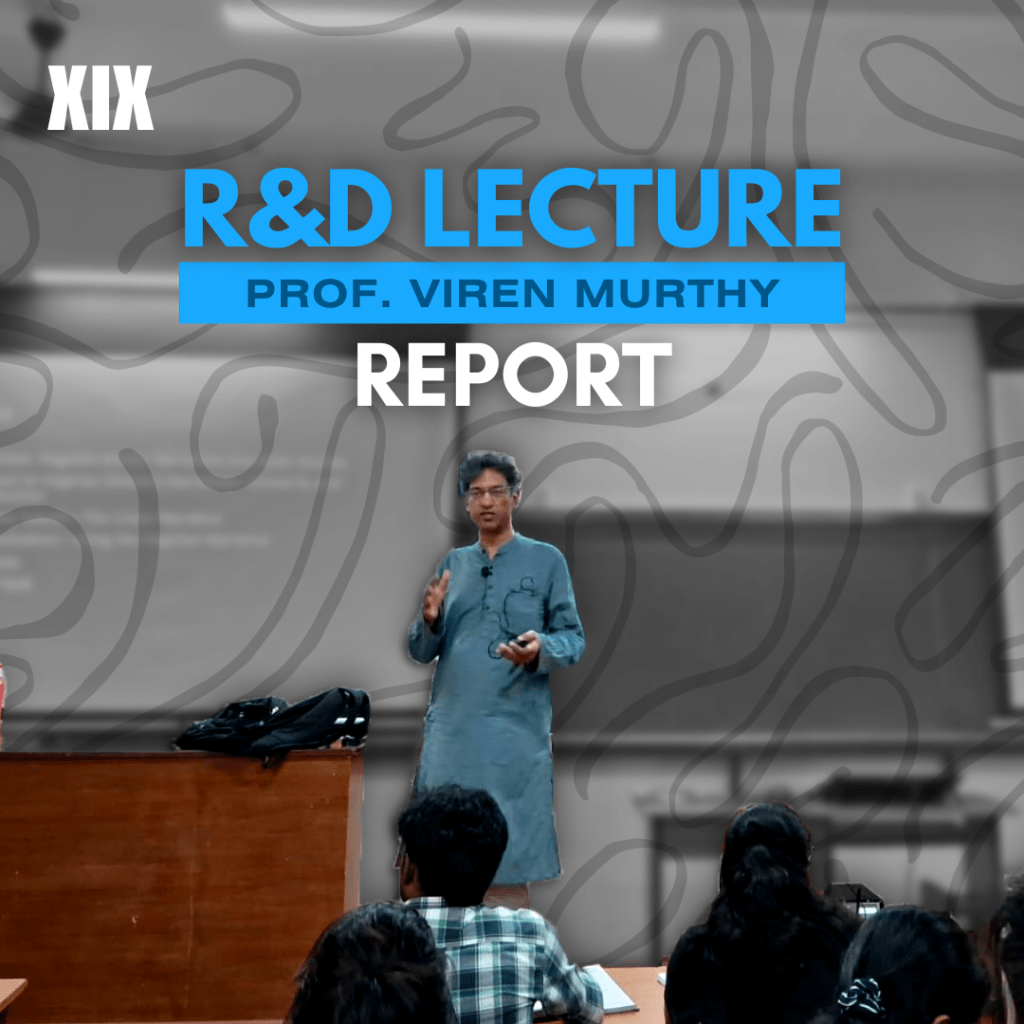
On the 25th of August 2023, Viren Murthy, Associate Professor of History at the University of Wisconsin-Madison delivered a lecture at the Department of Humanities and Social Sciences, IIT Madras on “Periodising Chinese and Japanese Modernity via Hegelian Master Narratives”. He was introduced to the audience by Solomon Benjamin, Professor at the Department of Humanities and Social Sciences, IIT Madras.
The main body of the talk involved Murthy looking at the responses of Japanese and Chinese thinkers in the 1930s and 1940s to Hegelian Philosophy.
Murthy began by addressing the perception that scholars have of Hegel’s work as a lynchpin to Eurocentric triumphalism, and Asian studies’ love-hate relationship with Hegel. He insisted that simplistic critiques which dismiss Hegel entirely on these grounds don’t fully grasp the conceptual nature of Hegel’s work, or the potentially unstable relation of this same conceptual structure to global capitalist imperialism.
Critiques which consider an Asian intellectual adopting a Hegelian narrative as self-colonisation or delusion, must take into account the assumptions it makes with regard to ideas emerging from absolute autonomy, and a narrative of emancipation presupposing an idea of a shared temporality. Why is Chinese and Japanese history not periodised the same way Europe famously was?
Murthy then laid out his agenda for the talk. After his initial introduction to Hegelian Master Narratives and Asian Studies, he would go into two types of Asian responses to Hegelian narratives – Linearity and Provincialisation. Using Fukuzawa Yukichi as a demonstrative thinker for the approach of Linearity, he would then look at Iwao Koyama, Mizoguchi Yuzo and Wang Hui as examples of the approach of Provincialisation.
Beginning with the linear approach of Fukuzawa Yukichi, Murthy talked about just how central the historical events like the Meiji-Restoration and Sino-Japanese War 1895 were to Fukuzawa’s theory of history. The Meiji-Restoration in particular, as an affirming of indigenous culture, and of civilisation and enlightenment. An early advocate for reform in Japan, Fukuzawa looked for subjectivity in Asia, and spoke of the “spirit” of civilisation in Asia moving towards greater levels. He did not focus too narrowly on this linear progress, but also incorporated aspects of Chinese civilisation that moved to Japan, and attempted to frame the “actuality” of China and Japan.
Looking at the Provincialisation approach now, Murthy moved on to Koyama Iwao. Koyama’s approach sought not only to think about the narrativisation from different centers, but also to think about it in terms of critiquing modernity as well. He spoke of an Alternative Modernity for Japan, for which Murthy contextually brought in Frederick Jameson’s critique of the underlying symptom of singular modernity – the structures of capitalism. Koyama’s modernity once again treated Japan’s Meiji Restoration as a pivot point, splitting Japan’s modernities into pre-Meiji Restoration and post-Meiji Restoration. He sought to relativise history, in order to create a new universality that Japan would make possible.
Murthy moved on then to the next thinker in this approach – to Mizoguchi Yuzo. Mizoguchi’s valuable critique to Japanese historians, advising them to rid Japan of their mind while speaking of China, was valuable to his attempt to uncover the internal logic of Chinese history using Hegelian narratives. Mizoguchi periodised Chinese modernity in the Ming-Qing periods, and focused on Chinese intellectual history. He sought also to question the usual periodisation of Chinese modernity with the Opium war stimulus response, and rethought the significance of 1949.
Murthy then moved on to Wang Hui, who was influenced by Mizoguchi. He sought interestingly to look at the 1911-1976 period of China, choosing to splice the period at the death of Mao Zedong. Wang Hui also looked at post-1978 Reforms, and reflected on the difference of temporalities across the West and the East, and how the “Century” itself came to be known in the way that it does now, only after the 20th – a historical passing which altered ideas of temporality in a manner that was particularly Western. Wang Hui thus said that “China has no nineteenth-century”, in the same way that Europe did, and Murthy underscored the consequences of that view on how the Chinese perceive “the century of humiliation”. Murthy then reflected on, in the context of Wang Hui, “the moment of the political”, the logic of action, politics and military strategy, and passingly, on Karl Schmitt and Lu Xun. He also raised the question of the crisis of the critique of teleology, connecting it to the analysis of the actuality and determinacy of the Chinese Communist Revolution post-1949.
Concluding, Murthy reflected on Wang Hui’s project of history, as one that must somehow make the Chinese Communist Party the very embodiment of the world historical project of socialism. In the Hegelian narrative context, Murthy says we can interpret Wang Hui and scholars of his ilk as attempting to guide the CCP “beyond capitalism”, and pondering the question of what makes a post-capitalist ideal possible today. With that, Murthy concluded his talk.
Report by Yatin Satish
Picture byYatin Satish
 Article 19