
“God is the only being who, in order to reign, doesn’t even need to exist”
Baudelaire’s sinisterly divine verse, displayed at the start of Emir Kusturica’s documentary ‘Maradona by Kusturica’ (2008) captures perfectly the brief interstice between the human and the divine in football. Only football can manipulate the world around a ball with a poetic divinity that sculpts gods out of mere men. Diego Armando Maradona, one of the greatest to ever touch the ball, in the 1986 FIFA World Cup Quarter Final, dribbled past four English defenders and goalkeeper Peter Shilton in a 10 second, 60-yard dash to score the ‘Goal of the Century’. And just four minutes prior to that, he’d avenged Argentina against England, for the Falklands War, by scoring the revolutionary ‘Hand of God’ goal.
This goal, that he enjoyed like “stealing an Englishman’s wallet”, best depicts the football ground, spanning beyond a mere venue of consumerist entertainment, into a spectacle of political revolutions, profound deceptions and divine incantations, where the ordinary human for 90 minutes can play Prometheus. The backyards and favelas of South America exude the mythological and lyrical lifelines of football. India is no stranger to the religious obsession with football. Kozhikode or Kolkata could perhaps be more strongly polarized over the support for Brazil and Argentina than other social factors. It is that ability of the game to render a different collective identity, blurring national, religious, gender lines, and erase rationality into a stream of frenetic anxiety that takes it to the realm of the divine.
After 1986, Argentina fans have waited every World Cup since to have another chance at revelry, idolizing many as the saints who would bring joy to the land pillaged by neocolonial shock therapies and inflations. Aimar, Batistuta, Riquelme and others tried and failed. And then there was Leo Messi, born only two days after Maradona lifted the cup in 1986. He became the terminal hope of a nation in a trophy drought. But 2010 saw an Argentina team, coached by Maradona, leave the tournament humiliated by Germany. In 2014, now a captain, Messi was denied a hairbreadth’s distance from glory in the cup final, by Germany again, from Mario Goetze’s stunner at minute 113. A collective feeling of indignation and abandonment pervaded fans of Argentina as Messi walked past the trophy, defeated. Argentina’s hope of a trophy remained distant for the next two years in successive Copa America finals. Messi announced retirement from the national team, and failed the hopes of his nation and their unmatched idol, Maradona. He returned from retirement in 2018, but the metric of absolute glory, the World Cup, eluded him once again, and Maradona, the greatest revolutionary of football, died without witnessing poetic justice.
Flash forward to 2022, when Argentina had an impeccable squad and a confident, pragmatic manager in Lionel Scaloni. They arrived in Qatar with two international trophies in hand. Fans all over were once again brimming with hope, only to be ridiculed by Saudi Arabia, losing 2-1 in the first match. Watching the game in SAC, I felt stripped. This was a new low, and entirely unexpected. But every match after that was a tactical struggle, curated to match each opponent and earn a win. The drama of every match would have put an HBO series to shame.
And then came the final. Lusail Stadium. December 18. Many giving not a damn about the endsem exam the next day, flocked into OAT to watch what would be christened the greatest spectacle in footballing history. To witness the dream of decades, come true. I’d entered OAT earlier, securing my spot among restless fans and families. The gallery filled, the screen lit up, and soon, many of us occupied the bowl, stitching our senses to the screen. From the first whistle, hope and anxiety infused into blood, rationality vanished and breath was suspended. My atheist friend, befriended superstition like a true Argentinean, and stayed in his room so that we’d win. All markers of identity were temporarily shed, and there was only a sea of Argentineans synced in a pool of tremors, and the others, who wanted to see anything but Messi lifting the World Cup.
23rd min, Messi scores.
Muchachos, ahora nos volvimos a ilusionar, (Friends, now we can dream again)
36th min, Di Maria doubles the lead.
Y al Diego, en el cielo lo podemos ver, (And Diego, we see him up in heaven)
Half-time.
alentándolo a Lionel. (cheering for Lionel)
80th min, Mbappe scores a penalty. And a volley the next minute, a bullet right into the gullet of the goal. The familiar hopelessness hit me instantly. I was beginning to regret orbiting the bowl in full sprint after the second goal. Despair pervaded the theater, and there was a drop in the collective blood pressure, and in the cheers. My vision blurred and all sounds were swallowed.
108th min, Messi scores again. 10 minutes in, Mbappe retaliates. Restlessness ate the crowd. At the very last minute, France’s Kolo Muani leaps up to goalkeeper Emi Martinez, solely guarding the Argentinian post. All breaths clutch for a second, Muani blasts it, Martinez blocks it with his left calf, and the world breathes again.
Into penalty shootouts, the slow torture that every football fan deserves. First shot, Mbappe dashes it into the left end, escaping Martinez narrowly. Messi, “the little boy from Rosario, Santa Fe”, takes his turn, almost mockingly leaving a groan of a shot past Hugo Lloris into the goal. Just 20 minutes ago, I was held upright by friends against dropping blood pressure and rising temperature. Now I was back on my feet, glued to the screen. France’s Tchouméni and Coman denied, Argentina’s final shot was taken by Gabriel Montiel, who clarts it into the bottom left corner. I was back sprinting already, dashing through delirium.
“Scaloni will be fated, Messi will be sainted”
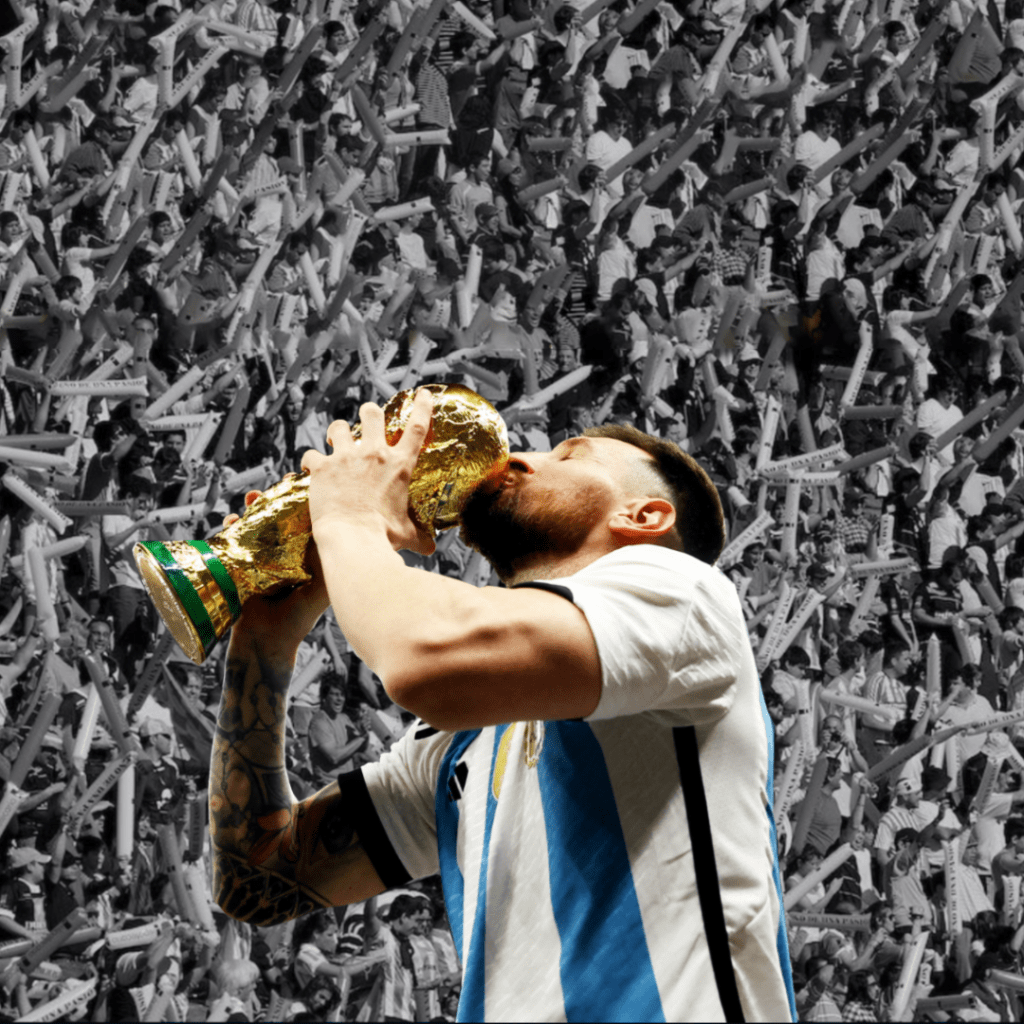
Peter Drury’s words served the ceremonial climax to the 2022 FIFA World Cup in celestial lyricism as we huddled up in front of the screen, with beaming faces and full eyes, watching Leo Messi lift the World Cup, an image of imagination, now stretched on the white screen. Michelangelo’s ‘The Creation of Man’ was recreated, as the fingertips of Maradona and Messi kindled the contact of gods. There are few moments in history that one can distinctly remember- where they were, what they were doing, who they were with. And on December 18, 2022, I was drowned in a sea of pounding eyes, our veins full with existence, witnessing the greatest night of football.
Edited by Amirtha Varshini V C
 Article 19