
Siddharth Sareen is an alumnus of HS06. He is currently Professor in Energy and Environment at the Department of Media and Social Sciences at University of Stavanger, and Professor II at the Centre for Climate and Energy Transformation, University of Bergen. His work broadly focuses on the areas of energy governance, human geography, political ecology, and energy poverty.
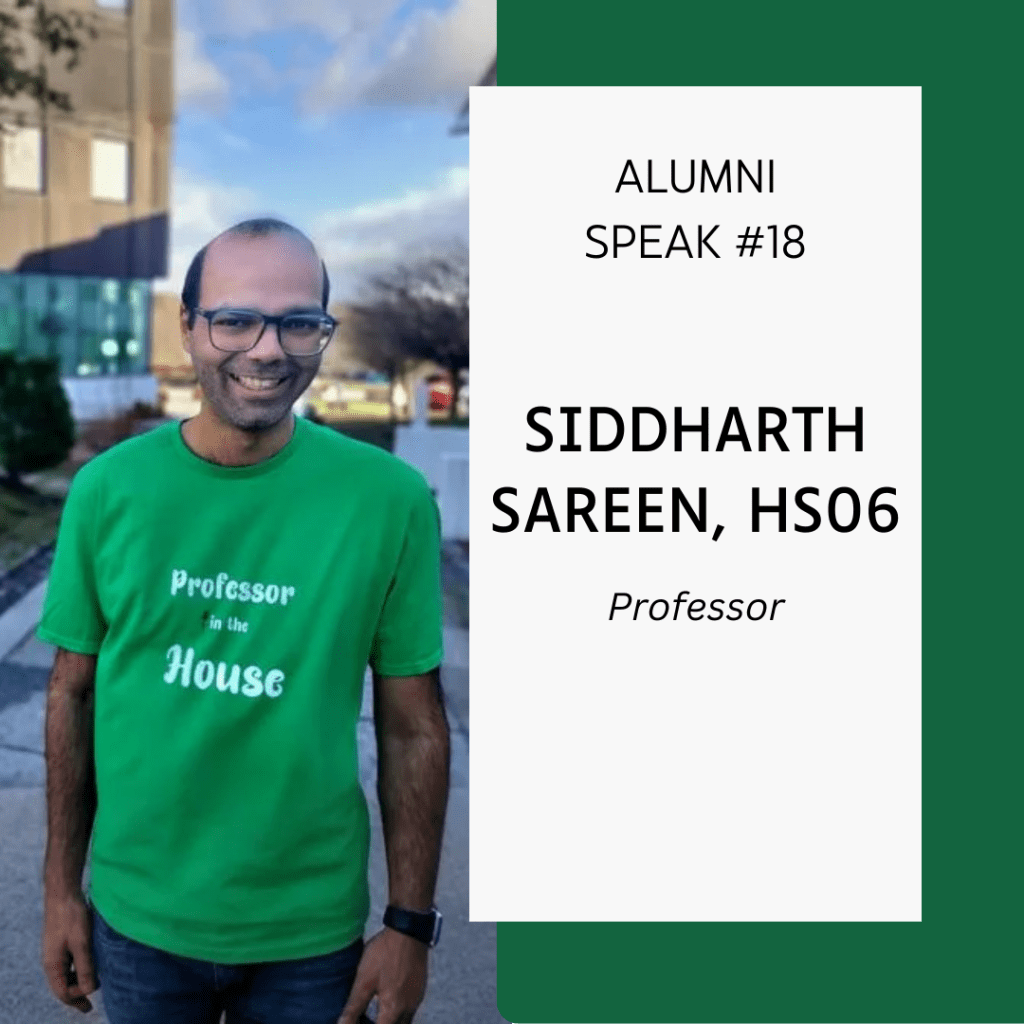
The following is an excerpt from the interview with him:
So what’s it like to be back on Campus?
It’s super nice. There’s a lot of memories tied up with this campus. I took a little walk to see how much the trees around Tamiraparani, my hostel, had grown – I sent some photos on a group from the old batch and somebody said, “I can’t even believe it, this looks like a forest.” We used to play street cricket around there.
So, what was the campus like in 2006?
Yeah. I mean, a lot of it was similar in that it takes a while to get to the Main Gate. (Laughs)
I used to be on the athletics team, so I went by the stadium and they’ve built up a little bit there as well. So there’s a few changes – Gurunath is gone, that was a huge change. You just had the 60th Convocation, and ours was the 50th, even though it was 12 years ago. Also reminds you that a couple of years of very strange times happened in between, with the pandemic.
The last time I was back was eight years ago, and that’s a while, but yeah. A lot of things are the same as well, which is nice.
What about this specific area? (Gesturing around the area outside CLT)
Ah this was very similar, except the solar panels on there – which I quite enjoyed seeing! I think that came up in 2015.
So what made you join this very brand new course in 2006?
It’s funny, just earlier this week I was at my old school at Rishi Valley, where my little sister is studying now. My former Maths teacher – she’s the senior school coordinator now – was the one who gave me a newspaper clipping back in 2006 and said that it looks like something for you.
I wasn’t sure if she meant it as an insult. (Laughs)
I wouldn’t have known about it otherwise. I had very broad interests. I didn’t want to commit to one subject. I liked everything from theoretical Physics to the Social Sciences.
Like, you know, I like writing. I wanted to develop some analytical ability. I wrote the entrance in Mumbai. I think we had about 3000 Applicants in all, about 85 were at that centre, a very small one. And I’m pretty sure that Milind Brahme was one of the invigilators.
I remember I was so badly prepared that I didn’t even have an eraser, and this was a multiple choice thing. And that I hadn’t studied for it. One of my school mates handed me her big books that she’d been using to prepare. I had to ask the invigilator about six times if I could borrow an eraser from the girl behind me. And each time Sir would go. I wouldn’t have made it here otherwise.
I think quite a few people here relate to that feeling of unpreparedness during the exam.
I think it’s quite nice. What is being prepared? I think you’re unprepared in a sense, in another sense, all of life is perpetual change.
So, the programme was a good fit also in that all the batch mates I had and the ones in subsequent years did have a certain set of competencies and interests. A broadly talented bunch of people. It was a curious coincidence – or maybe not – where for the first several batches every year two or three people from my high school would crack the Top 30 – a miniscule possibility. You had people with that kind of open interest – like we don’t necessarily know what we want to do and we don’t have our whole life mapped out and very defined.
What expectations did you come into the course with and how far did the course live up to your expectations? Especially considering that this was a very new course with no one else who had done this before.
So I got a call from my Dad, I think, that I had got this letter home and that I had gotten into this programme. I was in a tiny Gujarati village called Nargol with a friend. I said I was too busy playing a game of Scrabble, so call me back later. (laughs) Then it kind of sunk in. I went for a swim in the sea and got whacked behind the knees by a jellyfish, which stings like mad. And so that’s what I mainly remember, (laughing) standing by the village well, dumping water and quite unhappy.
To answer the question more seriously, I guess having lived in the Nordics many years, one of the cliches about that is that with some truth – as many cliches have – is that you have very low expectations, which is why you’re very happy. And I guess I didn’t have very defined expectations.
Then I asked around with family, friends and people who knew Chennai in that context and really liked that it has a campus because I’ve grown up in nature. But I also like culture, and that you’re in a fantastic city where you have the possibility to go to Music Academy, or Kalakshetra. And go to the beach!
But the fact that we were the first batch meant there were a lot of resources around – in the sense that we had basically as many Professors as we had students. So the relationships we formed with the faculty were quite special, in that we started with 30 of us.
By the time we were done, there were more than 150 – then they just had that much more of a student population to spread their attention around, and then the research scholars and so on. Also it wasn’t like you only have the Department. You have the others you live with and you have all the BTechs and a lot of fantastic people around – many of them still friends I bump into here and there.
So I think all of those things are important to me. A vibrant cultural and sports scene on campus, those facilities. Life in Chennai was fantastic. I wrote a piece in the Fourth Estate or the Fifth Estate a while back –
It’s the Fifth Estate now.
Ah. It was about some of these different green initiatives. I was caught up with the wildlife in those student years, and I think the fact that IIT is not some remote campus far out also allows for you to plug into different things going on.
Who were some of the Professors who really influenced you? Maybe during your five years here or even afterwards?
I think there are several, in different ways. I really liked Swarnalatha’s classes. I thought she was just fantastic – the pedagogy as well. I took a lot of literature courses. I was interested in that – wasn’t my major, wasn’t my minor, but I had that interest.
I really enjoyed Milind’s classes. I learned German and then I’ve gone on to learn Danish and Norwegian – I give public talks in Norwegian. I talk to people about policy in the Germanic languages. So that was kind of the basis. The connection there – he was also my Master’s Supervisor – was more of a human connection, in terms of working in a particular way. I like a flat hierarchy. I like being able to focus on the value of learning, and interactions for their own sake, regardless who you’re speaking with. That also stayed with me.
I chose, for instance, Copenhagen over Oxford and other places where I had PhD Offers, because to me it was really important to go to a context like the Nordics, where there’s a flat hierarchy.
That’s not a comprehensive list. I think there’s a lot of people who influence you among faculty – I also really enjoyed chats with Chella Rajan. Many people wouldn’t know him, but also Chaudhary Sir – he retired a while back – he was great.
In the first year, we had the late Mattison Mines who was here from UC Santa Barbara on a sabbatical at the time, and took some Anthropology Courses. He was also instrumental in facilitating access to some Social Science journals like JStor and such. Otherwise the library mainly subscribed to engineering journals.
You know, early years you get through a lot of these things, some of the positive aspects of being a sort of Guinea Pig batch, with the Professors also learning by doing, right?
[Professor Suresh Babu M. (SBM) approaches cautiously.]
SBM: Sorry to disturb you, I could not meet you.
Sareen: No, not at all. we’re talking about you! (Laughs)
SBM: So. So how are you? Sorry, I’ll just take a minute, I could not meet him because he was at the centre of the talk. (Smiles)
Sareen: They asked me which Professors had been important to me.
SBM: So how are you, Siddharth?
Sareen: I’m good.
[Recording pauses as Sareen and SBM exchange greetings. Professor SBM kindly agrees to sit in for a few minutes with us as well.]
Sareen: [Gesturing at SBM] We hung out for several days in Copenhagen, when you’d come to visit, and Milind – with families. There’s also this deeper sense of connection you get with the faculty, who also sort of become friends, along with guiding you – someone you call a friend.
SBM: Of course, you are! (Smiling at Sareen) He was a very ardent cricket fan – so that time Mohan was his… Mohan was your cricket – [laughs].. [turns back to interviewers] So there was another Professor Mohan. So every time I cross the veranda, I can overhear some conversation about yesterday’s match – “Actually that wicket was a crucial one.”
Sareen: We had a staff-student match. I remember Muralidharan Sir was the head then and I remember I bowled him, so.
[SBM and Sareen laugh]
We were just going to ask you. What extracurricular activities did you take up apart from your academics?
Sareen: Oh, several. Some of us would go on turtle walks. January to April is the season when the turtles eggs hatch.* So we’d walk every Saturday night, starting at Neelankarai at 11:00 PM and then walk all night up past Besant Nagar. You’d meet all these fantastic people; and you’d learn a lot from them.
You’d then typically go to the tea kadai, have some juice, maybe a bread-omelette. And if no bus was going to run for a while or no auto agreed to ₹50-60 back then, you’d just walk another 4 kms back to campus, have breakfast and then crash.
I also ran with the Madras Hash House Harriers. They call themselves a drinking club with a running problem. You’ve got people who are ex-marathon runners and others who can barely walk, all united by a common love of exploring different parts of town, and of course, socialising with some beer. (laughs)
I wrote for the Times of India. I did 120 stories for them. That was really fun and a good bit of pocket money as well, for travelling on weekends, and things. This usually meant talking to a lot of people, sometimes Bollywood celebrities, sometimes people who came to campus or conferences, sometimes going out into town to find a story to cover. That was useful.
I was introduced to V. Suresh, a lawyer, and at the time, the National Secretary* for the PUCL – People’s Union for Civil Liberties. I think it was Milind who introduced us. My classmate, Ashish Gupta and I both spent the summer interning with them. I don’t think I contributed as much as I learned from that.
We also worked with Karen Coelho at MIDS, and her partner, Nityanand Jayaraman*, an environmental journalist. He was a big part of the Corporate Accountability Initiative and the Bhopal movement, which was quite active in Chennai as well.
Dow Chemicals had wanted to hold on-campus placements* and that became quite a big fight. Some of the chemical engineering students were looking for placements (at Dow Chemicals) after they graduated, they were one of the more sought-after employers. We took a stand that we needed some sort of ethical prioritisation. You can’t have on-campus placements of the company that’s still got cases sub-judice for corporate lack of accountability against people in our own country, the CEO going scot-free. They valued the lives of Americans far more than the Indians in Bhopal, after a disaster that they were really culpable for.
Being part of that and seeing some of the same chemical engineers who had been critical of our opposition come around, donate and sign postcards to the Prime Minister and contribute that money to concerts at Spaces in Besant Nagar, that was really useful.
We put together a newsletter called the Views Paper, around 10-20 of us. We distributed 5000 copies overnight. So imagine printing those outside Taramani (laughs) eight sheets at a time and getting people to run around and put that under each door before 6:00 in the morning the next day. And we were running to a deadline because we had to go catch a train for Bangalore. I remember Ashish being really mad at me because we barely made it to that train. Lots of fun things but also meaningful things.
Considering your very diverse set of interests, what did you do your MAP in and did that help you in whatever you have done afterwards?
Sareen: I think everything helps you with whatever you do in the sense that your experience shapes you in very complex ways. The theme I took up was childhood poverty and access to education. I worked on a pedagogical model based on the school-in-a-box system that sprung from the Rural Education Centre, where I did my high school in Rishi Valley.
I was working with schools where students had very different experiences of education- some were from migrant families, some were more advanced in certain subjects than others. The school-in-a-box – instead of trying to teach a bunch of students at different levels, they would use classroom resources that would allow very limited human resources to operate in meaningful ways and then the teacher could be more of a facilitator.
Milind supervised my thesis and he was the third-party evaluator appointed by the National Government for state government schools in Tamil Nadu. Around 5000 public schools had embraced this programme and implemented it top-down across all public schools. I accompanied him and his research team to some of these schools and talked with the students and staff there to see how this top-down version was translated and made more contextually relevant to Tamil Nadu and how that worked along with the sort of understanding of where it stemmed from.
I guess in terms of doing interviews and trying to make sense of things across different scales, all of that stays relevant no matter what you do.
SBM: In fact, with this MAP, Milind and I got into the whole notion of how education can be inclusive, and we ended up with a book on inclusive education. Until then I also could only conceive of education as public policy and not this kind of pedagogical nitty-gritty. The starting point was his MAP.
Sareen: People from Würzberg and Regensburg!
SBM: Yeah, we had that exchange running for many years.
Sareen: And then I met Milind while he was in Germany and he came over to Copenhagen to visit around the time I was based there. The world really is a small place and it’s nice to see these connections over time and how they develop in curious ways.
We just have three more questions. What were some of your favourite hangout spots in Insti?
Sareen: I really liked going to the Andhra Mess, out of the Taramani back gate. I enjoyed going up on the roof of our building, I’m not sure if that’s politically correct. (laughs) I think it was quite popular among several people.
We hung out a lot at the computer lab late into the night and in those days, Tiffany would close by 1:00 and you’d lose your chance of getting your last filter coffee. There was always Quark, I believe it’s now called Zaitoon.
Quark was usually open until 2:00, but it was a bit of a walk and so typically if you were still there at 2:00 in the lab – What do you call it these days? DCF? – So if you’re still in DCF, you had to figure out who you could convince to get on a bicycle and go off to the main gate. There was a fruit juice and bread-omelette shop about less than half a kilometre after taking a right from the main gate. That was open throughout and you’d get things like butter fruit, banana shake and avocado juice. And so whoever would go there to thulp some stuff themselves, and if they were being nice, would cycle back to the lab with bread-omelettes for all of us, and that would keep us going for the rest of the night.
We pulled lots of all nighters. But you had to turn up on time, especially for someone like Mohan Sir. 8:00 AM and you had to be in class.
SBM: Properly dressed!
Sareen: I once got into trouble for coming in shorts, I’d just come back after athletics or something.
SBM: Yeah. Mohan was very particular about time. (SBM and Sareen laugh)
Sareen: I spent a lot of time on athletics, out on the sports field.
This was also around when the director at the time, M.S. Ananth, had this vision of getting students to write down their ideas on scribbled paper napkins. This was how the idea of the subsidised CCD came about!
What else? I don’t know if you can do that now, but you could go past SAC to the left and it turned into a kind of marshy area. There were lots of deer and you could walk towards the lake. Some nights we would camp out over there. I’m pretty sure that wasn’t allowed, (laughs) but it was good fun. I mean it’s not like you were trying to damage anything. You’d wake up and there would suddenly be like a hundred deer in the field nearby. And that was amazing.
I think Professor Solly was talking about how you liked cats.
Sareen: Yeah, I think you might be mixing up a couple of different stories there. (laughs)
I was spending the summer here on an internship and there was this cat outside Tamiraparani, and it was quite persistent! I was supposed to meet Milind to help out with something in his office and so I brought it along and then we took it over to his place.
I have never seen a child jump as high as she did when she came home and saw this cat. Clearly it wasn’t going to leave! That cat came to be known as Coffee. I think now there are eight. There are four indoor cats and four outdoor cats.
SBM: The population has increased in Milind’s house, no? (Laughs)
Sareen: Coffee’s children are still there, I think. Spot and Whistle.
I grew up with dogs. We’ve got a Portuguese water dog in Stavanger. He loves the sea! We had him in Portugal for a month before coming to India, and he gets a lot of attention when he’s there.
I think our final question has to be – what do you think about the Integrated M.A. Course being scrapped?
Sareen: I guess there must have been a detailed consideration before taking that kind of decision. My little sister is just finishing school this year and, in a sense I was sad that an option like that in the liberal arts, in the broad-based Humanities and Social Sciences isn’t available because on the one hand, there aren’t as many of those options as someone would like in India.
But on the other hand I noticed, since she was looking into this, that there are more options that have appeared that weren’t necessarily around then – some private universities, and things like that. Since I don’t know the thinking behind it, the way that I see it as probably an assessment of what the institution can offer meaningfully, and to what extent one can stretch the human resources of the Department when you’re dealing also with research scholars and research projects, then education at an undergrad level can be quite demanding.
And I will say that the kind of cohorts that have gone by over the years, I’ve come across many bright people and friends from junior batches that you meet over the years.
So there are these connections and I think that has produced a lot of right people doing good things. So if that happened for whatever 17 years, 17 batches then that’s a good accomplishment in itself. And it has served a purpose that is very valuable.
Hopefully we’ll see a lot of interest in the first batch already here. It’s nice that there’s people coming in. The Master’s I teach in Stavanger in Energy, Environment Society, we get students who come straight out of Bachelor’s in Sociology or Political Science. But we also get somebody who’s done journalism for 10 years, or worked in an energy company for 20 years. So you get a big mix of experiences and competencies in 40-50 people. That’s also a very interesting dynamic, to have a Master’s where people come in with lots of different backgrounds, especially because it’s quite a broad-based set of specialisations.
So I think both things are quite nice and maybe it’s not always possible to have everything you want, but… yeah.
Thank you.
*The interview has been updated for factual accuracy. We apologise for the same with thanks to Prof. Milind for pointing those out to us.
Design by Niranjana M
 Article 19