
The 13th Annual HSS Department Conference, held over the 6th and 7th of April 2024, was a noteworthy success. Presenters and scholars from various universities across the country came together at the Central Lecture Theatre, IIT Madras to discuss and present the numerous innovative ideas they put forward in their papers. Having covered a diverse range of themes in the past, the theme for the Conference this year was ‘Artificial Intelligence’. In addition to an exciting lineup of panels and presentation by scholars and students, the keynote speakers for the Conference were Mr Krishnan Narayanan, co-founder of ‘itihaasa Research and Digital’ and Dr Amandeep Singh Gill, UN Under-Secretary-General and Special Envoy for Technology on Days 1 and 2 respectively.
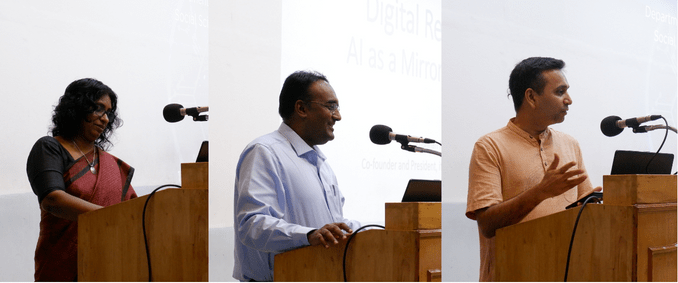
The Inaugural Ceremony was held on 6th April, the first day of the conference. Chenni, a student from the batch HS22, introduced the theme of the conference – AI. Following this, Dr Binitha V. Thampi, representing Dr Rajesh Kumar (HOD) who could not be there, delivered the opening remark. She gave an overview of the conference as a completely student-run conference which attempts to make multidisciplinary and interdisciplinary enquiries into various themes of relevance. She went on to discuss the thematic possibilities of AI in terms of technology-mediated transmissions, information and misinformation, data, memory, privacy, questions of ethics, legal frameworks, public policy, education and pedagogy, aesthetics, digital humanities, linguistics, and more. She congratulated the student-team of the Department of Humanities and Social Sciences for organising the conference on a topic of immediate contemporary relevance.
This was followed by Professor Aditya Kolachana, faculty advisor to the Department Conference Team, introducing the concept note of the conference and elaborating upon it.
Keynote Address – Day 1
The Keynote address by Krishnan Narayanan, an alumni from IIT Madras, and the co-founder and President of ‘itihaasa Research and Digital’ commenced immediately. His presentation, titled ‘Digital Reflections: AI as a Mirror to Humanity’, emphasised on the opportunities for Humanities and Social Sciences research in the realm of Artificial Intelligence. Mr Narayanan first traced the history of Artificial Intelligence, from famous farces like the Mechanical Turk to Dartmouth College’s 1956 research question. Using his expertise, he outlined the specifics of Artificial Intelligence, and its possibilities for application in India. Outlining some of the illusions and risks that people researching AI are capable of being susceptible to, he underscored that AI, and technology in general, must depend primarily on a foundation of life experience.
Mr Narayanan then clarified the various fields in the Humanities and Social Sciences where AI holds research possibilities, along with the potential downsides of Artificial Intelligence, briefly touching on AI Hallucination and Biases, and the inequalities that are capable of being exacerbated through AI Algorithms trained on limited data sets. He further underscored the importance of ‘Explainable AI’ in this context, and the need to overcome the ‘black-box’ problem of AI.
Mr Naryanan’s address was an important start to the Conference, with it being referenced at several points later on in the Conference, throughout various panel and paper discussions. At the end of his address, he was facilitated with a token of gratitude by Dr Binitha V. Thampi, and Dr. Aditya Kolachana, faculty at DoHSS, IIT Madras.
Panel 1: AI and Identity
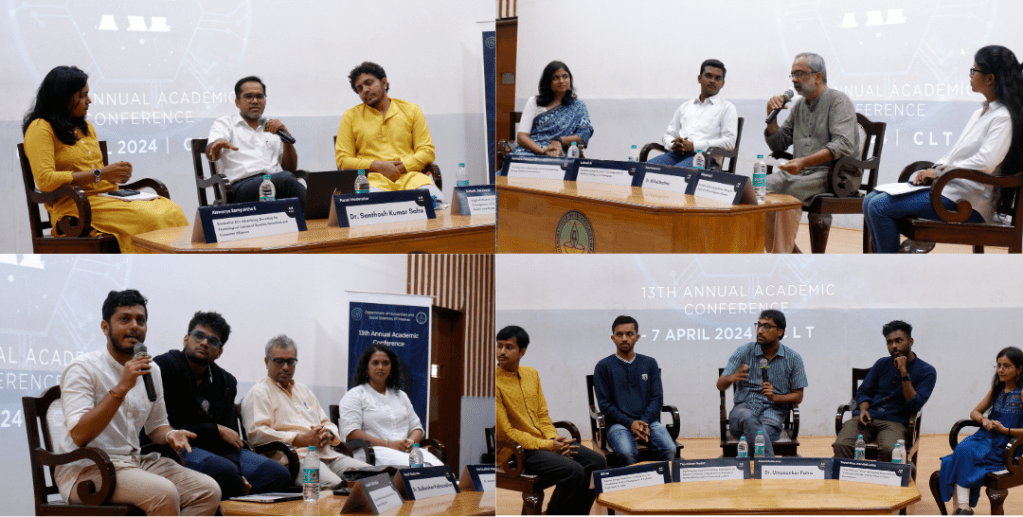
Moderated by Dr Umasankar Patra, faculty at DoHSS IIT Madras, the panel attempted to come to grips with the sweeping changes that Artificial Intelligence could have, and indeed has introduced to questions of human identity and agency. The two panellists were Minna Jose, a research scholar in IIT Roorkee, and Arnab Mukherjee, a research scholar in IIT Madras.
Minna Jose’s paper, titled ‘Reimagining Intimacy: Exploring Artificial Intimacy through Postfeminist Perspective’ looked at the commodification of intimacy and the recontextualisation of agency within digital spaces, specifically with regards to the emergence of artificial intelligence-powered ‘sex dolls’. Using performance pieces and conversations featuring an AI sex doll called ‘Harmony’, Jose outlined to an understandably fascinated audience the debate between proponents and detractors of AI sex dolls – from questions of providing companionship and emotional comfort to those in society who are most deprived of it, to the horrors of reducing women to a mere collection of discrete, objectified body parts. She concluded with a well-rounded look at the concept of the ‘Post-Feminist Parasite’ as a method of resistance, which accepts the impossibility of complete disengagement from structures of oppression, yet seeks to subvert them from within as a ‘trojan horse’.
Arnab Mukherjee’s paper, titled ‘The Quantified Subject and Algorithmic Governmentality: The Implications of the Information Compromise’ attempted to understand the psycho-social dimensions of the digital subject by theorising a general ontology for it. Mukherjee looked at the problems inherent in ‘quantifying’ social spaces, as well as the issue of local knowledge not having the capacity to be fully accountable by AI, using James Scott’s outlinings of the same in his book ‘Seeing Like a State’. He described an ‘algorithmic governmentality’, drawing from Foucault, which was outlined as an intensification and supercharging of governmentality, where both surface and depth capabilities were increased. Taking the examples of the ‘seeding’ marketing strategy for the hit NetFlix show ‘Squid Game’ and the ‘pursuadables’- based voter microtargeting programmes by the Conservative Party in the United Kingdom, Mukherjee finally argued for a Digital Subject as existing on a different plane – the Digital Plane – which cannot be reduced and explained with reference to the offline world due to the abstractions necessary in the creation of the former.
The panel discussion following the paper presentations was most fruitful, with critical discussions surrounding the particulars of ‘parasitic resistance’ and the ‘quantisation of data’.
Panel 2: AI and Cultural Expression
Moderated by Dr Umasankar Patra, this panel attempted to examine the ways in which creativity and cultural expression of various orders and forms have been, and are going to come to be impacted by various aspects of Artificial Intelligence. The three panellists were Tajuddeen Nadaf, a research scholar from IIT Dharwad; Bihan Das, a research scholar from IIT Kanpur, and two co-presenting scholars from Jawaharlal Nehru University – Sayan Roy and Nandini Lohia.
Tajuddeen Nadaf’s paper, titled ‘Exploring the Impact of Artificial Intelligence on Literary Creativity: A Comparative Analysis of Human-Written and AI-Generated Content’ looked at the implications of AI tools on the creation of short stories, listing the merits and demerits of introducing Artificial Intelligence in creative writing. Using “The Lost Child” by Mulk Raj Anand as an example, while comparing it to a similarly prompted AI-generated short story, Nadaf then undertook an analysis of narrative structure, character development, emotional resonance and other thematic elements, finally advocating for a balanced and conscious integration of AI in creative writing.
Bihan Das’s paper, titled ‘Beyond Image Production – Looking Into the Possibilities of AI in Changing Art and Cultural Experience in India’ looked at both the risks and the possibilities in utilising AI as a tool to bridging gaps in the social, cultural and economic landscape. First looking at the unethical ways in which AI is being used in digital art and image reproduction, Das also looked at the ways in which government museums and digital archives in India could use Artificial Intelligence to democratise these same social spaces, through AI models like ‘BHASINI.’ He also touched briefly on digital necromancy, with regards to a project in Bangalore which constructed M. F. Hussain as India’s first AI-enhanced, conversational digital persona. Das also used various related examples in the realm to critically answer the various economic, aesthetic and cultural possibilities within the same, as questions of a ‘foreign sense of aesthetic’ and ‘localising AI visuals’ came to the fore.
Sayan Roy and Nandini Lohia’s paper, titled ‘You Only Live Twice: Navigating Metacreativity in ‘Cinematic Afterlife’ and the Ethics of Digital Necromancy’ attempted to look at the metacreative and ethical dimensions of employing AI to digitally resurrect images of dead celebrities. Considering that the emotions portrayed herein are disembodied from a tangible presence, several ethical and creative issues were thrown up, which Roy and Lohia attempted to critically analyse. Looking at attitudes towards death and the Occult of Necromancy, they underwent an analysis of the concepts of ‘Digital Necromancy’ and ‘Metacreativity’ in the context of cultures of grief, and mourning.
The panel discussion following the paper presentations covered a host of new, exciting ideas brought up by all of the panellists, with an interesting discussion particularly zeroing in on the overlap between Das’, and Roy’s and Lohia’s paper on M. F. Hussain, and the ethics of digital necromancy involved therein.
Panel 3: AI and Economics/Development
Moderated by Dr Santhosh Kumar Sahu, faculty at DoHSS, IIT Madras, this panel threw up several interesting ideas about the different ways in which Artificial Intelligence is making its presence felt in the fields of Economics and Development. The panellists were Krish Jaiswal, a research scholar at IIT Bombay, and Aiswaria Samyuktha S, a research scholar at PSGR Krishnammal College for Women, Coimbatore.
Krish Jaiswal’s paper, titled ‘Digital Watch: A Comparative Analysis of the Emergence of Surveillance-Industrial Complex in Kochi and Hyderabad’ took a particular focus on AI-based Facial Recognition and Smart City policies in studying the Surveillance-Industrial Complex across the cities of Kochi and Hyderabad. Noting the use of Special Purpose Vehicles (SPVs) and Intelligent City Surveillance Systems (ICSS), he underscored the nuanced balance between enhancing urban safety and the potential risks of surveillance technologies, especially in the context of government structures, technological deployments and their implications for civil liberties. Jaiswal concluded by highlighting the need for a balanced discourse that considers the socio-political implications of surveillance technologies within democracies.
Aiswarya Samyuktha S’ paper, titled ‘Generative AI in Advertising: Decoding the Psychological Canvas of Dynamic Narratives and Consumer Influence’ looked at Generative AI and advertising through the lens of cyberpsychology, hoping to understand the ways in which user perception and judgement is affected. Aiswarya Samyutkha S brought in several cultural discourses, including Baudrillard’s conception of the ‘hyper-real’ to lend weight to her arguments. In the contexts of reception theory and consumer psychology, she highlighted how algorithms make way for a massive variability in AI-generated content, that allow for a diverse set of interpretations by viewers with extremely different cultural backgrounds. She concluded by emphasising once again on the variability of AI- generated content, and provided insights on its mulit-faceteed impact on the advertising landscape, where Generative AI harbours massive potential in marketing narratives and consumer needs.
The panel discussion focused mainly on questions of methodology and data-gathering.
With the end of the discussion came the end to the proceedings of Day 1 of the Conference.
Panel 4: AI and Governance
Day 2 of the Conference opened with a panel on AI and Governance.
Moderated by Dr Sudarsan Padmanabhan, faculty at DoHSS, IIT Madras, this panel sought to focus on questions of democracy, electoral politics, policy-making and governance in the face of the wave of Artificial Intelligence. The panellists were Anand R and Yatin Satish from DoHSS, IIT Madras, and Mrinalini Manda from Mount Carmel College, Bangalore.
Anand R and Yatin Satish’s paper, titled ‘(AI)yyo! Artificial Intelligence, Electoral Politics and Agenda-Setting Theory’ sought to delve into the theoretical approach that media studies and information theory has long-used to understand agenda-setting in the public eye. Tracing the history of agenda-setting theory, they looked at how theories in the social sciences and humanities have made way for, and adapted to massive changes in the socio-political landscape. Emphasising that Artificial Intelligence is not simply an ‘external’ phenomenon to be legislated upon, as AI tools are already pervasive across fields, the presenters underscored the idea that ‘AI is both the wave and the shore’. The panellists concluded by emphasising the importance of media literacy.
Mrinalini Manda’s paper, titled ‘AI, Imran khan and Era of New Politics in Pakistan’, co-written with her faculty, Divya Malhotra, took as a case analysis the various ways in which AI was used in Pakistan’s 2024 General Elections. While acknowledging the methods in which AI has been used to spread misinformation for political gain, Manda looked at how Artificial Intelligence was used as a democratic trailblazer in allowing Imran Khan to campaign through various methods facilitated by Artificial Intelligence, in spite of being jailed because of various political interests in Pakistan. Manda’s paper was appreciated by the panel moderator for being a specific case study.
The panel discussion was a fruitful one, with both panellists seeking to pick the brain of the AI Policy expert at the table, Dr Padmanabhan, on various broad policy approaches to Artificial Intelligence.
Panel 5: AI in Transforming Education
Moderated by Dr Milind Brahme, this panel took on one of the most pertinent questions to the research scholars, professors and students gathered at the Conference. How is Artificial Intelligence transforming education? The panellists were Humaira Mariyam B, a research scholar from NIT Tiruchirappalli; Lokesh N, a research scholar from Loyola College, and Nityashree S, a research scholar from Bharathiar University.
Humaira Mariyam B’s paper, titled ‘AI in Education: Optimising Connected Learning among Tertiary-Level Learners’ looked specifically at the way in which AI has been incorporated into the learning assemblage by tertiary-level learners in an ESP (English For Specific Purposes) classroom. Highlighting just how the students went about utilising various online and AI tools to approach tasks through a collage of screenshots, she used Vygotsky’s ZPD (Zone of Proximal Development) model, along with the theory of Connectivism to analyse and contextualise her findings. Non-linearity in learning, involving human, non-human and technological resources was highlighted. Her paper presentation neatly summarised her findings, and concluded with the hope that her study would facilitate educators to formulate strategies to include AI in teaching.
Lokesh N’s paper, titled ‘Revolutionising Education: The Integration of Artificial Intelligence in Pedagogy’ gave an overview of the various ways in which pedagogy has been transformed by Artificial Intelligence. Encouraging a student-centric approach, he looked at Adaptive Learning, Intelligent Tutoring Systems, Virtual Assistants and Data-Driven Education, all while acknowledging the risks associated with Global North cultural norms being reflected through AI models, and the inadequate data sets they draw upon and are trained on. He looked at the various ways in which pedagogy can be revolutionised, while also underscoring the need to prioritise ethical considerations and equity in ensuring that the benefits of technological advancement are accessible to all.
Nityashree S’ paper, titled ‘From Winter Chills to Spring Blooms: Charting the Progress of Artificial Intelligence in Education’, historically charted out the various “chills” and “blooms” of Artificial Intelligence as an advancing technology, and as an endeavour in education. Contributing a vital chronological aspect to the panel, she outlined the various challenges and setbacks (or ‘chills’) that AI as a technology faced, while contextualising it, and tethering it to our modern understandings of the same. Instead of viewing Artificial Intelligence as a technological inevitability, or a monolith, her approach of tracing the ‘blooms’ and ‘chills’ of Artificial Intelligence helped give the panel a more grounded approach.
The panel discussion that followed was a lively one, starting with Dr Brahme noting that the paper presentations segued into each other very well, providing a fleshed-out picture of the topic under consideration. He went into the parts of each of the presentations that he found interesting, and highlighted that learner autonomy was capable of being a teacher concern as well. The question-answer session with the audience that followed covered multiple domains – from the much-required need to distinguish between literacy and education in analysis, to the place that translation should have in pedagogy, to the possible changes in the role of the teacher in a swiftly-advancing new world.
Keynote Address – Day 2
The much-awaited Keynote Address of Day 2, by Dr Amandeep Singh Gill, UN Under-Secretary-General and Special Envoy for Technology commenced after this panel. Dr Gill, throughout his talk, repeatedly underscored the multidisciplinary requirement to tackling the policy challenges of Artificial Intelligence. Recalling initially that there had been an under-reaction to Artificial Intelligence, he said that the problem was now very much the opposite, and expressed hopes that “the pendulum would come back to the centre”. He expressed the need to create appropriate social and economic incentives so that the benefits of Artificial Intelligence are equitably distributed, stressing the crucial role that public-private partnerships could play in this aspect.
Dr Gill, after mentioning that he was once an engineer himself, briefly mentioned the possible dangers of the “hubris of the engineering mindset”, and stressed the need to bridge that lack of understanding through multidisciplinary involvement, which could in turn address far more contexts across the rural and agricultural contexts in India, both of which are of paramount concern and importance to India’s development story. The limitations and excesses of modelling, as well as the need to incorporate local language contexts have to all be taken into account within the broader requirements of the Sustainable Development goals Framework. Connectivity remains an important concern, and Dr Gill said that India’s implementation success with its Digital Public Infrastructure Paradigm is extremely impressive. Nevertheless, there remains a need on a global scale to bridge the Global North-Global South digital divide in order to tackle Global AI challenges like misinformation, and broader problems in LLMs. Dr Gill said that he has worked with several powerful technologies, including nuclear and chemical weapons, but nothing with the same potential to “shift the ground around our feet” like Artificial Intelligence.
As a consequence, questions of public trust, public interest and governance become very pertinent. Dr Gill in his conclusion stressed the requirement of a multidisciplinary form of governance, as opposed to a technocratic variety, which is opposed to a Democracy’s inclusivity priority. This push towards a better future does not just require help from the UN and its incumbents, but from communities as well. The engineering community will contribute a lot to this. Thus, this community will have to incorporate codes of conduct and ethical frameworks for itself while working with Artificial Intelligence. At the school level, engineers must be allowed multidisciplinary interactions, which will allow them greater insight into just how data as an abstraction works. At the graduate level, various disciplines must be allowed to cooperate and gain insight from the others. Just as in business, where multidisciplinary businesses are more likely to succeed, so are policies.
In the question-answer session that followed, Dr Gill heavily emphasised the need to involve relevant stakeholders in building ‘iterative feedback loops’ which allowed for caution, while not impeding progress.
Wrapping Up
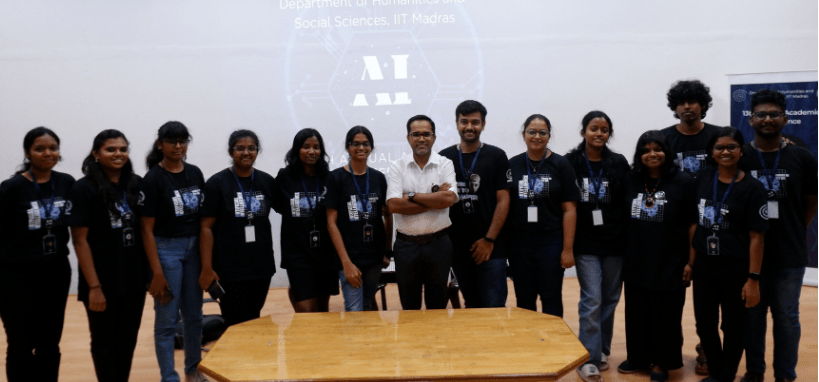
After the Keynote Address, Dr Aditya Kolachana briefly rendered a vote of thanks to the various members of the Department of Humanities and Social Sciences who had participated in and contributed to the Conference’s success. Finally, the Conference – a two-day academic extravaganza, made possible and run tirelessly without a hitch by a dedicated team of student volunteers – was declared closed, as refreshments were made available to those in attendance.
Report by Yatin Satish
Design by Alphin Tom
Photographs by Aravind M
 Article 19