
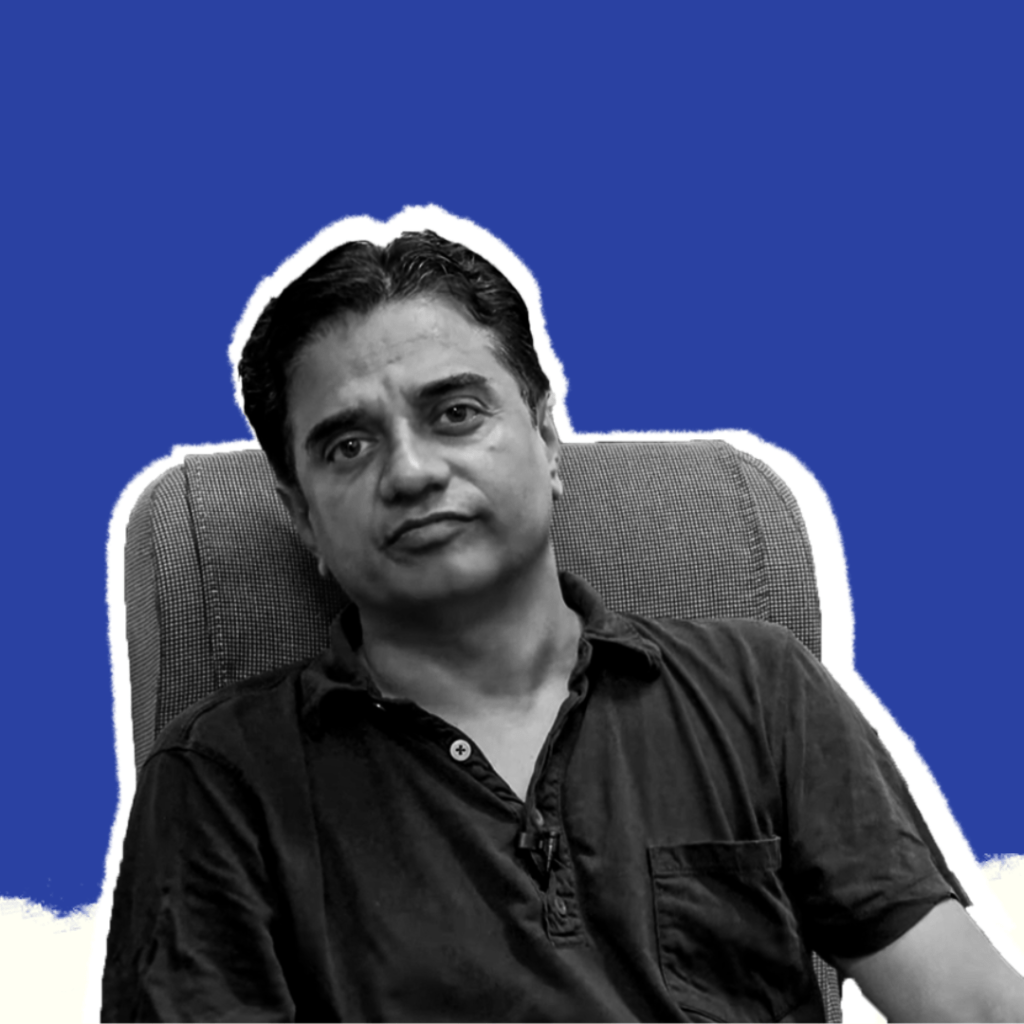
With the recent appointment of Professor Rajesh Kumar as the HOD of Humanities and Social Sciences, a new chapter unfolds at our department.
Article 19 offers an interview featuring Prof Rajesh Kumar, anticipating his invaluable contributions and visionary potential to propel our department to new heights.
What is it like being the HOD? What are some of the things that have changed for you since being appointed?
See, the most important part of being the Head of the Department, and as far as the transition is concerned, is meeting with a lot of people, and also looking at several time-sensitive situations – several things that require immediate attention, like the academic, health, personal issues of people. This can become, at times, overwhelming, mainly because it is new to me. And you are not looking at these things if you are not in an administrative position. So before, I was allowed to look just at my classes, teaching, research, and research scholars. But now I have to look at a lot of these other things as well.
We have already seen some of the changes around the department like the reopening of Usha. So what are some of the other new initiatives that you are planning on bringing into the department?
On that note (about Usha), what I will say is that there is one specific concern about that, which is, cleanliness. You know, we are responsible, quote-unquote educated people, and also adults. It’s not too much of an expectation to keep our place clean. To be more precise, we have some really heavy furniture in our classrooms, so it becomes very difficult to clean the classrooms if there is food inside. So that is the reason I have requested people not to bring in food to the class.
Apart from that, this is an academic place. When you are spending five years of your time as an MA student or a research scholar, these are the important five years of your life, and it is hard to list every change that you may have seen or would see. But when you are spending five significant years of your life here, our effort is only to make sure that they become memorable five years for you, and that the stay also does not become stressful. All our efforts will only be in this direction which is again, a little too much to look forward to (for or from just one person). It is a cooperative effort. The Usha canteen as well – it is a cooperative thing.
Also, you know, we were badly hit by the pandemic and it has changed a lot of things. But one specific thing that I want to do is bring in some substantial changes in the academic atmosphere in the department. There should be academic engagement in the form of activities. But again, it is not something that the office or a small group of people can do. (Students and faculty) from various domains need to help, cooperate and work on this to make the department a space of real academic engagement.
Could you elaborate a little on what you mean when you say you would like to see more academic engagement in the department?
Yes, so for example, we are – if you look at the composition of this department, particularly – many departments in one. Collectively, it is called the Humanities and Social Sciences department but it has multiple disciplines from anthropology to international relations, sociology, different aspects of linguistics, language, all aspects of economics, developmental sciences, and so on under one roof, which you do not really find in many other departments. We have a whole range of courses, of course, but we also get a lot of visitors in the department who are specialists in different domains, and we have a lot of talks and lectures as well.
But one specific thing that is expected from a vibrant academic culture is, whether or not something is a topic of your specific interest, are you willing to learn (more) about something new? For that, you have to be willing to participate in things that may not be of your direct, or immediate, interest. One way to do this is to force the people to participate, but that is not the right way. Participation, by definition, means you should be willing to take part in it. So my concern is: how do we get people to participate in these activities voluntarily? That’s one thing.
Also, we often have many conferences and workshops going on. These are free of charge – they don’t cost you anything but time, and in return, you get to learn something as well. And also, you know, when people talk, they are giving their best performance, right? So you are learning the best that they have to offer. We would want more people from various domains and disciplines to participate in these workshops and conferences.
The other thing is that different activities should originate from the students themselves. I’m not talking about some department night or some farewell function, but academic events, like the Department Conference, for example. It would also be good to see some specific discussion groups coming up. Ideally, I would really like to see some more functional peer learning in the form of (students themselves) giving talks, because this is less formal in nature and often can be very useful.
So you mentioned that this is a department which contains a lot of departments, but it is also a department located in IIT amidst a lot of technical departments. So where would you situate the HS department within the Institute? And how do you negotiate that sort of difference from other universities and places with larger humanities departments?
See, it doesn’t require much negotiation. In general, you have to look at the history of the Institute to understand where it is located. This department is one of the first few departments to be constituted here. So we cannot suspect people’s intentions right from the beginning. When they were conceptualising an institute, which was largely going to be known for technical education or creating what we know as technocrats – engineers, a group of people thought about establishing a department of Humanities and Social Sciences. So we need to start from there to understand the answer to your question. The interest in humanities, learning about society, relevance of its courses and efforts in the midst of technical education has been the goal of the Institute since its inception. So this is what I meant when I said that it doesn’t require much negotiation.
Generally, people do ask the cliche question: Why would we need such a department, such courses, for a technical institution? The answer is very simple. Actually this is not the answer so much as its relevance. We have to understand that even a technological institution is a part of society. An institute, whether it teaches medicine or technology or mathematics, is not independent of its relevance to society. Their existence is materialised and conceptualised according to the requirements of the society. Therefore, the relevance of, and the effort to understand the way in which society works, human beings work is not a new endeavour. Human beings have always been curious about how humans behave, how humans do different things, of which medicine, technology, or anything (else) is just one part. So, we need to look at it differently and change our perception. It’s not that this department is located in an engineering institute. We need to see engineering institutes as located in society. And I think this has been very clear to the people who conceptualised this institute from the very beginning. We may have later started having difficulty understanding this but the people who conceptualised the institute cannot be blamed for that.
The five year MA programme has recently been scrapped. Do you see this programme coming back, maybe in some other form, as a possibility in future at some point?
My simple response will be – why not? All possibilities remain open at any given time. “No” is not an important answer for anything that is in the realm of possibility. But that’s too abstract of an answer. The real thing is that as a part of the Senate of IIT Madras, these are all experimental processes as a part of the department. Once again, look at the history. The institute started in 1959. But there was no five-year programme till 2006. It took a long time to get to that point. In some form or the other, it can still be there.
You also need to look at the New Education Policy of the Government of India which talks about four year undergraduate programmes. So as an experiment process, again, it can be brought in some other form. This is the best part of these kinds of institutes which work on their own academic structure – you can experiment with anything and it is always open to look at various possibilities.
Moving to a slightly different direction, in your capacity as HoD, how do you seek to address the issues related to students’ mental health and well-being?
Again, very simple. First of all, mental health is an important aspect of our life. And we need to look at the holistic development of an individual in order to understand mental health issues as well. In the sense that mental health is not related to one specific thing. Again, I don’t understand health related issues much. For example, I don’t even understand how we get a fever. Ok, so when we get a fever, that is also not just for working, right? So mental health is indeed a serious thing. And it must be addressed properly. It doesn’t originate with one specific thing. Addressing this issue is also not addressing one specific thing. We need to accommodate various different things.
Having said that, we need various stakeholders to participate, we need students also to realise what causes these grades of concerns and then staying away will be advised but one imperative thing is to understand and work on something that causes these. For example, if you are in a specific season, you know you will get the flu, then you take certain precautions.
Same way various stakeholders need to work on certain precautions. And as part of the department, and as you see in the Institute, you see work being done on the academic aspects of it, psychological aspects of it, and, food, psyche, well-being. One can always say this is not enough, but we don’t need to evaluate it in terms of what is enough or what is not enough. We need to look at the intention of the department and of the Institute as a whole, whether it considers these things seriously or whether it is willing to address them. So if you look at those things, you will see the Institute in general, like recent Kushal efforts, and all these things that you see – they are not simple, they are very serious efforts of the administration to look into these matters. And my understanding tells me that it requires cooperation from various stakeholders, and like any other difficulties, this is part of our life and we need to deal with these things.
What is something that you have learned from or something that you appreciate about your predecessors, that is, the HoDs before you? And what is something that you would take from them in terms of either doing something differently or drawing from their work during your tenure (as HoD)?
Because it’s like I said before – general efforts have been to make things better for the academic environment. And in my understanding, all HoDs have worked on this part in their own ways. We can always evaluate somebody’s work, but we cannot question people’s intentions. They have put in efforts and hard work into this. So that is one thing I would want to take up, you know, because when you see the functioning of the Department, it doesn’t function with one person. Yeah, one person may be the head, but it involves everybody. So I have been involved earlier also and I know about the intention and the hard work of previous people. And I can only try to add more to it in a more participatory way, involving more and more stakeholders into it, and if there was anything in which people had difficulty seeing the impact of those efforts, we will try to make those things apparent to people. Things may not be too visible to you, but then there are efforts. So that will be one way to appreciate others’ efforts and take it forward.
Our final question is, given your many years of experience in the department as a Professor, how has the department changed throughout these years?
Our institute is in an evolutionary process all the time, so change is the only constant thing and it has changed, and it will change further. Though as far as my experience is concerned, I have always seen it changing forward. And we may or may not be able to see those embedded good things immediately, but all changes are for good.
So, I don’t know what specifically to mention as a change that I have seen. But, like you see, we have now started with a two year programme. This is just one year old, so we are experimenting on this part in order to understand how we contribute to postgraduate programmes. Same way we need to evaluate how we contribute to adding more, which is not just in terms of electives, but also minor programmes in the department and also the ways in which we can add more to people’s learning. So a lot of these things did not exist years ago, but slowly you would see things changing. The Institute’s overall academic environment allows us to experiment, and look at how we become more relevant in terms of our output directly relevant to the society. So, that will be one specific thing to mention in this context.
Interview by Garima Sane & Swapnaneel Dan

