A look into India’s Freedom of Speech, From the First Amendment to the New Criminal Law

India has always boasted of its liberal democratic values – of how the makers of the constitution braved divisive spirits from all sides, and embraced ideals that were quite indigestible for a significant proportion of the population. And yes, our constitution remains a wonder – a gem of a work which has laid the foundations for the world’s largest democracy.
We laud the founding fathers, often rightly so, but it also dangerously borders on overpraising, and ignoring their fundamental humanness – which caused error in the form of policy decisions and Amendments. Jawaharlal Nehru was indeed the best person to take up the helm of the country post-independence, and the Institutions and Ideals that have formed the structure of modern India is very much a testament to the vision of his, and of the members of the Constituent Assembly.
But he too was human, and as suave and classy as the man with that clipped-accent and excellent instinct of statesmanship was, he too made grave errors, and that too with the very first Amendment of the constitution – which changed the Article 19 to enable the government to apply restrictions on the Freedom of Speech. Laws empowering the State are to be made under the assumption that the ones who wield that power needn’t have the best interest of the citizens entire; it should be drawn in a way to restrict the damage if the wrong person holds the power, and not as an expanding scope for hope of goodwill. And the Indian constitution does tend to lean towards the latter approach, giving more power to the Centre. Hence, when we hold high the constitution (as we rightly should), it is important to not run into the risk of considering it infallible, and to understand what arguments and principles shaped that document.
The First Amendment, and Sedition Law
The 1951 Amendment did three things: Abolished the zamindari system, brought in caste reservations, and – the focus of this article – made it constitutional to censor speech that was deemed as a threat to national security. It was the domino effect of a list of publications which preached against the State, and one that called on Nehru’s dictatorial tendencies. Thus, the Article 19 of the Constitution, which enshrines the Fundamental Right to Freedom of Speech, had edition added to it, and so reads Article 19 (2):
“shall affect the operation of any existing law, or prevent the State from making any law, in so far as such law imposes reasonable restrictions on the exercise of the right conferred by the said sub-clause in the interests of the security of the State, friendly relations with foreign States, public order, decency or morality, or in relation to contempt of court, defamation or incitement to an offence.”
This was further supported by the Sedition Law in the form of IPC 124A, the origins of which are rooted in the colonial era, where the British enacted it in 1870, and which had famously been charged against people including Mohandas Gandhi, for his dissent against the British Raj. However, the first amendment made the laws against sedition constitutional in New India, although not explicitly, as despite his role in the addition of 19(2), Nehru himself was critical of the 124A:
“Now so far as I am concerned that particular Section (124A IPC) is highly objectionable and obnoxious and it should have no place both for practical and historical reasons, if you like, in any body of laws that we might pass. The sooner we get rid of it the better.”
But also adding to it:
“We might deal with that matter in other ways, in more limited ways, as every other country does but that particular thing, as it is, should have no place, because all of us have had enough experience of it in a variety of ways and apart from the logic of the situation, our urges are against it.”
One can attempt to reason this dilemma of ideals reflected in the speech as attempts to reign back the communal tensions the country was going through back then, and the wish to get passed the other two provisions in the amendment, which both the zamindars and a good proportion of the ‘upper-class and caste’ citizens were vehemently against. Satire is the best weapon of the powerless against the state, and magazines with cartoons mocking the Prime Minister were also in print. Citizens rising against the state and planning revolutions it’s not the ideal that a State craves, and the Government felt as if the people had too much freedom. This decision was met with fierce opposition from many, but perhaps most notably by Shayamaprasad Mukherjee, as detailed by Tripurdaman Singh in his Sixteen Stormy Days.
This, Gentle Reader, could serve as a reminder that, power will always ache for more power and control, for reasons it may find justified – no matter how holy or pure the people working in it may seem, and more importantly, why discussions and debates from a strong opposition is vital for the functioning of a liberal democracy.
…..
The topic of FoS has been in political debates forever, and more so in the last five years ,with the increasing influence of social media on politics, and the spurt of Cancel Culture. A strong argument still persists, sometimes for well-intentioned reasons, that “reasonable restrictions” on speech, like in the case of Hate Speech, are valid to be legal. But the fact of the matter is, restricting speech is not going to sweep away the bigotry expressed – especially when we live and debate on the internet. Corporations and individual institutions can have their own regulations to tackle ‘hate speech’ targeted against any individual or community, but that being translated into becoming a law by the State has adverse effects, especially because we can’t precisely define what the ‘inappropriate speech and expressions’ are – perhaps more explanations on it for another time. The point of bringing this up was just to highlight how the FoS is actually a Right if and only if citizens have freedom to say whatever they want, make however many bad jokes they want to against State and religious interests, no matter who it offends. For, that very freedom ensures that true criticisms against State and religion can survive.
It is a very tricky subject, to decide what is actually right and wrong, and who decides what is right and wrong. You definitely don’t want the State (nor religion) to have the power to decide it for you – a quick glance at history should tell you why. Hence, the only way is to make Absolute Free Speech a Right for all citizens. And India had it, during those brief 46 months. This is not to follow the bandwagon of blaming it all on Nehru’s govt – subsequent governments too had the time to make it right, but it didn’t happen because having the power to control what is printed and said is the greatest power one can have to control the people, and also to restrict what and how they think.
In fact, it is worse in the new criminal laws implemented in the country – specifically, in the Bharatiya Nyaya Sanhita, which was brought forth to tear-up the Indian Penal Code of the colonial past.
The Change in the BNS
Although there is no mention of the word ‘Sedition’ in the BNS, it is much draconian and illiberal to the core, what the new law states:
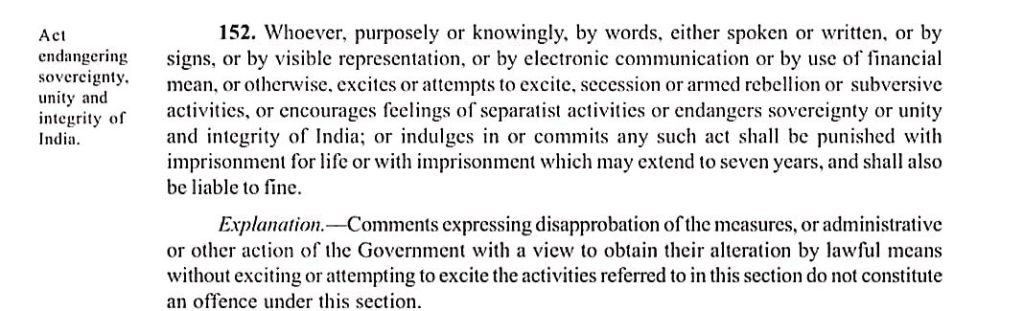
Not only guaranteeing an imprisonment, and adding the means of electronic communication, another major change that was noted from the IPC is that ‘the object of harm is the Government established by law’ whereas in the BNS, it is ‘India’ – this broadens the scope of offence taken “as it can encompass criticism of the government, public figures, or even society and communities in general.” What is more so dangerously detrimental to the liberal spirit of this democracy is as there exists no clear definitions, even legal ones in the BNS, (or even in the IPC) for what all might cause offence, it leaves us in a bizarre place that if the State deems it harmful for the unity and integrity of India, it is punishable with imprisonment.
The Blasphemy laws too has not taken even an inch back – Section 196(I) with its three subclauses containing no clear definitions required for a reasonable interpretation of a Law guaranteeing three years imprisonment, lives on in its new form, stopping any possible criticism of religion, however rational it may be, for it could be read as an “ act which is prejudicial to the maintenance of harmony between different religious, racial, language or regional groups or castes or communities, and which disturbs or is likely to disturb the public tranquillity”.
As a personal moral guiding principle, the words in the law is perfect, barring of course the bit about serving time, but precisely that is the issue – it should be up for individuals, and never a matter in the hands of the state to decide what should be said or written, unless there is a call and instigation for violence, which are dealt with in other provisions.
To clarify and reinstate an earlier point, laws need to be limited under the assumption that the wrong people can hold that power, and that it can be misused.
…..
The existence of these laws empowers the state to ban books, films and other works which are even mildly critical of any religion or the state itself, on the grounds that it might inculcate a divisive spirit amongst citizens, or harm the integrity of India. And for personal principles, one better than ‘let no one speak ill of anything’ might be Voltaire’s “I may not agree with what you have to say, but I will defend to the death your right to say it.”, for who knows what we hold to be true and sacred are actually so, and just in case, the other party is right, it would be a crime against our own minds to not hear it out.
Well, in brief, the state of affairs in India is, ‘You have the Freedom of Speech & Expression, but you are not allowed to speak or write against the two entities which have historically been the biggest tyrants of the very same freedom’. Freedom of Speech, if to be a true right, must include the right to offend and criticise – not because it will lead to an utopian world where everything is right or where truth reigns, but because every time someone had the power to decide what someone else should or shouldn’t read or write or speak about, it has never ended well.
Specifically for the state, other than the arguments for why debates and dissent and free enquiry are vital for the survival of a successful democracy, the best way to explain it is as Charles de Gaulle said while intervening to stop he arrest of Jean-Paul Sartre for civil disobedience:
“You don’t arrest Voltaire”.
Edited by Yatin Satish

