
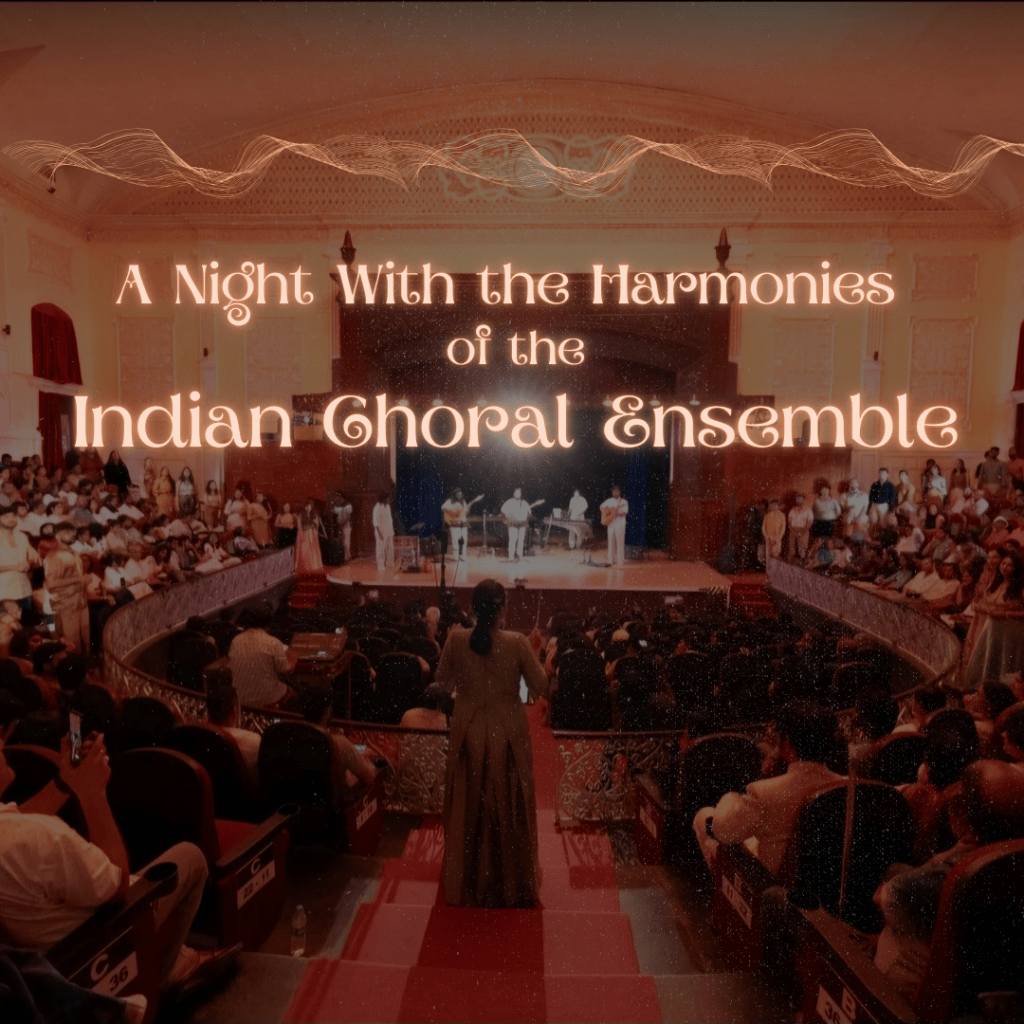
On a rainy Saturday evening, I set out with a bunch of friends to attend a concert. This wasn’t just any concert, it was a live acapella concert!
Acapella requires tremendous effort and coordination to deliver a piece of arrangement and doing it live in a beautiful auditorium for an audience of 500 is nothing short of a wonder. This was made possible by the Indian Choral Ensemble, an acapella troop of 40 led by Kalyani Nair and Karthick Manickavasakam at the Museum Theater, Egmore, on August 3rd.
Thanks to the rain and traffic, we almost missed the concert! We arrived at the last minute, managed to collect our tickets, and settled into our seats when a bunch of people, in nicely coordinated outfits, walked into the auditorium from the door right next to our seats, and took their position in the aisles.
Kalyani Nair, one of the conductors, took her position in the middle of the auditorium and held up her baton. With a swish and a flick, she unleashed magic. As all the voices came together and started singing ‘Iru Manam’, one of their originals, I closed my eyes and let the music flow through. ‘Iru Manam’ is a song about how what appears to our eye as beautiful is a reflection of inner beauty. The voices carried us with them through all the ebbs and flows of the song. From listening to this song on Spotify on loop to finally listening to it live was a dream come true. This, however, was just the beginning.
Their second song was called ‘Kaaya’. This was conducted by Karthick Manickavasakam. This song, in particular, was very special. The arrangement initially felt very complicated because of all its layers. The harmonies felt all over the place, but as the song progressed, they came together beautifully. ‘Kaaya’ is a song about the passage of life, reiterating the inevitability of change in one’s life and the fear that accompanies it. As I listened to the song, I realized this was a composition that would sound different every time you hear it, for every time you chose to focus on one part of the arrangement, one would hear it from a different perspective. It was a very well-written arrangement and was executed just as perfectly. The first part of the song was syncopated and had a very lilting quality, creating a feeling of calm and discomfort at the same time.
Next up, they performed another one of their originals called ‘Nam Tham’. For the majority of the song, the singers only sing the words ‘Nam’ and ‘Tham’ in harmonies of different rhythms until Kalyani Nair takes over the stage, with her voice nestled cozily in harmonies. The song describes the conversation between nature and a budding flower, encouraging her to bloom and witness all the wonders that the world has to offer. Kalyani’s voice delivers the same comfort that one can find in a mother’s lullaby. They also performed a lullaby in Malayalam called ‘Omanaththingal’, the lead for which was sung by Kalyani. The song was written for the Queen of Travancore to sing to her son, Swathi Thirunal. Kalyani, with her song as sweet as a nightingale, made me feel like listening to her through all of eternity. Her song made everything disappear for a minute, and I found solace in her singing. She left me longing for more and feeling at a loss when her song ended. Those few minutes would forever remain etched in my memory.
The best part of the concert for me was TICE’s rendition of a very popular carnatic keerthana, ‘Chinnanjiru kiliye’. The song started on a high, with 40 voices harmonizing together, filling the entire auditorium. Straying away from the traditional way of singing the keerthana, the song was elevated with the addition of acoustic guitars and a flute to the acapella version of the song. Acapella versions of carnatic keerthanas are unheard of, and with this, they opened a trove of treasure. They even managed to calm a crying baby with their voices. The coordination with which they sang all the runs only proves how talented singers they are.
They also performed M.S. Subbalakshmi’s ‘Maitreem Bhajatam’, another Carnatic keerthana. This keerthana bears a lot of historical significance, for it was performed by M.S. Subbalakshmi at the United Nations on United Nations Day on October 23, 1966. The lyrics preach friendship among all and renouncing war. Not even in my wildest dreams did I imagine listening to a Carnatic version of this keerthana. What made it interesting was that the conductors made their audience participate by making them sing different harmonies. Audiences at concerts in Chennai never fail to impress. Everyone sang in pitch, making the auditorium resonate with melody.
Just when the show couldn’t get any better, TICE performed the song ‘Vendum’, which they had recorded with the singer Sean Roldan for Coke Studio Tamil. The song is about bringing about a change in the world to make it a better place for us to live in. With complicated notes and melodies, they delivered the song to perfection, compelling a standing ovation from the audience. A perfect ending for a perfect evening.
I was awestruck by all the vocalists for their impeccable ability to sing without mics in a group of 40, with each voice completely in harmony with the other and also with the band that added so much more to the show on the whole. A special mention to the band, which consisted of Akshay Yeshodharan and Chris Jason on guitars, Rahul Vanamali on mallets, Laxman Aravind on bass, and Nikhil Ram on flutes. It was truly inspiring to witness their hard work over the course of two years culminate into something so beautiful.
The concert lasted for an hour and a half, but people couldn’t get enough of it. It’s been more than a month since the concert but I still can’t get myself to move on.
Acapella is more than just people singing together; it is the coming together of multiple voices with a life of their own, blending together in harmony to create an experience. It is the journey of a team united by their love for music and their dedication to the art. This concert by the Indian Choral Ensemble was, I believe, a once-in-a lifetime experience for me, and it will always be special.
Edited by Yatin Satish
 Article 19