
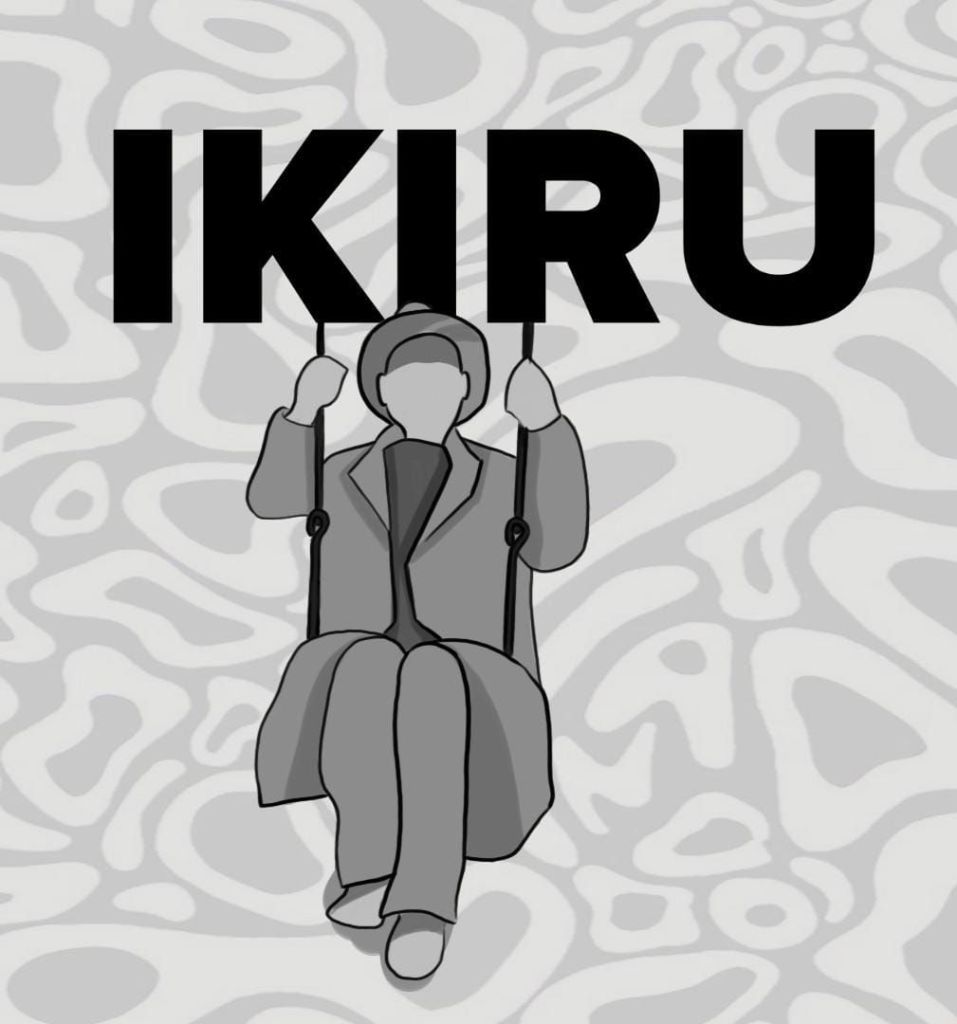
‘How would we live our lives if we knew the date of our own demise?’;
Especially when it is in the very near future. Almost all versions of the Proust Questionnaire, where it is modified as a personality test, have one form of this question. We see it posed to people of renown during interviews, and it is a theme that has inspired many works of art and literature.
Ikiru, translating to ‘To Live’, is a 1952 Japanese film by the legendary Akira Kurosawa, which tells us the story of a Kanji Watanabe, who is living a monotonous Sisyphean routine as a bureaucrat. Played by Takashi Shimura, he takes upon the role of Kurosawa’s protagonist for the eighth time. The film opens with an X-ray of a stomach, informing the audience of the cancer that is spreading through Watanabe, putting a near end to his life. And then we see Watanabe, a weary man surrounded by stacks of paper, slowly stamping his sign on the files on his table, as he has done for the last 30 years. A voice-over tells us – “He just drifts through life. In fact, he’s barely alive.”
Now, Gentle Reader, before you proceed further, you’ve been fairly warned of spoilers, although knowing the plot beforehand didn’t really take much away from the viewing experience for me.
…
Ikiru has been featured in all the ‘Greatest Films of All Time’ lists since its release and has been reviewed and widely acclaimed by multiple legendary critics and directors. The film deals with multiple themes – bureaucracy, existentialism, collapsing father-son relationship while also carefully weaving in the life of post World War Japan in the background. And considering its fame and existence of more than seven decades, every aspect of its script, cinematography, acting and structure has been deeply analysed and written about.
But why the film is so profoundly moving (not that this aspect is some purely original thought which has never been written about) is because the story is very much grounded to ordinary life. We don’t see the hero’s journey. In fact, we are deprived of it.
The film cuts to his funeral wake as we see that he has decided what is to be done to find meaning in his life. We don’t see a man who strikes the knowledge that he has been merely existing without experiencing life, and turning his life over to the well-being of others; nor is there a mawkish montage where this decrepit frail man, pushes through sheer conviction against the chains of apathetic bureaucracy to finally get a park made for the kids. We are just informed of his last days – how he got the project done; through his colleagues when they too discuss the same with fascination and also a tinge of frustration for not being able to place the reason for the sudden change in his behaviour.
What changed, of course, is the knowledge of his very imminent death. He spends that night drinking out his sorrow in a bar, where he confides in a stranger after finding himself unable to disclose the news to his son. He laments on how he wants to live and enjoy life, but does not even know how to spend money, and is helped by the stranger in a night of indulgence – which is often the answer to the question at the very beginning of this article when the time period offered is one day. If we knew we had just one more day, I am assuming we wouldn’t be in a rush to complete that pending work, or even care to leave a legacy; one might want to spend that last day with loved ones, enjoying all that can be enjoyed – the material and the spiritual.
There is something so disturbingly sad in Watanabe’s eyes throughout that we feel pity. The film makes no attempt to glorify his life, for it shows the scene for what it really is – an utterly pitiful situation where a human being realises they have done nothing significant in their life, and worse, knows not what to do about it. And there is a mirror held up for us.
With the realisation that indulgence in what is perceived to bring enjoyment – the expensive sake and the dancing and the pachinko and the crowds – maybe was fun, but is not what he seeks, he wanders with his own down and swollen. Intrigued by Toyo Odagiri – a colleague who needs his stamp to quit her job, he begs to know what makes her so joyful. Maybe in our daily interactions and the way our mind makes heroes out of people who can speak confidently about life, we are indeed looking for someone to explain to us, how to live.
There is not a second chance offered again, if we falter on this one – whatever faith it is that you believe (or do not believe) in, deep down we know we are not living this life again, at least, not in this same consciousness.
…
Throughout the film, Kurosawa keeps us at an arm’s distance from Watanabe, although we get to see him in his lowest moments, when no one else sees him. Maybe we, the audience, are like the strangers who stumble upon this man’s life when he was down, but not close enough to follow it through – not when he is struggling to finally fulfil what he figures out will give meaning to his life by making something. Nor were we, the strangers, with him in his last moments but mere witnesses from afar.
Ikiru is a necessary reminder that to convey the search for meaning of life, we do not need great philosophies written as dialogues nor the images of the stars and the expanse of galaxies (to be extremely clear, they do serve its purpose – and films like The Tree of Life does it perfectly). The human urge to leave behind a legacy is carried out in many ways – sometimes an oeuvre, or great inventions, or even a family name or fortune. What Watanabe finds solace in is to get back to his work to get the park made, the petition for which was juggled around by different departments of the government – he gets its done with his calm persistence, and for his own contentment, and cared not of the credit.
Nor do we, the audience, get the chance of seeing the park being made or the applause he should’ve received, as we are just told of his death midway through the film and hear the rest of his life in fragments – which was the bravest and the best decision of the film- something which is different even from other works which dealt with the same theme, and from its source of inspiration, The Death of Ivan Ilyich.
The beauty of Ikiru is how grounded to the ordinary reality of human life of you and I it is – the camera treats everyone the way we see the people around us, there is no element placed to mythically inspire and preach to us about life, nor does it exploit the uncertainty concerning our life and legacy after our death. What happens in the very last scene back at his office is the opposite, even – it can fill us with hopelessness if that scene alone exist, leaving us with the burden of the knowledge that this is the most probable reality, but as an ending for the film, it does nudge us To Live
There are two moments in Ikiru that strike deep emotional chords, capturing the essence of human vulnerability and resilience. Both scenes focus on Takashi Shimura’s achingly heartbroken face as he softly sings a song, a melody that becomes a poignant symbol of his journey.
The first occurs during that night out, where his voice, fragile yet resolute, fills the room with a haunting beauty – when he decides to truly start living, to seek meaning in the days he has left. There are drops of tears spilling, his face a mix of sorrow and newfound determination. The second moment unfolds on Watanabe’s last day, as he sits on a swing in the park he helped create. But this time with a sense of peace and contentment, he sings the same song, Gondola no Uta, part of which goes:
“Life Is Brief
Fall In Love, Maidens
Before The Boat Drifts Away
On The Waves
Before The Hand Resting On Your Shoulder
Becomes Frail
For Those Who Will Never
Be Seen Here Again”
The concept of mortality is the most confounding of all, for we know it is inevitable, but have not a modicum of understanding of what it is or what happens after. We fear its inevitability and uncertainty, and try hard to grapple with it by making legends and religions, to find some ray of hope in that inevitable darkness. I went into this film (after doing the perhaps-frowned-upon-habit of going through the wikipedia summary,) expecting to see a meditation on human mortality. But as the title of the film itself says, Ikiru (To Live) is the most realistic and thus, hope-giving reminder that life is as inevitable as death.
Edited by Oishi Banerjee

