
‘Enchanting the Archive: A Symposium’ organised by The Archive of IIT Madras on the 22nd of January 2025, was truly a noteworthy event in the history of IIT Madras – as academics and scholars from across the country, encompassing a dizzying range of fields, gathered to discuss various academic matters surrounding the question of the Archive. From methodology, to experience; from those who access Archives, to those who are key to its construction; from conventional historians and archivists, to not-so-conventional archival processes – a range of different views and perspectives were shared in an extremely open, inquisitive environment. It made for an invaluable learning experience to anyone and everyone who was present that day.
This report aims to acquaint the reader with the various ideas and perspectives discussed by the Panelists at the Symposium, and attempts to communicate the air of enthusiasm and academic collaboration that pervaded it.
The theme ‘Enchanting the Archive’, as explained by Mathangi Krishnamurthy, faculty at the Department of Humanities and Social Sciences and Chairperson of the Archive of IIT Madras, was birthed from a fundamental question: How does one bring people to the Archive? For if Modernity is disenchantment, it leaves room open for an investigation into how the Archive may be enchanted. It was this question that popped up over and over again throughout the Symposium, and while encountering a smorgasbord of research questions and historical examples.

Just the previous day, The Archive of IIT Madras, in collaboration with The Heritage Centre, hosted an exhibition by the Massachusetts Institute of Technology which provided an entry into such a research question, titled ‘South Asia and the Institute – Transformative Connections’. It explored the historical connections between South Asia and MIT. The Chief Guest of the event was the Honourable Minister for IT and Digital Services, Tamil Nadu, Dr. Palanivel Thiaga Rajan, who in his address reflected upon his student days at MIT, and the value he gained from the unique interdisciplinary education that was mandated there. A short film was screened, titled ‘Revolution on the Ganga: The Making of the Technological Indian’, which delved into the history of the Kanpur Indo-American Program. A short panel discussion followed. The participants of the panel, moderated by Mathangi Krishnamurthy, were Dr. Hamsa Balakrishnan, Associate Dean of Engineering and William E. Leonhard (1940) Professor of Aeronautics and Astronautics, MIT; Dr.Sana Aiyar, Associate Professor, History, MIT; Dr. Ranu Bopanna, Former President of the MIT South Asian Alumni Association, and Dr. Srinath Raghavan, Professor of History and International Relations, Ashoka University.
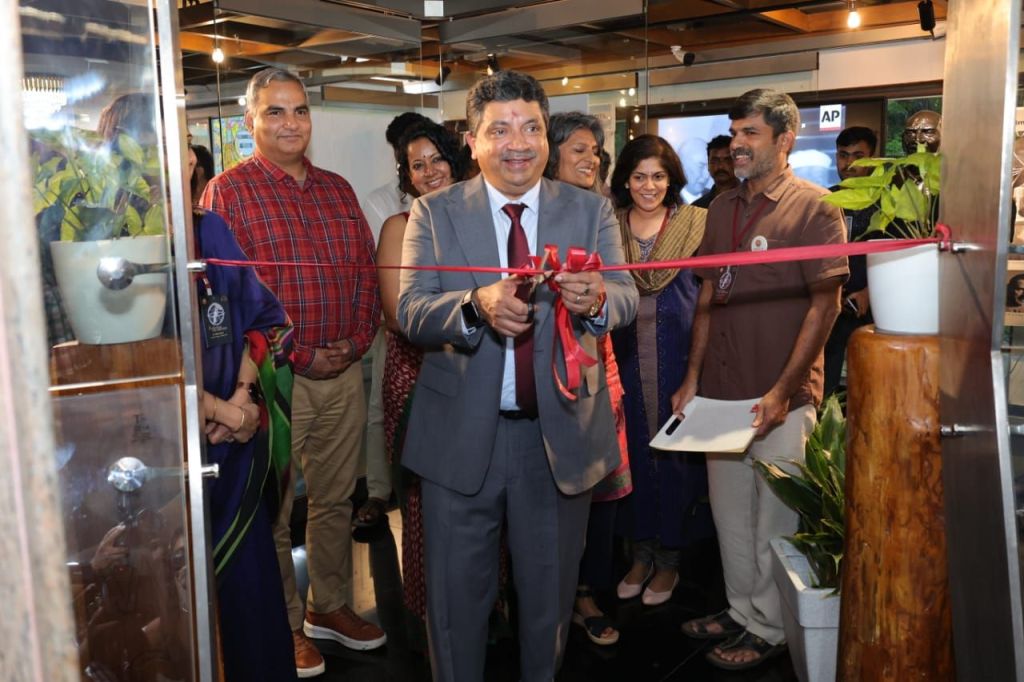
The Exhibition at The Heritage Centre, followed by a tour of the Archive of IIT Madras, provided a perfect launching pad into the Symposium that would follow it.
Panel 1: How do You Solve a Problem like an Archive?
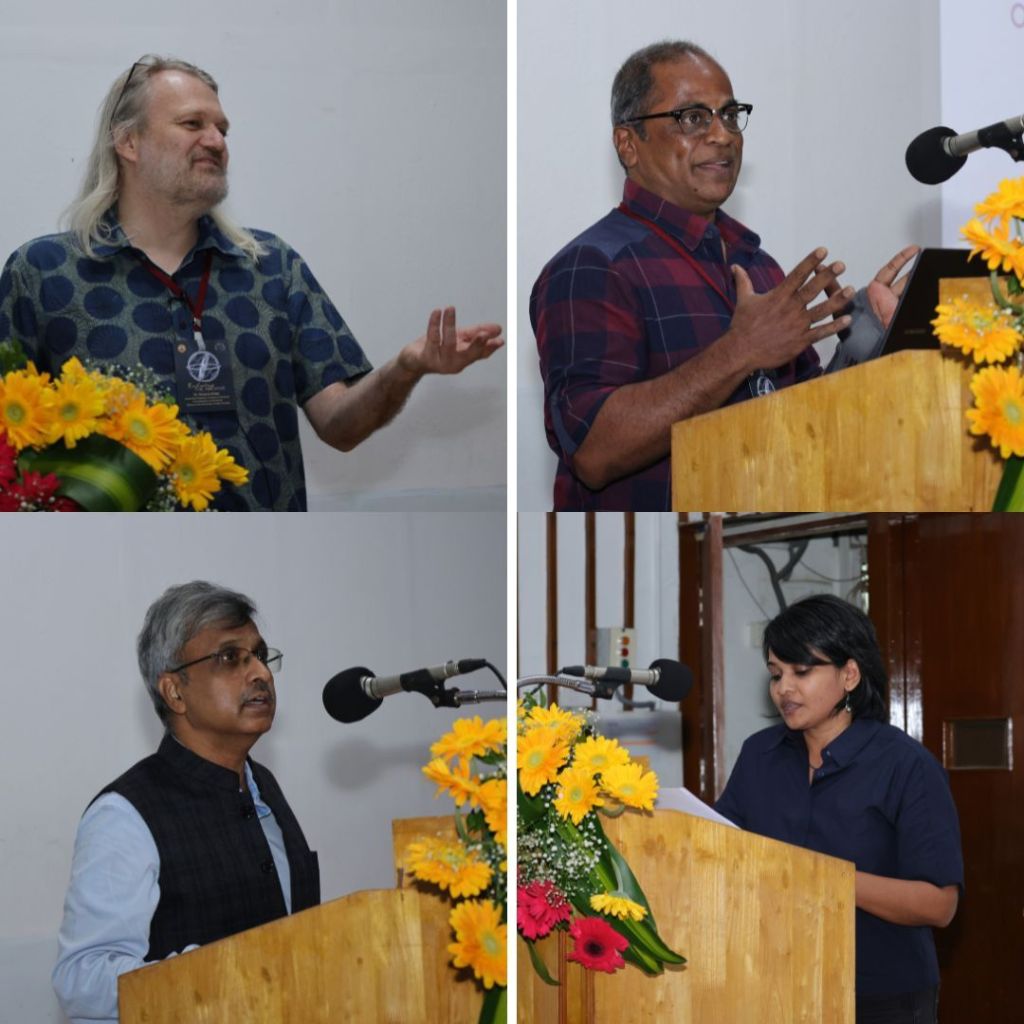
After the Opening Ceremonies and Welcome Address, the Symposium was kicked off by Dr. Roland Wittje, Associate Professor in History of Science at the Museum of University History of the University of Oslo, and ex-faculty at the Department of Humanities and Social Sciences, IIT Madras. Wittje was also crucial to the founding of the IIT Madras Archive in its present form. His talk was titled ‘No Archive, No History! On the Importance of the IIT Madras Archive.’ Despite the title, Wittje, after highlighting the crucial importance of Archive Building and Archival Research in the context of his own work and experiences, emphasised the importance of moving beyond even the Archive. Questioning the processes that go into the construction of Archives acquires critical significance, in terms of the materials that are privileged entry into Archives, and societal preconceptions in terms of what is allowed to be “standard” in the process of archiving and archival research. Wittje used the memorable example of basketmaking and its associated oral histories as a technological practice and historical form that acquires special significance in historicising the ‘Technological Indian’. Basketmaking as a science was the cornerstone of Indian industry even up until the turn of Indian Independence, while many historians tend to privilege formal institutions like the IITs as the start of the ‘Technological Indian’. Indigenous Practices that utilise various technologies and are very often overlooked in this construction of the ‘the scientific’ – like the making of instruments, or various fisheries and agricultural practices. This makes us confront the area of archival methods over and over again, especially in the context of what must enter the Archive.
Dr. Senthil Babu, Historian of Mathematics at the French Institute of Pondicherry, came next, with a talk simply titled ‘Recording and Reconstructing Practices.’ Babu argued for a “program” in history that would “bring together hand and mind” to reconstruct a different history of Mathematics in India. A program that would not privilege a single language as the language of record-keeping, as has been done with Sanskrit, but rather all Indian languages, and one that would not privilege a single practice, such as “the scholarly”, but rather take into account the practices of various other realms, such as the agrarian, the mercantile, and the bureaucratic. Thus, a strict questioning would have to be made of hegemonic histories that have so far been dictated by texts and caste hegemonies. Different modes of abstractions have to be considered while making historical accounts of various events, as “practices of the hand” must be brought into the historical archive – practices such as sculpting, boat building, house building and mercantile accounting, of which Babu gave several historical examples and case studies from South Indian archives and texts. Babu also noted the historical importance of “simple” measuring rods and other methods of measurement, which were used in agrarian and bureaucratic contexts and as a result often ignored by visitors in museums, or stashed away in decrepit cupboards. The ways in which spatial segregation evolved are critical to any understanding of history, and these tools, along with the contexts in which they are used, are often key to informed readings of past events. Babu ended his talk by warning against the prevalent attitude of looking at historical practices simply as matters of lofty, idealised heritage and nothing more, even as critically important matters of continuously evolving workplaces and technologies are buried.
Prof. A.R. Venkatachalapathy, Professor at the Madras Institute of Development Studies, titled his talk ‘In the Penumbra of Archives: The Practice of History in the Digital Age’. Venkatachalapathy began his talk by noting that in India, we live in an era in which archives are actively being destroyed – thus leading him to the statement that we are all living in ‘the penumbra of the archive.’ He reflected upon the archive and its association with the cliché of the musty corridor, and how it is at odds with the new, squeaky clean archives of today. He went on to recall archives as places of socialisation and mutual learning for historians. He urged that in the digital age, the practice of history goes far beyond ‘Control F’, even though that is how it must appear to most. The rate of the digitisation of historical documents is overwhelming in volume, though there is little thought poured into how the process of digitisation must take place – which copies of documents are taken into account? Are there marginal notes? What is understood to be the “master” copy? How are variations to be taken into account? What does this mean for the field of History? Venkatachalapathy reflected on the struggle the historian used to face – of the availability of sources dictating the scope of research, of mazes of Indexes, of infuriating misspellings across material, of mistakes in abstraction, of falling face-first into sleepy tomes after lunchtime, and the difficulty of successfully tracing lines of research through the tenures of ever-changing Bureaucrats and Departments. Venkatachalapathy acknowledged the incredible usefulness of digitisation, and how it helped him unexpectedly in his recent work, yet warned that too much material can also be a curse, as an over-reliance on the abstractions that technology now offers may lead to oversights of crucial differences and diversity. He concluded by emphasising upon the all-encompassing importance of historical imagination and literary sensibility to the role of the historian.
Krishnapriya C.P., an Artist, Curator and Cultural Producer, went up next, with a talk titled ‘Artistic Research: Exploring an Archive of Curios.’ Her approach differed considerably from the historians who had come before her on the Panel, as she offered her views and perspectives on the Symposium primarily as an Artist. She began by noting how artists are generally not invited to speak at such events, and more noticeably, at IITs. The Artist of course also has a claim to the archive, and Krishnapriya sought to share her experiences with archives by speaking of her experience unravelling the history of the Madras School of Arts, established by the surgeon Alexander Hunter. It is now known as Government College of Fine Arts, Chennai. She spoke of the early community and history of the college, and its beginnings with Anglo-Indians, at the intersection of Colonial British practices and Indian cultural forms. Krishnapriya’s interest in the beginnings of her college led her to be interested in questions of the archive – of records, letters and histories. Yet all too often these records turned out to be fragile or inaccessible – oral histories and the memories of staff were all too often what she could turn towards. Art transcends simple visuality, and the process of artistic research becomes very broad in scope. It becomes a larger mechanism to reconstruct quintessentially human stories from the seemingly banal or superficial. Krishnapriya used a memorable example of a modern standardised brick she found on campus, stamped with ‘School of Arts Madras’ to demonstrate her approach to artistic research. She concluded by asking the audience what it takes to build an Institution. It is a solid look at previous hopes that we use to build such places, and the drive to move towards creating a new future.
A discussion followed the four panelist’s presentations, where the audience was invited to ask questions.
A question by Priya Sangameshwaran probed into how a history of natural artefacts could be accomplished, and the German influence in relation to the same. Roland Wittje answered that the German influence lay in seeking Ethnography as a historical method. There is a split, he observed humourously – there is History of Science in the West, the rest is Anthropology. This goes back to the difference between the written word and practice, to what Babu referred to. Senthil Babu himself chipped in at this point, talking about how landscape change is sought to be understood. So far, he said, a very sectarian approach has been undertaken, where questions of livelihood and labour are underplayed. The Archive becomes a more palpable, larger pedagogic resource when it speaks to such ignored aspects.
Next came a question by a student on how to ensure a more scientific history of marginalised communities. It evoked great interest amongst the audience and the panelists, and came to be mentioned several times later on in the Symposium as well. Babu took up this question, and said that the scientific nature of history was and is a hotly contested question. Oral histories have started to come to the fore in Historical Research, especially in the context of marginalised communities who have not had access to recorded history. Milind Brahme, referencing Venkatachalapathy’s talk, then commented upon History being a hermeneutical exercise of filling in the gaps, and underlined the requirement of literary sensibility in the same.
Venkatachalapathy spoke of how the trend of microfilming destroyed newspapers as historical devices for research. He also spoke of the technological dangers associated with digitisation – of hacking and malafide intentions. He emphasised the need to protect physical artefacts. Babu chipped in, saying that unless the historian is able to deal with the material measuring instrument, and determine whether it was constructed in a certain way, or placed in the social context of paying tribute or distributing wages, how will they be able to speak to historical injustice? The result is a dissonance – people who have nothing to do with the labour process come to dictate the ways in which the rest of society lives.
As the discussion came to a close, the Symposium broke for lunch. A lunch that the writer of this report would like to enthusiastically describe as incredible.
Panel 2: The Uses and Slippages of the Archive
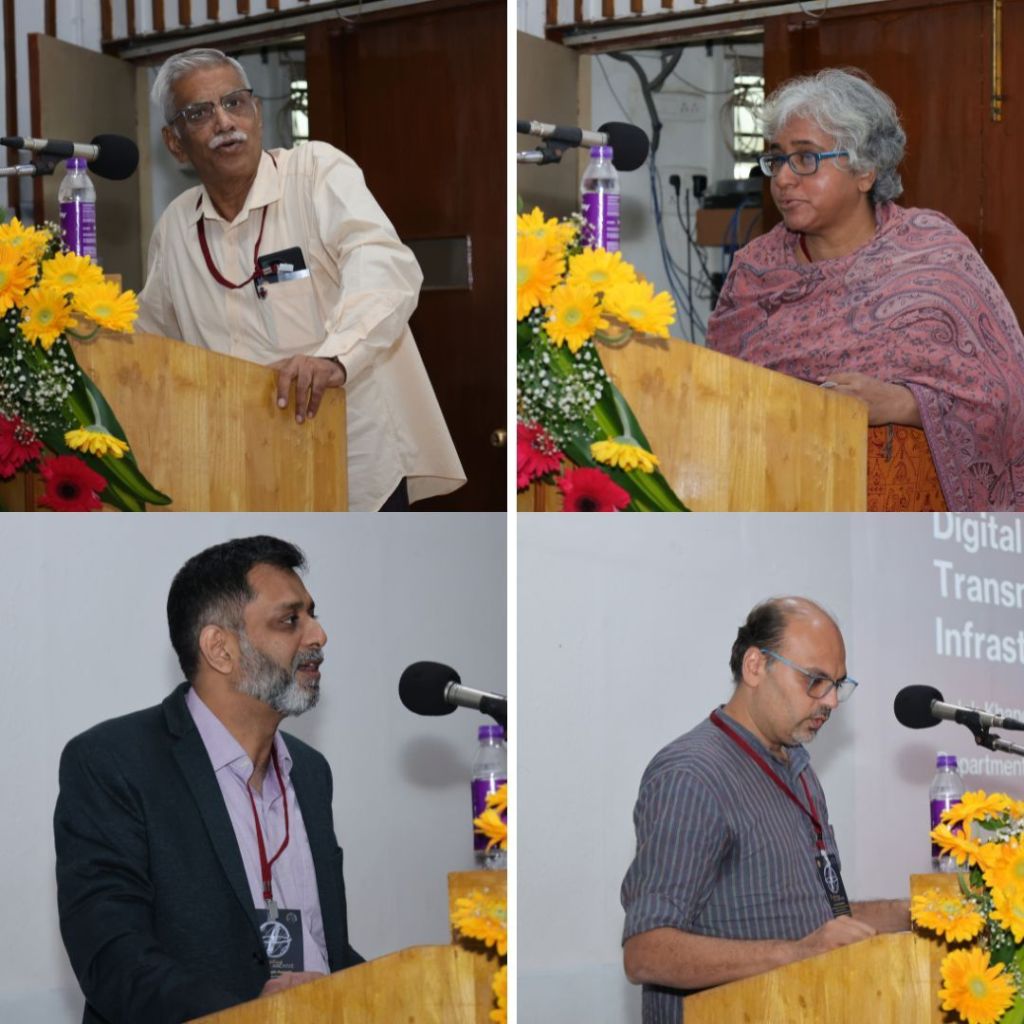
Starting off the next panel was Prof. K. Rajan, Academic and Research Advisor, Government of Tamil Nadu, and former Professor, Department of History, Pondicherry University. His talk was titled ‘History of Science and Technology – An Archaeological Perspective’, and delved into history and archaeology case studies that gave context to his engagement with the Archive. At the outset, Rajan set out to focus on a two-fold set of perspectives, that of Trade and Technology, and Water Management. However, due to a paucity of time, Rajan could only properly focus on the first – that of Trade and Technology. He outlined the historical nuances of the Musiri-Alexandria Trade Contract, and spoke about just how difficult it was to reconstruct the science of navigational history. Of how wood was used, of how sails were set, and much more. Monolithic monuments that go back at least 2500 Years present similar difficulties – how was the stone quarried? Early Gem Stone Industries are also interesting to look at – at what level of social organisation is a society that knows the difference between Corundum and Quartz? The complexity of entities like Hydraulic Devices in the 5th Century AD, or the components of water tanks from the same period present very interesting questions to the History of Science. In the same way that cultural understandings of technology shift, so do cultural understandings of religion and societal organisation – Rajan here gave an example of the Hinduisation of a Jain deity, and emphasised the requirement of an interdisciplinary lens in such historical analysis. So far, only the surface has been scraped. What constitutes the difference between the Indus Valley Script and “common” graffiti found on the site? Rajan concluded by remarking that in academia, we sit in a citadel. There is a need to go into the field, to extract and to document. Of course there is a requirement to move beyond paper, but there is still a fundamental need to record in order to make a treasure trove of cultural history and heritage.
Next up was Prof. Priya Sangameshwaran, Professor of Development Studies at the Centre for Studies in Social Sciences, Calcutta. Her talk was titled ‘Retracing Land in the City: Between the Archive and the Field.’ Sangameshwaran quickly mentioned how the title of her talk was at first a little different, instead holding the phrase ‘From the Archive to the Field’, but chose an edit that more accurately represented the actual cyclical process between the two. She began by noting that Archives have been instrumental in resolving debates surrounding the historical classification of various settler societies, and the way that land can be retraced through Archival research can be invaluable to studying various contexts in the Humanities and Social Sciences. Sangameshwaran then spoke of her own work on the land agreements of companies in Thane, studying ‘right to alienate’ clauses and the ways in which legal policy and history intertwine in the archive, as well as the implications that all of the above hold for urban land. Her archival research revealed several layers of interesting connections between the Thane Small Scale Industries Association, the princely Scindias of Gwalior, and the British Pharmaceutical Company Glaxo. Through an examination of legal documents from the Collectors Office, combined with research from other sources, Sangameshwaran was able to trace land through royal families, the Government of India, British Industrial Powerhouses and Investment Companies – thus riding through the political History of India, and the merger of the princely states into its fold. Along the way, she encountered scams and illegality. A search on the internet revealed a CBI Enquiry that was ongoing. After outlining her findings, Sangameshwaran reflected on methodology, remarking upon the importance of the internet and social media sources for her research. She noted the difficulty of verifying claims over land, and said that there was no reason to extend undue reference to archival records. Paperwork is constructed to meet various ends, which in turn work to create reality on the ground. She concluded by emphasising the need for a multiplicity of sources in research, while noting that her work, though extremely specific in nature, also traced the historical arc of India’s Federal and Financial Integration.
Dr. Aparajith Ramnath, Associate Professor in the Humanities and Languages Division, School of Arts and Sciences, Ahmedabad University, went next, with a paper titled ‘Writing a Life from Fragmentary Archives.’ He began by noting that digitisation as an archival practice has grown parallel to his career, and went on to speak of History as Ephemera. As something just beyond reach. He then delved into his own process of research, and his experience of dealing with Archives. Here Ramnath agreed with much from A.R. Venkatachalapathy’s talk – especially with the incompleteness of the ‘Control F’ school of thought. Accounting for the umpteen different spellings of the subject of his recent research project, Sri M. Visvesvaraya, was not exactly a cake walk. He spoke of his experiences on the project – of piecing together Viswesvaraya through the fragments of official letters, to stumbling upon an important set of photocopies in a small cupboard in an archive, to realising that most of what he learnt was not citable or “manuscriptable” but rather more contextual, related to the things he saw and the people he spoke to. For example, he outlined a memorable example of making the connection between Visvesvaraya’s Victorian sensibilities in official missives and finding Samuel Smiles books in personal effects. Very often, History of Science devolves into a history of the pronouncements of scientists, when it could be so much more. Ramnath concluded with a set of observations – what the historian gets is more than just the sum of individual sources, it’s a broader experience. The need to engage oneself in a set of texts from a certain period to gain a contextual understanding of one’s projects is just such an example: the way a historian can note a person’s handwriting changing as they get older, or get a sense of a bureaucrat from the specific nature and moods of the comments they leave in the margins of a document or report. Things like this prove that History should not try to be a science – it should be an art, it will be an art, albeit with a certain sense of quantification and rigour. This should not mean there should be a fetishisation of a certain kind of ideal archive. Moving forward from fragmentary pieces and the consequent process of interpretation is extremely important – even as a certain kind of necessary “jugaad.” Yet at the same time this should not serve as an excuse to not invest in systems that are robust and long-lasting.
Dr. Arun Menon, Professor of Structural Engineering at IIT Madras, titled his talk ‘Criticality of Archival Data in Built Heritage Conservation.’ This was an extremely interesting presentation from the Engineering point of view which dealt with the proper nitty-gritty of the consequences of archival use in the immediate, material realm. Menon focused on active, extremely detailed case studies which dealt with archival data that was used in the Built Heritage Conservation of three different Indian structures – the Konark Sun Temple, the Rashtrapati Bhavan, and finally closer home with The Kirk, or St. Andrew’s Church in Egmore, Chennai. He went on to compare the first few steps in approaching Built Heritage Conservation as extremely similar to what a doctor would do – Anamnesis, Diagnosis, Therapy and Control. He then went into each of the case studies. In the case of the Konark Sun Temple, he spoke about how various historical paintings, photographs, engineering drawings and palm-leaf manuscripts helped aid conservation engineering efforts. An archived as-built drawing by the ASI in a survey from 1903 proved to be of great importance. With the Rashtrapati Bhavan, Menon described how the Edwin Lutyens-designed structure, built with the intention of constructing a new language of architecture for the Raj that was a mish-mash between East and West, had issues of corrosion and distress with its 1.2 Kilometre long sandstone sunshades. Once more, an as-built drawing from 1931 proved crucial. Similarly, reconstruction efforts for The Kirk, after its steeple was struck by lightning, was greatly aided by archival records of engineering drawings. Extremely detailed drawings of its foundations were also important in deciding courses of action. In Menon’s concluding remarks, he stated that a potential research area was now open, where the study of historical ‘bills of quantities’ and receipts from previous construction efforts can provide insights into past conservation strategies and materials adopted for repair, and may thus be used for more economical efforts in the future. Finally, he emphasised the importance of an Interdisciplinary approach to Built Heritage Conservation.
During the Panel Discussion, Aparajit Ramnath reflected on the specifics of Visvesvaraya’s work documents, while the other panelists concurred with him upon the enchantment that historians encounter and experience when accessing the archive. Arun Menon answered a question on Heritage Conservation today, and the need for archival research to work in tandem with the conservation efforts in question. Venkat Srinivasan, Head Archivist at NCBS, asked a notable, tongue-in-cheek question from the audience: “So far many panelists have looked at the archive as incomplete evidence, have any of you ever seen it as false evidence?” Priya Sangameswaran answered that falsity of evidence itself is evidence for a researcher, and the very existence of falsity becomes a story for the researcher to undertake.
Panel 3: May a Thousand Archives Bloom

Kicking off the final panel was Dr. Aalok Khandekar, Assistant Professor of Anthropology/Sociology at the Department of Liberal Arts and Affiliated Faculty at the Department of Climate Change at IIT Hyderabad. His talk, titled ‘Digital Archives as Transnational Infrastructures’ was an interesting look at emerging Digital Archiving Platforms from the point of view of an STS (Science, Technology and Society) Scholar. It also analysed the efforts taken by online communities and infrastructures in making these spaces more inclusive and collaborative. Khandekar spoke of the importance that a 2018 Annual Meeting in Sydney had for the field of Transnational STS, which has always been very Eurocentric and US-centric, echoing Ronald Wittje’s observation that for many, “Europe has History of Science, the rest is Anthropology.” Small additions to Digital Archiving Platforms allow for the addition of metadata, as well as the logic behind the submission of certain materials to the platform – why and for what reason is a submission being made in a wider socio-political context? Is there a bias, or deficiency that is being addressed? Annotations and community responses further enhance the space of the Archive as being more collaborative – Khandekar demonstrated the same, showcasing a submission on an archival site that dealt with ‘The Lack of African ICT Research.’ Such efforts may go offline as well, as Khandekar showed examples of collaborative efforts, Exhibits and Archive Stagings that attempt to put forth into the world a more transnational articulation of STS, and develop a transnational experimental pedagogy that takes into account a broader range of perspectives that is a far cry from the Eurocentric beginnings of the field. Khandekar concluded by commenting upon the potential of archives in facilitating more open communities and ways of thinking. Archive are capable of showing the way to how things can be otherwise. Thus, the values, infrastructure and design of archives is crucial to paving this path ahead.
Paromita Vohra came next – the Filmmaker, Writer and Founder/Creative Director of ‘Agents of Ishq’, whose presentation was titled ‘Dancing with Documentary: Desire and the Archive.’ Vohra spoke of her experiences as a Documentary Filmmaker and the Creative Director of the multi-media project ‘Agents of Ishq’. She began by noting how the Documentary is perceived, how it seeks to present itself as inherently authentic. It presents itself as showing concern, truthfulness and virtue. Vohra questioned if these ideas were stable, and if there were ways to destabilise these same notions. Vohra sees documentary as a dance, with both the creator and the viewer “leading each other on”. Using clips from her documentaries, Vohra demonstrated how archives help build communities, and how communities help build archives. She also pointed out, using an example of a music archivist in her documentary, how processes of digitisation can be selective and damagingly partial for various reasons. There is an idea of relying on technology and digitisation as “saving” the archive, of pretending it is a purely scientific process, consisting of such and such technological steps in extremely high tech environments. It is important to move past this tendency and acknowledge the holes and slippages in this process. Through yet another documentary, Vohra explored the “messy” idea of archiving feminism and the “messy” women and conversations this historical process involves for each individual. She also spoke of how she experimented with looking for places that audiences could insert themselves into processes of archiving. This led her to speak of her project ‘Agents of Ishq’, which approaches archiving in just such a collaborative way, and which takes the body into account as well – as holding all types of knowledge – of hurt, oppression, caste and many other social dimensions. This approach also requires not just viewing oral history as something said and then recorded, but rather something that is co-created in a collaborative effort. Vohra further introduced many entries on ‘Agents of Ishq’. Two stood out – one was an entry on Dr. Alyappin Padmanabba and the other a Queer Map of Mumbai which sought to combine oral history and geography in its composition. Vohra concluded by envisioning an ideal where stories and histories are set side-by-side, where one is not privileged. The desire of the people involved in constructing the archive is what makes it as such – it is what in turn kindles desire in the person entering the archive. The archive itself, she said, need not always be imposing and institutional, it can and is very humble and personal as well.
Anuja Ghosalkar, the founder of Drama Queen, a Documentary Theatre Company, went up next with a presentation titled ‘The Best Hiding Place?’. Her presentation was simultaneously a performance as well – which opened up some very interesting interpretations of the space of the Archive from the point of view of the performance artist. Ghosalkar went on to say that the document is the heart of everything she does, in her field of Documentary Theatre, in the context of images, memories, metaphors, gestures and mediums. The heart of her performances are rooted in “archival interventions and provocations.” Commenting upon the subject of desire and the archive, and indeed the theme of the conference, Ghosalkar pronounced that she finds archives sexy, not simply enchanting. She went to cite her great-grandfather, who worked in Marathi theatre as Lady Anandi, as an inspiration for her own work. Yet another inspiration, and a person she did intensive research upon in the NCBS Archives, was the late Veronica Rodrigues – the biologist who worked at NCBS, whose academic advisor was Obaid Siddiqui. Ghosalkar went on to speak of her work on Obaid Siddiqui and Veronica Rodrigues, and how she reconstructed Siddiqui as an individual from various ephemera – bills, letters, and greeting cards. Looking at Rodrigues through Siddiqui’s folder was all the more interesting as Ghosalkar began to see as a female scientist in a man’s world. However, this interpretation in her performances resulted in complications later on, as people who knew Rodrigues in her lifetime disagreed with Ghosalkar’s interpretation of Rodrigues’ life. She commented upon how such events throw up complications for the archive user, and for the act of interpretation in general. As a performer, for Ghosalkar, archival practice is embodied, as her body itself becomes an archive. She concluded by quoting the poet Gaddar, as further commentary upon regimes that actively seek to destroy archives, and distributed a short pamphlet for the archive user working against such odds.
Venkat Srinivasan, the Head of Archives at NCBS, Bangalore, titled his talk ‘How Do You Solve a Problem Like an Archive?’ Presenting the perspective of the Archivist, Srinivasan’s talk – peppered with little jokes and humorous observations – dealt with outlining the complex process of archives becoming archives, of the on-ground reality of archives as sites of gatekeeping, and the way the archive is understood in the public imagination of India, all while emphasising the importance of understanding the Archivist and the Archive as two different entities. Using the example of the “rockstar” Canadian Entomologist Leslie Coleman “hopping across Empires”, Srinivasan demonstrated how lives and worlds may be reconstructed from the archive, while also acknowledging the difficulties that pop up in the process. Srinivasan emphasised the need to humanise the archive, as well as the people who access it, as he went through a set of criteria related to the different ways in which archives can be assessed and benchmarked. He spoke also of the Milli Archives Foundation, an initiative close to his heart, that seeks to create a “Catalog of Catalogs”, with the aim of fundamentally understanding archives as the enablers of diverse stories. Srinivasan concluded with a plea to build diversity in the very imagination of archives – to move away from archives simply as sites of extraction, to reorient the Archive as a “third space” for the public, and as a space for in-between stories. Most importantly, he said, archives should allow for multiple ways of seeing.
Moving, Ending
As Venkat Srinivasan wrapped up his talk, news arrived that barbarians were at the gates – students would soon flood into the hall for an upcoming class! The Symposium swiftly evacuated the Central Lecture Theatre and pitched its tents in the nearest available room. A warm atmosphere immediately pervaded, as a cozier, more intimate space announced itself – jokes, banter, critiques and reflections flowed around the little room, with its simple set-up of plastic chairs and happy human beings.
A reflective note was struck, as the participants looked back upon some fundamental questions thrown up in the Symposium – questions of the inherent exclusivity and exclusion that archives initiate, questions of methodology, digitisation and interpretive rigour. The wide mix of roles that the final panel embodied in their talks – from STS scholar, to Documentary Filmmaker, to Performance Artist, to Archivist – made the discussion especially interesting, as previous panelists chipped in with their own experiences and perspectives. It allowed for a gentle exchange of ideas, viewpoints and appreciative smiles – a space that was friendly and supportive, yet academically inquisitive and critical.

With the Symposium winding to an end, Roland Wittje, Mathangi Krishnamurthy and S. Ponnarasu shared their personal stories, aspirations and reflections with regards to the IIT Madras Archive. They also thanked the participants of the Symposium for their contributions from varied perspectives, and expressed gratitude for the attendance of all present.
Finally, the Archive Symposium, made possible and run tirelessly without a hitch by the team at the Archive of IIT Madras and a dedicated group of student volunteers, was declared closed by Mathangi Krishnamurthy – even as warm conversation and newly-hatched ideas continued to buzz around the room, breaking through the final curtain of applause.
Report by Yatin Satish
Photos by Team Archive of IITM

