
The Female Body, Animality, and the Politics of Liberation
– Arshia Jain
Who belongs to liberation ethics? Doesn’t everyone have the right to a decent existence?
Red meat has been linked, for ages, with virility, power, and manliness; as if the act of eating meat proves one’s virility. But what does it mean when the notion of being virile relies upon one’s capacity to ‘eat’ someone else? Could masculinity not be about conquering others? Couldn’t it be a choice to spare others from harm?
(Please note that the distinction between refusing meat eating and questioning animal exploitation is key for the argument presented.)
Women have often been associated with vegetables, purity, softness, and submissiveness. Their bodies have to be gentle enough to serve. The idea of femininity has been extended to nourishment and self-sacrifice. Since when does gentleness mean powerlessness?
Women have been fighting against the regulation of their sexuality, reproduction, work activity, and autonomy since forever. But when the question goes beyond humanity, the notions of ethics become unclear. Female animals are often appreciated for producing cattle, milk, or eggs and being of financial help for us. Their bodies are commodified as resources while their individual experience and interests are of no value in the economy. This contradiction is the basis of Femegan.
I define Femegan as a notion stating that every female being, whether human or non-human, has a right to humane existence without cruelty, exploitation, or suffering.
Carol J. Adams explores the ties between patriarchal culture and meat consumption with respect to the representation of women. Her ‘absent referent’ shows how animals cease to exist behind the meat. The latter is just a commodity while the animal behind it has been a living being before it was used up as the ingested commodity.
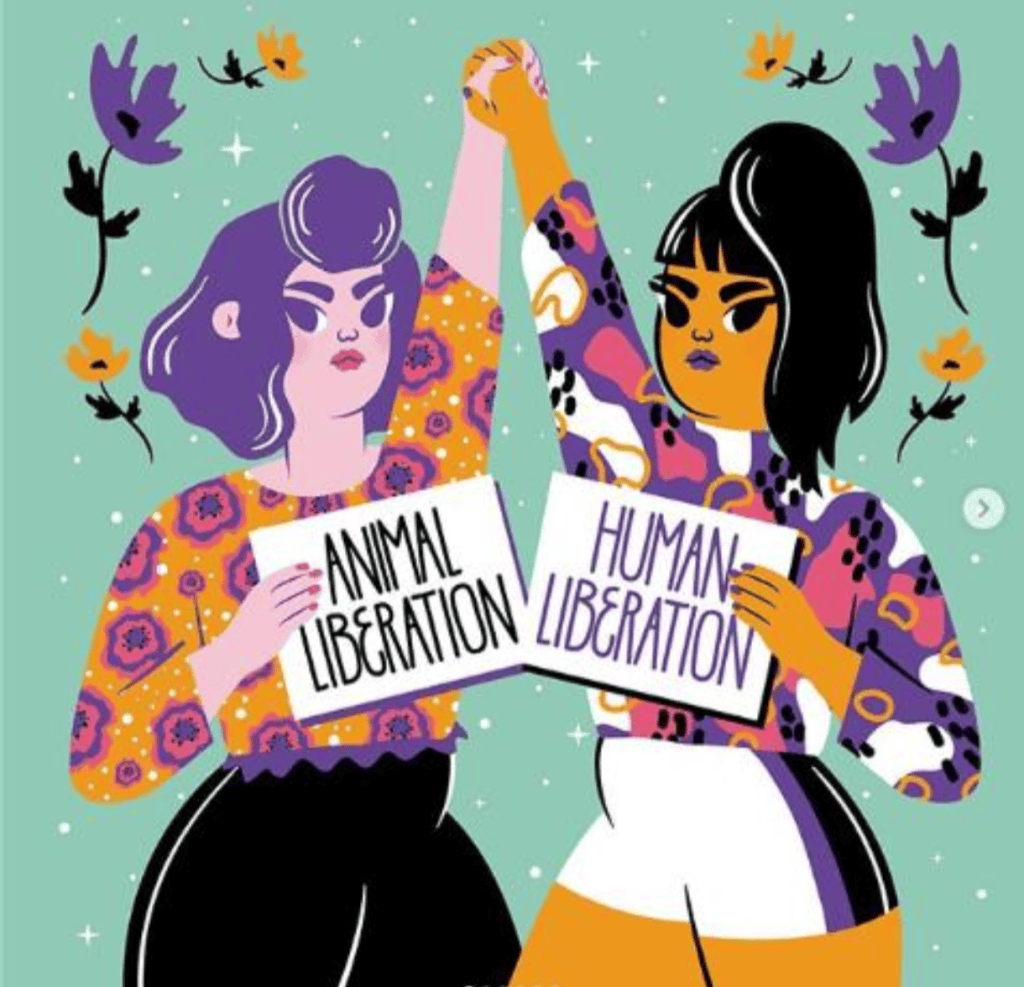
Through the works of Han Kang, J. M. Coetzee, and Charlotte Wood, I supplement Femegan as a lens for examining the processes through which certain people or bodies are assigned a value, stripped of agency, and turned into instruments.
The Politics of Consumable Bodies
Is freedom built on another’s suffering still freedom? This position of Adams draws attention to the relationship between visuals and material exploitation.
An animal is harmed because the animal becomes less visible as an actual living being in their own right. It is uncannily easy to see how something similar could happen in the case of women – being described or defined in terms of functionality of their bodies in sexual, reproductive, or commercial aspects. The subject of oppression is less visible than the function of their body.
But such comparisons should be drawn carefully. While women may become liberated by being recognized as human beings, they should not be compared to animals that have to look like human victims in order for their suffering to have a moral meaning. Femegan refrains from treating human female bodies as if they represented a particular type of universal figure that eliminates differences between species. My interest lies in how this (loose) comparison helps to fill in questions of agency, vulnerability, and ownership.
Adams presents an interesting way of looking at dairy production. Vegetarianism excludes meat, but it does not necessarily exclude animal products that are obtained through reproductive exploitation. Interestingly, milk is often viewed as a natural product, rather than an agricultural product which includes the reproduction and lactation of animals.
Femegan asks the following questions:
Could it be a valid description when a ‘compassion-based’ food practice excludes meat consumption?
Should ethical consumption be understood on the basis of the experiences of animals involved in the process of production or on the basis of the moral status proclaimed by consumers?
Analysis of The Vegetarian
Han Kang’s The Vegetarian (2007) is an exciting literary background for Femegan. The protagonist Yeong-hye gives up eating meat after having disturbing nightmares. While Yeong-hye’s decision looks like a personal preference to the reader, her family sees it as a breach of their cosmic and moral order. They turn it into a battle for power, compliance, and the right to control her body.
Yeong-hye’s vegetarianism cannot be automatically regarded as an effective feminist act. The plot shows how she becomes more and more alienated and mentally disturbed while her efforts to escape from human cruelty becomes intertwined with a desire to get rid of her humanity. Her supposed transformation into plant life raises questions about the desirability of freedom in a society which interprets a woman’s body in relation to its ability to fulfill the needs of others.
The narrative structure of the book parallels this. Yeong-hye does not control the narrative as much as it can be traditionally expected from a protagonist. Her husband, brother-in-law, and sister narrate her life. The protagonist is described as she is perceived by others, which also helps us to understand why she wants to escape reality and people’s influence.
Rose Casey reads the novel as feminist worldmaking by non-conquest. Alix Beeston compares The Vegetarian and Charlotte Wood’s The Natural Way of Things delineating the complicated relationship between women and animals; showing that it is wrong to romanticise the fantasies of a woman about escaping from a violent society.
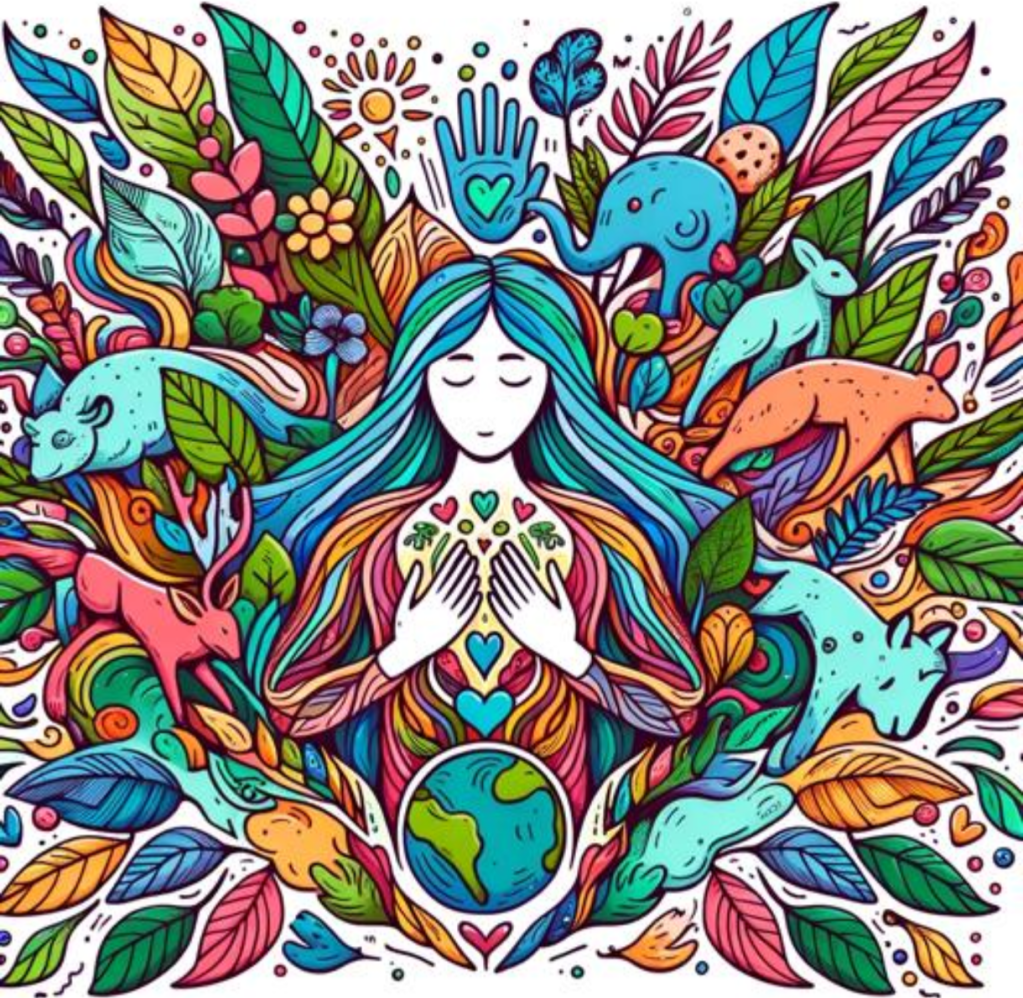
Femegan distinguishes between the denial of violence and the denial of one’s existence. Even though Yeong-hye’s refusal puts into question the idea of her body being an object of family pressure, her suffering indicates that it is impossible to understand her withdrawal as an easy way of achieving freedom. The ethical issue is not resolved just because a woman refuses to take part in one kind of violence.
Analysis of The Lives of Animals
J M Coetzee’s The Lives of Animals (1999) shifts the focus from a woman’s rejection of eating meat to the intellectual and moral implications of sameness in pain and suffering among humans and animals. Using Elizabeth Costello’s fictional speeches, Coetzee challenges the beliefs that allow humans to claim moral superiority over animals.
The oppression of women and the reproductive abuse of cows and buffaloes reveal a troubling notion that women’s bodies only exist to fulfill somebody else’s desires. Women are victims of sexual abuse, while female animals are subjected to forced impregnation, forced pregnancy, and mothers getting separated from their calves. Calves are also forced to either die or to be treated as disposable. Although these experiences take place under different contexts, both require us to ask how can living beings be treated like objects to be controlled and exploited? If motherhood deserves respect, how come a mother’s sorrow gets ignored so easily when she is not human?
The arguments presented by Costello disrupt the comfortable difference between day-to-day social life and ethical responsibility. The book asks whether sophisticated thought is compatible with indifference to suffering of beings who are “meant” for human consumption.
For Femegan, Coetzee’s novel brings in an important complication. Female-centered ethical theory should explain the importance of the victim’s sex without stating that only female victims are ethically relevant. Male animals can also suffer, be imprisoned or killed. Their suffering cannot be ignored simply because it lies outside the scope of this framework. As a result, Femegan is required to differentiate between expressing compassion and studying the approaches by which suffering has come to be structured, hidden, and kept alive.
Analysis of The Natural Way of Things
Charlotte Wood’s The Natural Way of Things (2015) takes place in a distant institution where women are held captive and subjected to humiliation. The animal imagery used in the narrative and the description of captivity sheds light on how women can be deprived of their liberty through discipline, punishment, and so-called natural hierarchy. The importance of the novel lies in the fact that the association of women with animals has an unstable political meaning. Historically, the idea of women being likened to animals has served as a means of denying women reason, dignity and social fullness. At the same time, feminists and animal studies scholars have questioned whether the animal state is pathologically devalued over time.
Feminism has dealt with this conundrum. If it confronts the injustice of female animal exploitation by drawing a parallel between the treatment of animals and women, it should refrain from assuming that being an animal in itself is a negative even if it seeks to equalize the status of animals and humans. It is not about giving animals a human status implicating that their lives are worthless. Instead the objective is to challenge the hierarchy that makes human identity a criterion for moral treatment.
The novel also unmasks the nature of the institutions that call their actions natural. Even the term nature can be a disguise for how the imposed arrangement operates. This idea can be applied with caution to agriculture. Social practices that seem normal may not be transparent as to what is involved in their processes. However, this analogy can hardly provide insight into the actual conditions of agriculture; independent evidence is required. But what the novel does accomplish is in providing the research questions for further empirical research related to the body, the owner, and the permitted suffering.
Limitations of Ethical Eating
The Femegan philosophy is not holistic if it reduces ethical responsibility to the actions of individual customers. Food practices are dictated by income, location, health, culture, family, and access to options. Not everyone has the same opportunity to be vegan. The moral weight of a dietary choice cannot be evaluated in isolation from the context wherein it is made.
In the Indian milieu, this issue becomes even more pronounced. Vegetarianism is associated with religions, regions, families, and the concept of purity. Neither can these practices be squeezed into one explanation nor can they be regarded as something that automatically amounts to the animal-liberation ethic. One can avoid eating meat for cultural or religious reasons while being indifferent to how milk is produced. Conversely, one can be deeply concerned about animal welfare without having the means of choosing a more ethical option.
Rajasthan exemplifies this incongruity between the reverence paid to cows in theory and the reality faced by cattle in practice. Reports from Jaisalmer (May 2026) indicate numerous carcasses of animals lying abandoned in an open municipal dump, culminating in substantial public outcry and consequent action by the officials. This incident gave rise to the harrowing question of what happens to the animals after they are branded useless. If an animal is worshipped, should it not be treated with the same dignity even after its death?
Val Plumwood’s Feminism and the Mastery of Nature (1993) provides a framework for understanding the hierarchies of thought distinguishing human culture from nature. Her theory talks about why the relationship between the impact of domination in society and the environment cannot be understood through individual ethics alone. Power relations also determine which lives are to be considered resources and what interests are excluded from the decision-making process.
Thus, Femegan needs to differentiate between the idea of ethical aspiration and moral enforcement. The goal of Femegan is not to create a new hierarchy between pure and impure consumers, but instead to address the driving factors that make such exploitation possible, socially acceptable, and unavoidable.
Bibliography:
Adams, Carol J., The Sexual Politics of Meat: A Feminist-Vegetarian Critical Theory (New York: Continuum, 1990).
Beeston, Alix, ‘The Watch-Bitch Now: Reassessing the Natural Woman in Han Kang’s The Vegetarian and Charlotte Wood’s The Natural Way of Things’, Signs: Journal of Women in Culture and Society, 45, no. 3 (2020), pp. 679–702.
Casey, Rose, ‘Willed Arboreality: Feminist Worldmaking in Han Kang’s The Vegetarian’, Critique: Studies in Contemporary Fiction, 62, no. 3 (2021), pp. 347–60.
Coetzee, J. M., The Lives of Animals (Princeton, NJ: Princeton University Press, 1999).
Edited by: Esha Ann Mariya | Design by: Priya Alex

