
Article 19’s correspondent Aswathy Venugopal in conversation with Sneha Annavarapu, who graduated from the Department of Humanities and Social Sciences, IIT Madras, in 2014.
Sneha is currently doing her PhD in Sociology at the University of Chicago. She can be found loitering in the streets of Hyderabad, supposedly doing sociological research while actually just Instagramming.
To begin with, can you tell us briefly about your academic endeavours since you graduated from the department?
Firstly, thanks for giving me a chance to connect with the department via this interview. I have missed out on quite a lot of alumni meetings, so it’s a pleasure to be interfacing with you one way or the other.
To cut a long story short: I graduated from the department in June 2014 and in September, I flew to Chicago to start graduate school in Sociology at the University of Chicago. For those of you who don’t already know this, a lot of PhD programs in the US have an MA requirement built into them, so I spent a couple of years in Chicago completing my MA in Sociology and then, since 2016, have been doing my PhD in the same discipline. This is pretty much all I’ve done since graduating from the department.
Can you tell us about the doctoral thesis that you are currently working on? What prompted you to take this particular topic up? What do you plan to do after completing your PhD?
My doctoral thesis, very broadly, is on how drivers from various social and economic positions in Hyderabad negotiate risk, safety, and pleasure in the city. Under the biopolitical state, ‘personal safety and injury prevention’ is the rhetoric that mediates disciplinary mechanisms such as traffic rule enforcement in metropolitan cities like Hyderabad and the figure of the “errant” and “unruly” driver is the object of social reform and regulation. Much of this disciplinary effort is contingent on how citizens view state authority and how rule-compliance is elicited by the state. So, my study seeks to examine the relationship drivers have to state authority in Hyderabad and what that can tell us about the social life of rules and authority in contemporary urban India.
I was actually working on a totally different issue for my MA in Sociology at the University of Chicago. My MA was on public kissing and moral panics in Mumbai and social control of public spaces has operated in the city through time. So, it was a bit of an empirical leap when I chose this doctoral thesis topic instead of just building on my MA work. But, basically, I was in Hyderabad in the winter of 2016 when I noticed a lot of “buzz” around road safety in the city – quirky messages on the roads, social media handles of the traffic police were becoming very active, there were (and still are) CSR efforts by automobile companies to educate school children on traffic safety, popularization of e-ticketing system of penalizing traffic rule-violators, etc. And yet, I was told over and over again that “nothing will change”. I became curious about this disciplinary effort and how it was being understood and acted on by drivers in the city when I realized that nobody had written a good book on driving in India even though “drive talk” permeates our urban condition. So, I thought it would be a fun project to embark on. Plus, I finally would have to stop procrastinating and learn how to drive (for the project, of course), so at least this way I pick up a life-skill…
Well, I want to teach at a university once I am done with my PhD. So, there you go – that’s a short answer. Finally!
How far has your time in the department helped you in developing your passion for research in general, and sociology, in particular?
I doubt I’d ever say that I have a “passion” for research. To me, it’s a job and like any other job, there are pros and cons to it. Sometimes I wonder if I even “fit in” because I have very little patience and research requires a lot of patience. Having said that, there is no one way to do research. Everyone has their own set of skills they bring to the table. I, for instance, love teaching and that’s the primary reason I decided to do a PhD. Now, the department may not have directly fuelled my interest in sociology per se, but it did make me realize that I wanted to teach. And that’s something I decided to take seriously. There were some classes I liked more than others, obviously, but each class led to some cumulative experience of being in a world where thinking critically is valued. And that’s what prompts me to stay on in the university context.
Sociology is not something I am actually still sure about. It’s a running joke in my department at the Univ of Chicago that I don’t do sociology. I am doing some interdisciplinary project while pretending to be doing a PhD in sociology. My thirst for looking beyond my so-called discipline is, perhaps, the biggest effect DoHSS has had on me – for better or worse.
How did you go about choosing where to apply for your higher education? What made you choose further studies over work?
So, my choice of universities was actually a very random process of going through the top ten universities for sociology in the US, and then being blindly sure of myself and applying to most of them. As you can imagine, I got a ton of rejects – because that’s what happens when you don’t plan your application process logically – but I also got three good acceptances which I attribute to luck and the fact that I wrote to faculty members that I wanted to work with and built a rapport with them (and, perhaps, a diversity quota). It is important to reach out to the people you want to work with early on (at least 6 months before you apply) and try to get them on board with your application. In my experience, I emailed Prof Kristen Schilt in June 2013 and she agreed to work with me if I made it – and she’s the chair of my committee today. So, early correspondences matter a lot more than one would think. If I could do things differently, I would make a list of universities based not just on the ranking but – more importantly – based on how many faculty members I can see myself working with. I didn’t do that for all the schools I applied to, and I didn’t make it to a single school that I did not bother establishing a rapport at. More generally, I would say that it’s always a good idea to apply to 3-4 great schools and 2-3 “average” schools. That way, you spread your chances out but you don’t undersell yourself.
Well, you won’t believe how much “work” “studies” is especially in an American university context where some component of teaching and grading is built into your graduate education. Graduate school offers a kind of flexibility that traditional work does not really allow for – which is what I like most about my life right now. There are days, weeks and months when I am painfully busy and stressed out but there are also days when I can just decide to chill, switch off my brain, and just do something else. Especially when one is ‘ABD’ (all but dissertation), your time is really – sometimes illusorily – in your hands and that is both a pleasure and a difficult responsibility. But, it’s still your call, and that can be a perk if you use it well.
Your research interests seem to lie in topics of high contemporary relevance such as honour killings, heteronormativity, Hindu nationalism etc. How effectively do you think can sociological analyses of these issues and research efforts bring about a change in the social attitudes surrounding them?
I think that critical discourse is never unimportant even if some people believe otherwise. Scholarship can be effectively used in the public realm to trouble taken-for-granted assumptions about how social life works. That’s why sociological analysis is important. To show the connections between seemingly disparate institutions is, supposedly, our strength so we need to use that to highlight and expose the invisible connections that reproduce social life as a ahistorical, unchangeable “reality”. That’s our mandate as critical thinkers. I do think that when we do engage in political conversations, we have to engage with empirical evidence, with analytical acumen, and – most importantly – empathy. Plus, writing for more open access and public media is critical. Access to critical discourse is crucial in making our work more politically relevant, and it’s up to us to make that happen.
Having done an impressive amount of research in the social sciences and being a research scholar at the University of Chicago, how well do you think Indian universities are equipped in terms of providing research opportunities for students of the social sciences?
Hmm. Quite fundamentally, there is a problem of resources. Having access to journals and books requires a lot of funds which many universities either do not have, or do not allocate to humanities and social scientific research. That, to me, is an issue that some of us solve using informal networks – so, for instance, I download some articles and send to my friends in India in case they need it for their research. But, I suppose, there has to be a more institutional response to this issue. Other than that, I think having more collaborative projects will be a great idea to involve more students in research at a younger age. Collaboration even at the institutional level – with universities, colleges, or even NGOs, working together on projects – might provide opportunities for students to get more involved in research projects.
What did you like the most about the nature of academic rigour in the MA course at the DoHSS? How different is it in Chicago?
The MA course, during my time, was a mixed bag of academic freedom and intellectual flexibility – which, at times, was more disorienting than helpful. Of course, with time, one tends to find clarity and balance but it can get confusing initially. Chicago is different perhaps because it’s an older institution so, you know, there is an established way of doing things. And it’s a single discipline, so it’s easier to orient oneself within a discipline as opposed to trying to find a footing across several disciplines. Academic rigor in the MA course was more about contemplating the several possible approaches to interpreting social life. To me, one of the most rigorous courses we ever did was Pritha Gopalan’s Field Methods and Report Writing. And that’s why I think paying attention to research methodology is key to establishing any sense of academic rigour. Research methodology and research ethics should not be given less priority than theory – they are, if anything, more important at an undergraduate level. It is difficult for any good work to be rigorous if it is not borne out methodological clarity. I think the MA course has done a very good thing by spreading out the MA thesis over two semesters. During my time, it was just one semester which made for some sloppy last-minute work.
I think that another very important aspect of “academic rigor” is that it is a function of how much time one is willing to put into one project. That requires effort from both the student and the advisor. My MA advisor, Mathangi Krishnamurthy, read several versions of my MA and gave tons of advice every single time. The fact that I could turn my MA into a journal article was, again, a product of several iterations of editing and inputs from my advisors at UChicago as well. Academic rigor is hardly possible without a dedicated effort towards ripping apart your work over and over again. And that requires time, patience, and commitment from both professor and student. 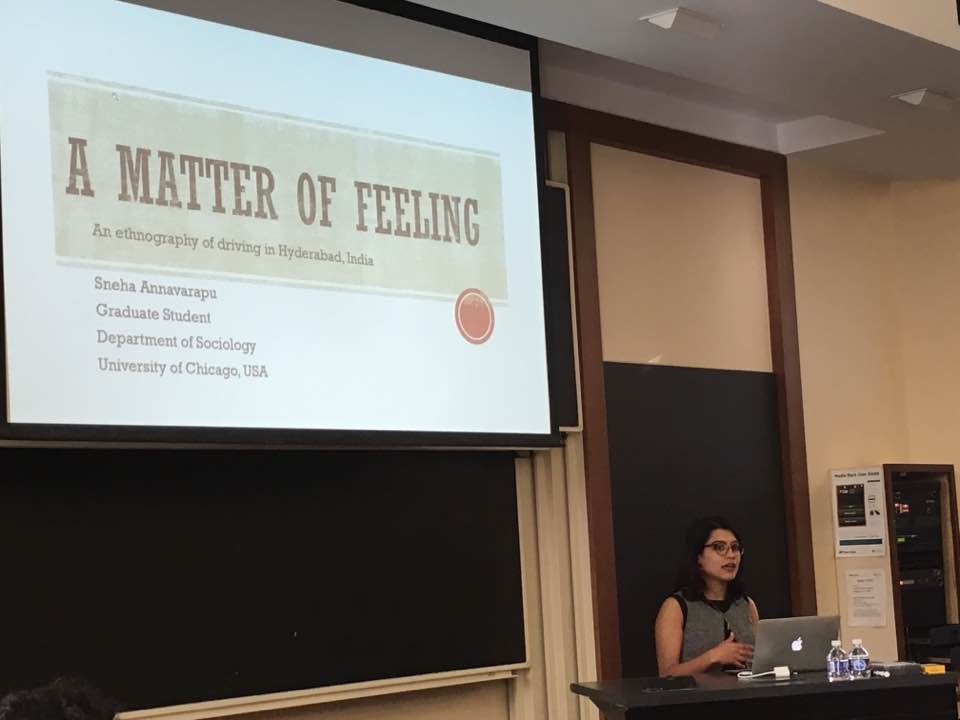
Having presented papers at several conferences and having worked in the organising committees, what would your comments be, on the annual academic conference organised by our department? Do you have any suggestions to give, with regard to this?
I think that the academic conference has evolved into a sophisticated and vibrant space of its own. I think the themes, papers, and guest speakers in the recent past have all been chosen and curated really well. Perhaps having smaller sessions on higher education, etc. could become a part of the conference where you could invite people to speak on research in India and abroad. – how to apply, prep for that, etc. That might be a practically useful thing to do, if that’s not being done already.
How would you describe your writing style? Could you give some advice or tips to aspiring researchers in the department regarding how to plan well and make the most out of their five years in the department?
When I was a student in the department, I used to feel this need to write in a complex and jargon-heavy manner that I am glad is no longer the case. For some reason, I had believed that good social scientific writing needed to be filled with “serious sounding” terminology. It was actually just a smokescreen – I had no idea what I was talking about and, thus, resorted to using complex jargon to obfuscate the fact that my basics were weak. As someone who grades undergraduate papers in Chicago, I see the same trend there: students who don’t know the concepts too well, hide behind jargon. And, of course, we grade them down. Over time, I have realized the immense pleasure of writing in a manner that can engage a wider audience. And it really is tougher than one might think. It is also a politically charged strategy to write inclusively. Alienating a set of uninformed readers is, by no means, inclusive. My advice to current students would be to write clearly, and write honestly. I also always advise undergraduates to read fiction, or even non-academic non-fiction to write in a more engaging manner.
In terms of practical advice: if you’re sure that all you want to do is a PhD after your MA, start early and begin to draft your application in the summer preceding your fifth year; plan your GRE and TOEFL early enough so that you can give those exams again in case you don’t do well the first time.; work on your writing sample – that’s quite important; write to faculty members you want to work with; ask for letters of recommendation early enough and make sure to share your writing sample and CV with your letter-writers; write to seniors who are doing their PhDs, take advice from them. Personally, I feel like one should apply for a PhD after graduating from the dept, not during the fifth year. Your MA thesis will make for a good writing sample, so it makes sense to apply after graduation. That will also give you some time to think about where you want to apply, what you want to apply to.
My more general “life advice” to aspiring researchers in the department is to not take research or academia too seriously. Please don’t stress over every failure, every rejection – trust me, there are more rejections in the academic world than there are acceptances. And, seriously, it’s not just you. Everyone, everywhere is dealing with some form of rejection or the other. Having that perspective is important because academic research can be isolating, lonely, and emotionally draining. Build a community of trust, empathy and care while you’re in college because that’s what ultimately matters.
Finally, can you tell us something about your campus life in Chicago? Also, how was hostel and campus life in insti?
Well, there isn’t much of a ‘campus life’ to speak of in Chicago if you’re a graduate student. Ours is a campus that blends in with the neighbourhood it is situated in, so I often talk about a ‘Hyde Park life’ as opposed to a ‘UChicago life’. I live on my own and the community I’m often a part of is just a set of friends I love to hang out with, work with, or get out of campus with. I’ve never been someone who identifies too strongly with the institution they’re a part of, so I don’t know if I even think about ‘campus life’ in a prescribed manner.
I wasn’t a very socially active person in insti, so I am not sure what I have to say about insti life. I hardly ever participated in Saarang or Shastra in any capacity whatsoever. No regrets; do it if you want to, don’t do it because you think you need to. I loved campus life for the opportunities it presented to make lasting friendships – the hours spent at CCD, Guru, T Gate or Tifs seemingly doing nothing of great importance. Towards the end of my stint there, I loved running on campus and I loved teaching some of my friends how to swim! That was great fun. Night-time walks were delightful – and I am sure most of you know why – and that’s not a luxury all other campuses can offer. Hostel-wise, not much to say. I don’t remember being involved in any co-curricular activities except, perhaps, Drams (say, once?). I guess I miss being terrorized by the dozen or so monkeys that would prowl about every morning and evening? Either way, it was home.
All I remember from campus life is that I used to read a lot, often either in my room or at CCD, and I would get out of campus a lot and definitely more so than some of my peers. That was partly due to having family in the city. So, I discovered Chennai a lot more than I discovered IIT Madras. Even now, I visit Chennai very often and I realize that my love for it can hardly ever diminish because I associate college life with the city.
Interview by Aswathy Venugopal.
Interested readers may find a link here to an article by Sneha, published on ‘Agents of Ishq’, in which she gives a compelling account of one her research interviews that revealed unexpected yet profound insights into sexuality, desire and consent among her research subjects.

