
Panel 1 of the Conference was moderated by Professor Kalpana. Of the three speakers, only one was able to present her paper as the other two were unable to make it to the conference – Sulthana Nasrin, a Masters student of EFLU.
Sulthana’s paper was titled “Reflections on Death as an Ability: Questioning the ‘Body’, Violence and Values in Times of Hatred and Mob Lynchings.” She talked of the body of the individual as well as the community, and whether only one or both are being violated during such heinous acts. She began by saying that the life of an individual has been recorded in terms of birth and death. The terms auspicious and inauspicious have been associated with birth and death, which invariably assumes that birth corresponds to death. It is from this that the issue of violence crops up, including the violence that pertains to mob lynching in India.
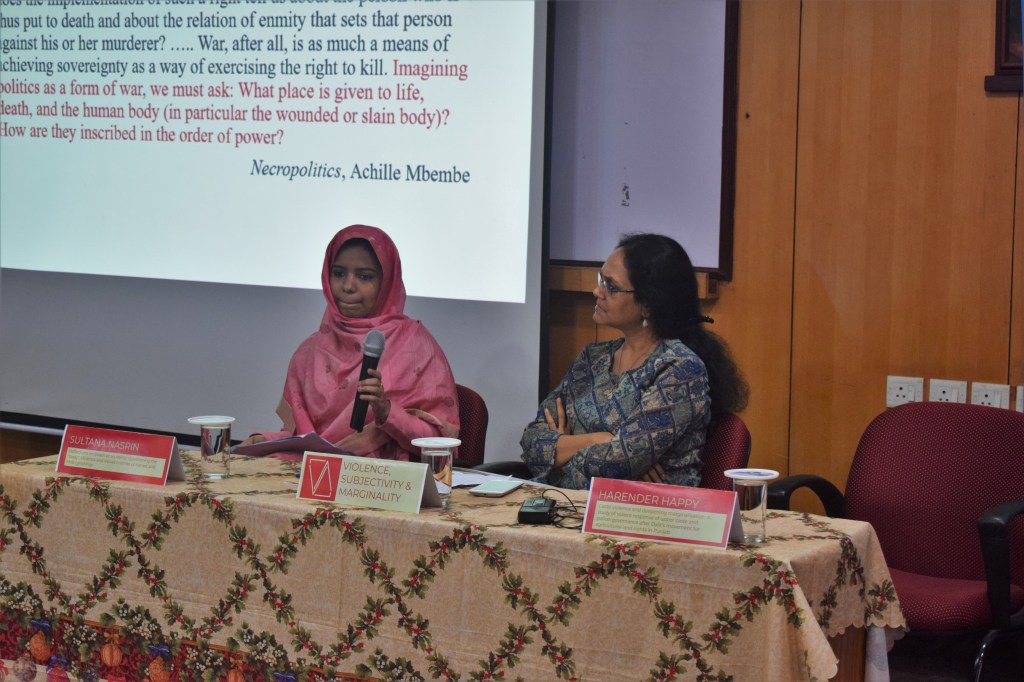
Here, she pointed out, it is essential to differentiate the blanket terms of ‘Rights to Live’ and ‘Rights to Die’. She also mentioned that conventional ideas of community building centered around birth as auspicious and death as inauspicious, but on the contrary, in the political sense, community building is largely related to killing or murder. She spoke of identity closure which pre-assumes that a certain community has to live or survive while the other is out or closed. She spoke of the othering that occurs in the country and how lynchings and persecution of some communities come to be seen as necessary over time. She talked of the imagined spaces of ethnicity, and that unseen violence should be analysed more, along with the politics of persecution.
She then spoke of how one person’s death will go unnoticed in the larger scheme of things, as opposed to that of a genocide, but also ensures the fear is struck into the hearts of the community. The mob lynchings that are prevalent in India today do exactly that. One can certainly see a link between religious identity and cultural practices as inciting reasons for violence, and also how certain practices are expected to come along with religious identity.
She also spoke of the media’s role in normalising the violence. The denial of bereavability also contributes to this. She talked of the right to die of the people, and also of the politics of sloganeering – along with mob lynching, there are incidents of forceful chanting of slogans during the acts of violence. Videos of these are circulated vehemently to further shun the community. The politics of hate is spread through these slogans. She also elaborated that minorities don’t not just exist, they are created through specific discourses of the nation, as carriers of unwanted history. The minorities blur the line between us and them, as they are necessary, but unwelcome. Minorities were always worried about their rights, citizenship, belonging and about their entitlements from the state. How the majority identity becomes the national identity was also explored in the paper.
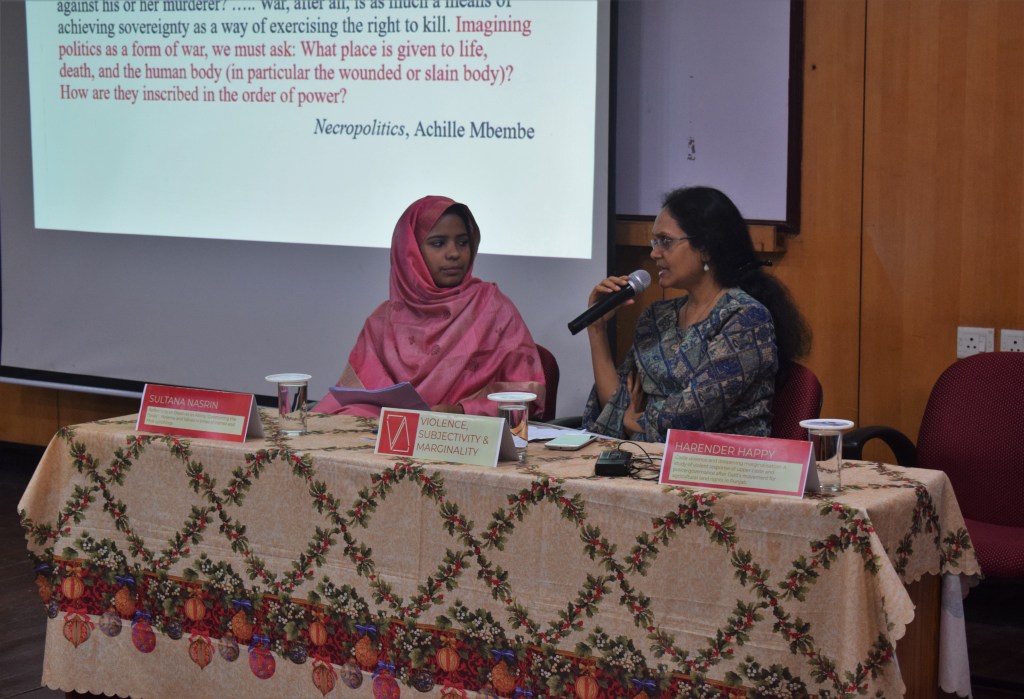
In the Indian scenario, minority refers to Aadivaasis, Muslims and Dalits, who are also perceived as a threat to nationalism. They are abused, violated and lynched to death. Humans viewed as insufficient by others are often the first target of marginalisation and cleansing. They are the weak elements of state entitlement, and have to compete for highly contended national resources. She also spoke of the politics of partition, and how it has called upon certain communities to prove their Indian-ness. She says that uncertainty of terror is completely exploited through the pervasive fear of small numbers. She summarizes by saying that one’s Right to Die is in many ways the bare minimum freedom that is possible, to squeeze out the last possibility to die as one wants to.
She concluded by stating that violence and terror are used hand in hand to justify mob lynchings, and are built from an uncertainty of madness. Uncertainty is a terrible political oppression. It can lynch and kill the other without rights, but also deny others’ rights. The moment of survival is in itself the moment of power. It is the positive power that is envisioned and aspired through engaging with the project of Right to Die.
The panel was then opened for a Q and A session.
Report by Meghna M
Photography by Sakshi Malpath

