
— Devika Dinesh
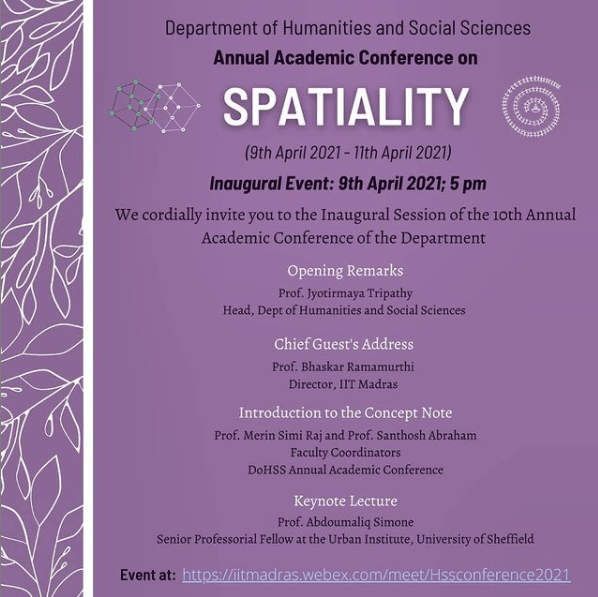
The 10th edition of the Annual Academic Conference of the Department of Humanities and Social Sciences kicked off on Friday, April 9th 2021. Following opening remarks and the Chief Guest, Prof. Bhaskar Ramamurthy’s address, the concept note was introduced by Prof Merlin. Simi Raj.
The theme for this year’s conference was ‘Spatiality’. Prof. Merlin noted the acute relevance of the theme in light of the changes we have experienced all over the world, since the outbreak of the global pandemic. In the past year, distinctions between the physical and virtual space have become harder to define in rigid terms. She discussed the changes the term ‘space’ underwent in academia since the 1980s. It became a much more fluid category that had significant influence over societal structures, institutions and even human relationships.
Space and spatiality have also been deemed as very political categories as well. The concept is also, quite often, tied to temporality as well. It has particular relevance in the field of memory studies. Prof. Merlin noted how spatiality assumes physical, metaphysical and spectral dimensions. She then went on to note that of the more than 220 abstracts that the Conference received from across India, the 20 best papers have been selected to be presented. Furthermore, there were to be 7 exciting panel discussions over the course of the Conference.
The historical significance of the period that we’re living in, especially in terms of the blurred boundaries between physical and virtual reality, was emphasised once again. With the hope that the next two days would provoke thoughtful discussion and debates, she concluded by thanking the participants, the Director and HoD, and the student community that worked tirelessly to conduct this conference in these challenging times.
Following the introduction of the concept note, the compere, Sharanya Kannan, introduced the keynote speaker for the inaugural lecture – Prof. AbdouMaliq Simone. He is a senior Professorial Fellow at the Urban Institute of the University of Sheffield, as well as a visiting Professor of Urban Studies at the African Centre for Cities at the University of Capetown. He begins by exploring the various meanings attached to the term ‘spaciousness’, in the particular context of urban spaces in Kolkata, and the varied ways in which they are being occupied. He talks about the various stakeholders involved in this process of defining and owning various spaces. He then elaborates on the various mechanisms of production involved in making such built environments, such as Special Purpose Vehicles and State Guarantees. The implications of urbanisation is also discussed, ranging from climate change to micro-toxins within households.
He discusses the various elements of broken-ness that seeps into urban life, in terms of both social conditions such as broken solidarities and material conditions such as houses that last less than ten years. The possibility of being ‘settled’ moves further out of reach, as constant movement becomes the norm. ‘Urban’ becomes a constant recalibration of movement.
Prof Simone then goes on to provide a brief history of space in the city, using perspectives from various schools of thought. Following which he gives a lucid explanation of the concept of ‘extensions’, emphasizing its detachability and artificialness. He elaborates on the topic with the example of the city of Jakarta. In discussing the nature of human relationships within these urban spaces, he also discusses subaltern possibilities. He concludes by asking several poignant questions urging the audience to think about redefining access to resources, sustainable inhabitation of urban spaces and the interplay between extensions and the broken. Following the lecture, the floor was opened to questions, after which the compere closed the Conference for the day after presenting the programme for Day 2.
Design by Conference Team

