
— Sharanya Kannan
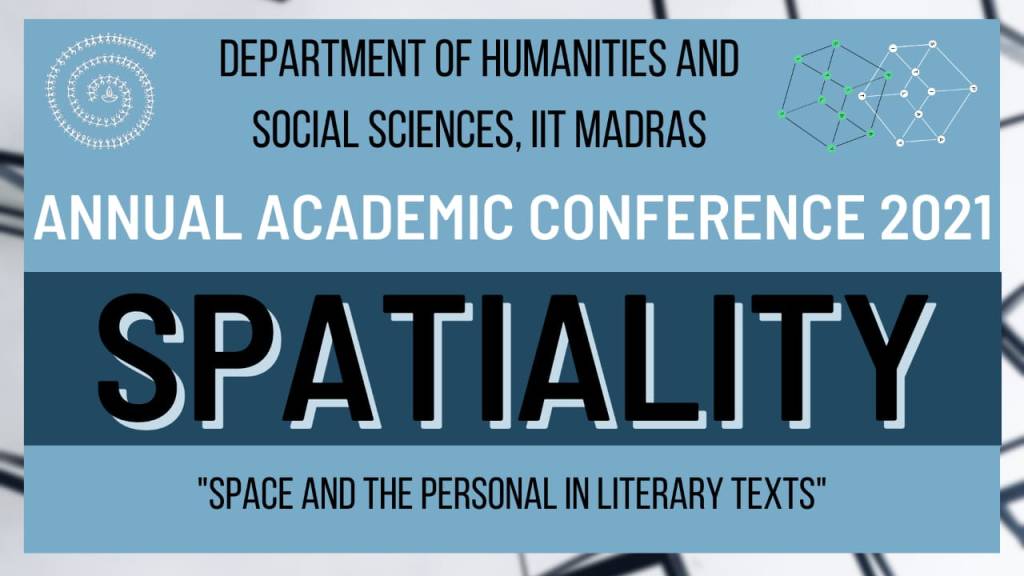
The first panel of the annual department conference, themed “Spatiality” this year, was on the topic “Space and the Personal in Literary Texts.” It took place on 10th April, Saturday. The session, moderated by Prof. Divya A, featured two panelists who presented interesting and thought-provoking papers. The third panelist was unable to attend due to medical issues.
The first panelist was Amrutha P U, a research scholar in English Literature from University of Hyderabad. Her paper was titled “Gendered Mobilities and Spaces of Resistance and Adaptation in Chimamanda Ngozi Adichie’s Novels.” In her paper, she focussed on issues of spatiality, migration and gender through the lens of two novels by Adichie, a Nigerian diaspora author — Americanah and Half of A Yellow Sun. As a post-colonial feminist, Adichie’s work deals with the gendered experience of mobility and the “doubly disadvantageous” position of women in these narratives.
Ms. Amrutha’s paper analysed the relationships and power dynamics associated with gender, and female bonding in unlikely circumstances with a focus on the evolution and transformation of feminine spaces during the process of mobility. The paper analysed the different gender roles played by Adichie’s female characters — while some of them align with patriarchal expectations and occupied the domestic space, she also represents the new trends in women’s mobility. The paper also touched upon Adichie’s analysis of the autonomy of women’s migration, and its dependence on gender relations in the home country. According to Ms. Amrutha, Adichie “demystifies the notion of choice in the neoliberal, late-capitalist migration, specifically from a gender perspective.”
The paper analysed spaces of emotional and sexual vulnerability through the characters of Eberechi in Half of a Yellow Sun and Ifemelu in Americanah. It also discussed the sexual exploitation and other difficulties of gender and power dynamics in the brutal masculine space of war, and the extra responsibility taken up by women in the domestic space when they are displaced. Other themes were the loss of space, both physical and psychological, and the adaptation of the displaced people as they forayed into spaces of unfamiliarity.
A major theme was the notion of “safe spaces”. The paper suggests that the Internet is envisioned in Adichie’s Americanah as a safe space through which the displaced women could regain access to their home culture. She sketches female spaces as those of “resistance and reclaiming”. There was also some discourse on the concept of “home”, its impermanence and constantly transitioning status in the minds of the displaced. The paper supported the reclamation of space by the marginalised as “constructive resistance”.
The second panelist, Noel Mariam George, is a doctoral student at IIT Madras in the Political Science and International Relations Department. She presented her paper on the topic “Being ‘with/also’: Intimate Spatial Metaphors in Virginia Woolf’s To the Lighthouse.” Ms. Noel said that she had originally started thinking about Woolf and the concept of spatiality while doing her Bachelor’s in Literature.
In her paper, she had two objectives in mind: firstly, to find out what a spatial reading of To the Lighthouse would reveal, and secondly, to discern the usefulness of the German philosopher Peter Sloterdijk’s spatial metaphors to understand Woolf’s engagement with space. Additionally, the paper also used the work of philosphers Julia Kristeva and Luce Iragaray to critique Sloterdijk.
The paper looked at how Woolf’s usage of intimate space made 20th century women “visible”. In the paper, Ms. Noel examined three types of spatial relations through Woolf’s work — the dyadic relationship between man and woman and Cartesian space, the relationship between mother and child and the womb, as well as the relationship between the self and the other within a woman.
In her analysis of the man-woman relationship, Ms. Noel noted that the stream-of-consciousness style of To the Lighthouse “disrupts the subject-object binary of Cartesian space.” In introducing a female narrative, Woolf subverted the tropes of Western myths that relegated women to the sidelines. According to the paper, the characters of Mr Ramsay and Mrs Ramsay formed the man-woman dyard in the novel, but Mr Ramsay operated in the Cartesian concept, which made him think in terms of subject-object binaries.
The paper then explored the mother-child relationship through Mrs Ramsay and her son. According to Ms. Noel, the nuances of this relationship were more accurately captured by a Sloterdijkian reading rather than an Oedipal reading. Woolf used feminine writing through the body as a method to challenge the patriarchy. The paper also touched upon the work of Iragary and her reinterpretation of Plato’s popular Allegory of the Cave, conceptualising the cave as a womb.
The paper analysed the relationship between Mrs Ramsay and another character, Lily Briscoe, to explore the relationship between the self and the other. Although these two characters have generally been portrayed as nemeses, Ms. Noel emphasised the nuances of the relationship. Woolf used the contrasting characters of Briscoe and Ramsay to show how women must “combine” their masculine and feminine aspects to become a modern woman.
Ms. Noel concluded by saying that Woolf’s work shifts the binaries of inside-outside and masculine-feminine, and that it challenges us to step into the “unexplored abyss” outside.
Prof. Divya thanked the panelists for their presentations. She then put forth some questions to the panelists. Firstly, she asked Ms. Amrutha on her views regarding hegemonic masculinity and the control over space, keeping in mind the elements of war which were discussed in the paper. She also wanted to know how women figured in this relationship. Ms. Amrutha pinpointed hegemonic masculinity with respect to the shrinking of spaces mentioned in her paper. She said that right to public space has always been gendered, with women being relegated to the domestic space. She also pointed out that while women in migration are viewed as very vulnerable (which is of course true), women in refugee camps are the ones who carry on the way of life as they occupy the domestic spaces. She argued that although there is a dominance of men in public spaces, the women are the ones who invisibly run these spaces.
Prof. Divya then asked Ms. Noel how intimate spaces can become spaces of power, with regard to notions of modern women and feminism. Ms. Noel answered by talking how Woolf, in contrast to traditional Western myths, gave space to her women characters. She mentioned how people like Iragary and Sloterdijk have brought up the concept of biology having feminine spatial connotations. She said that Woolf’s subtle navigation of what it means to be modern celebrated androgyny instead of thinking in binaries.
Prof. Divya also asked Ms. Amrutha to comment upon the concept of home as a space of resistance. Ms. Amrutha emphasised the point of home not being a purely physical structure, but a feeling of belonging. She also cites an incident from the novel Americanah to illustrate how displaced people reconnect with their homes. In the novel, the character Ifemelu remembers her home when she gets her hair done in the traditional style. Ms. Amrutha pointed out the transitive nature of homes, and how it is more about thoughts and memories than physicality.
On that note, the session was brought to an end. The host, Devika, thanked the panelists and the moderator for providing an enriching and interesting discussion.
Design by Conference Team

