
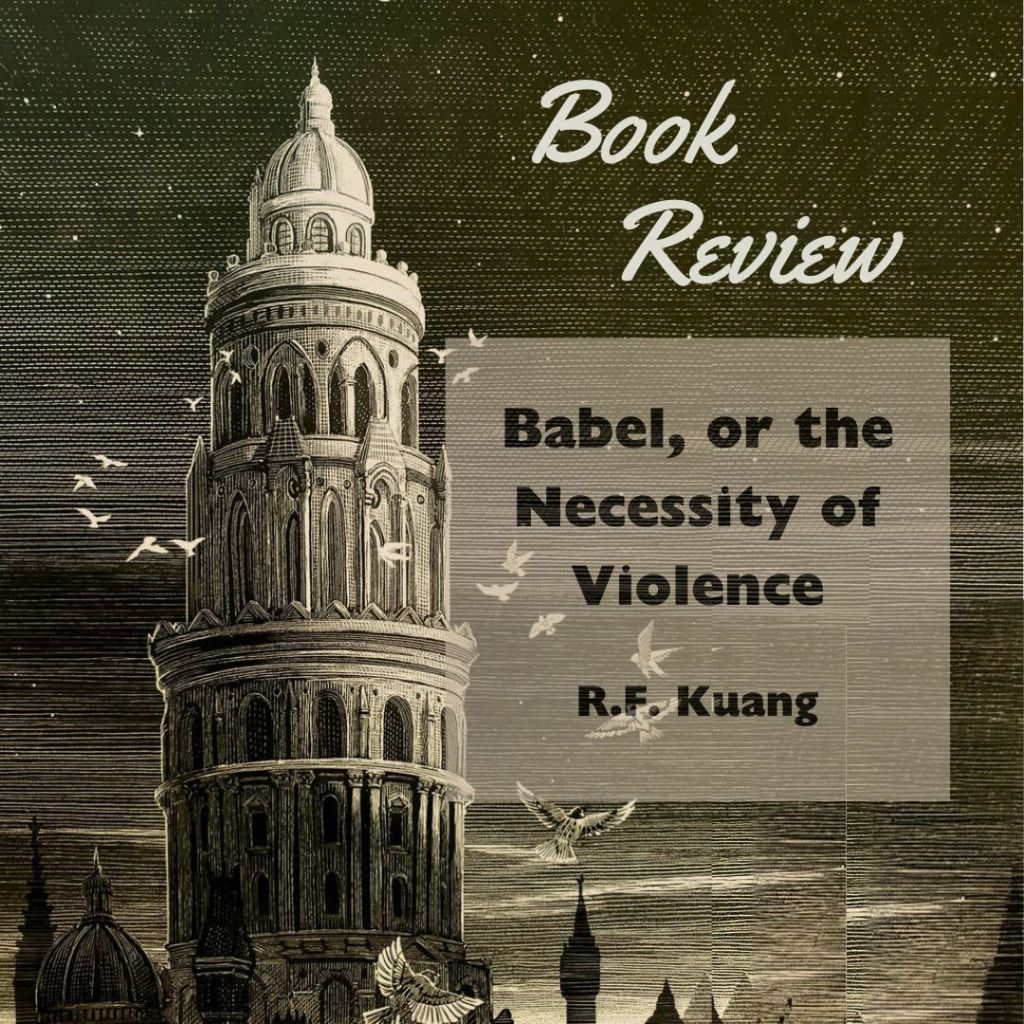
The year is 1836. The place is Canton, Southern China.
The white man saves your life. Now you belong to him and the Empire.
That is the story of young Robin Swift, a Chinese orphan who is the protagonist of the novel “Babel, or the Necessity of Violence.” It is a 2022 speculative fiction novel written by R.F.Kuang, about 1830s England where words in translation have power. With the advent of industrial development, Britain’s imperialist power comes from their possession and production of magical silver bars that harness the power of what is “lost in translation” between match-pairs in English and a foreign language. With this power, the colonial project is expanding, and it raises the necessity for translators and interpreters loyal to the imperial cause, who can aid in the production of more match-pairs to improve industries and cultivation.
This is the world into which Robin is thrust, a world that glimmers, not with the polished sheen of gold and silver, but with the glint of the metaphorical knife held to his throat if he refuses to work for the Empire.
Novels written about the colonizing project often focus on the point of resistance – how do we fight back? How do we reclaim a world that was invaded and stolen from us?
Kuang masterfully navigates these questions while proposing another viewpoint – when all you have known is the grace of the colonizer protecting you from death, when what he has given you is security and peace, how do you still choose the world over your safety? By weaving a thought-provoking narrative, Kuang pitches to us what is also the sub-title of the book – the necessity of violence. Presenting to us the differing viewpoints of Robin and his half-brother Griffin, the conflict between Robin’s desire for safety, and the Hermes Society’s desire for political change shows us just how many forms resistance to the violence of colonialism can take.
Violence in the novel is not limited to the colonizing act and the opium business in Canton. It extends to the use of language to highlight the questions of tenuous identity and the outsiderness of the students through language. In fact, the novel begins with a quote by Antonio de Nebrija, from Gramatica de la lengua castellana, which goes “Language was always the companion of the empire, and as such, together they begin, grow, and flourish. And later, together, they fall.” In an eerie, yet not unexpected act of foreshadowing, this quote tells us exactly what is going to happen to the Empire that functions with the power of language and translation.
That the world it built through the exploitation of the colonized will collapse, when the colonized wield their own language against them. A language that has been forcibly bent to support the colonizing project will turn on the master.
Babel is not a book you can choose to simply read over a day or two. Filled with footnotes and references to real-life historical events, it is a heavy, academically oriented book that aims at making you question your own position in a post-colonial world. At the same time, it presents to us the ways in which the people can still band together, how the oppressed and their allies can overcome the boundaries of space and geography to make a final stand against the oppressor.
One thing it leaves us wondering, however, is the result. When Robin and his friends make their final stand at the tower of Babel, and when the languages of the world overpower the English that has been engraved into the silver, what happens next? In a chilling mirror of the story of the Tower of Babel, they bring down the unified languages, but where do those who survived go? How did the destruction change the world?
These are questions that the reader will be pondering, even as they turn the last page and watch the final bricks of the Tower of Babel come crumbling down.
Edited by Yatin Satish

